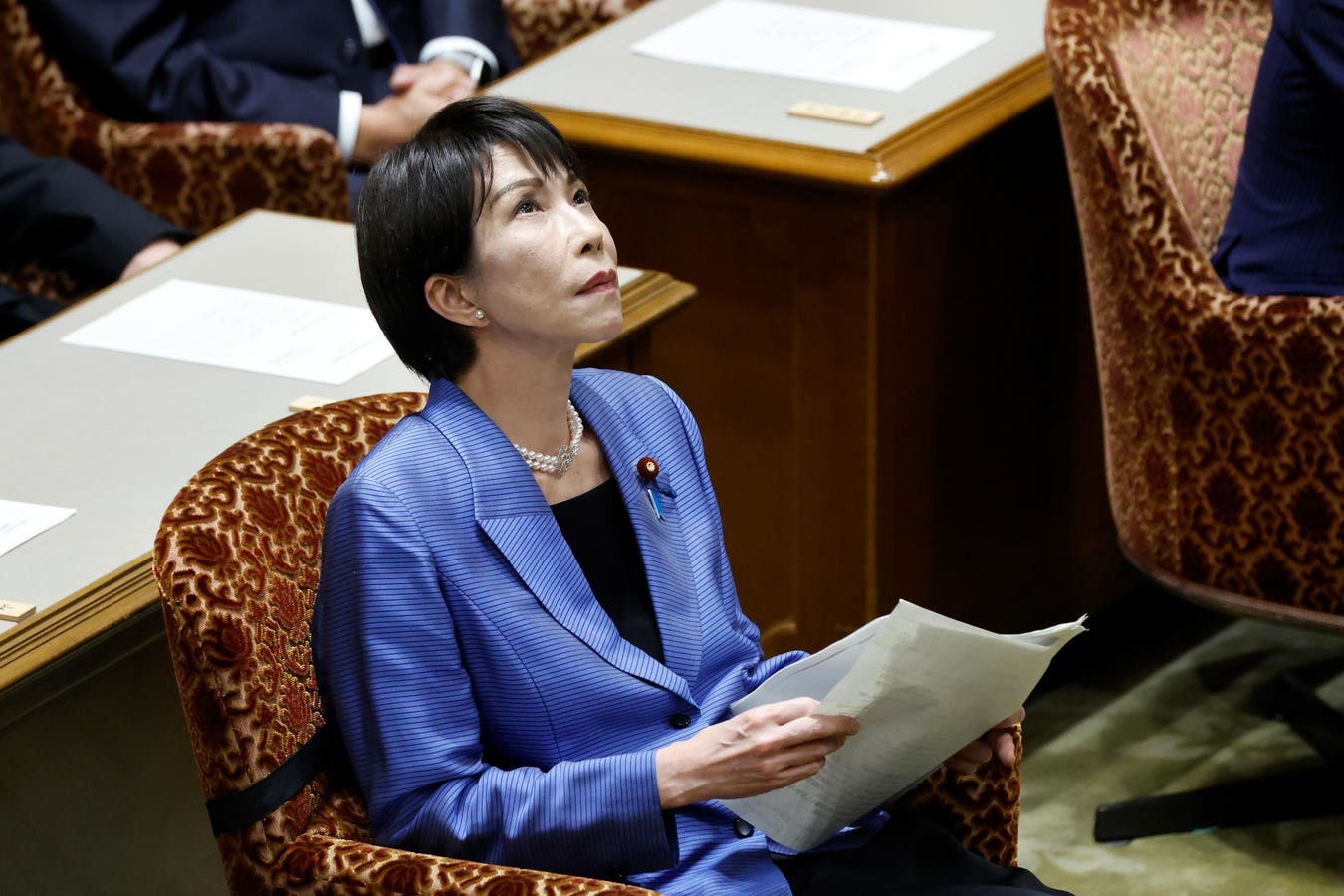
Sanae Takaichi, Japan’s prime minister.
Kiyoshi Ota/Bloomberg
The timing of Prime Minister Sanae Takaichi rolling out a Japanese version of Washington’s Department of Government Efficiency could scarcely be worse: the same week the U.S. admitted the Elon Musk-helmed DOGE had been quietly shuttered after achieving virtually nothing.
Turns out, unleashing unbridled chaos in Washington actually costs you efficiency and probably, to Donald Trump’s dismay, money, too. As the New Republic put it in its obituary-style account: “DOGE’s legacy is both very stupid and very sad. It decimated the federal workforce, including Social Security personnel at local offices, and made it easier for hackers to access your data. The agency tore apart USAID, which resulted in hundreds of thousands of lives lost globally.”
Did DOGE actually save money? Hardly, estimates the Partnership for Public Service, a nonprofit organization that studies the federal workforce. After all the firings, re-hirings, lost productivity, scores of paid leave arrangements, lawsuits, back pay and repercussions economists have yet to discern, DOGE is likely to cost the U.S. taxpayer $135 billion. The Internal Revenue Service predicted more than $500 billion in revenue loss due to “DOGE-driven” cuts.
By late May, Musk effectively ghosted DOGE. The abruptness of his exit spoke volumes about how much the enterprise had blown up on Trump World — and Musk’s brand. Tesla sales were cratering worldwide, while news reports detailed how DOGE made the federal government less, not more, efficient. Any “savings” remains maddeningly hard to quantify and, therefore, illusory.
Given all this, what, oh what, is Japan thinking in giving DOGE a try in Tokyo? It’s painfully clear how petrified Takaichi’s Liberal Democratic Party is about getting on the wrong side of Trump 2.0 and his tariffs. Takaichi may also figure that emulating DOGE is a great way to flatter Trump and make him less inclined to ask why his $550 billion trade deal “signing bonus” hasn’t arrived yet. Maybe even Musk will fly over here — and bring his chainsaw.
Aside from screaming bad judgment, creating a DOGE operation with Japanese characteristics will waste time that Takaichi can’t spare.
Let’s give Takaichi’s 39-day-old government the benefit of the doubt for a moment. Presumably, she and her team are looking at the original rationale for DOGE in the U.S. Any high-level effort to investigate and recommend ways to cut public spending and make the government more efficient would seem welcome. Just don’t put the richest man in your country with all too many axes — or chainsaws — to grind in charge.
Yet even if Tokyo avoids a Musk-style debacle, this isn’t the way to do it. Japan’s political establishment loves a blue-ribbon panel. And DOGE will be just that. Such panels, though, are notoriously glacial in their fact-finding, consensus-building and report-writing. That’s way too slow to save Takaichi from being replaced 12 months from now.
One year is all that most Japanese governments tend to get to make their mark. In bureaucratic, change-averse Japan, it’s virtually impossible to get anything big done in that time. This explains why eight of the last 10 governments since 2006 have lasted just 12 months before the political revolving door spun out the next government.
Japan does need some serious disruption. Its productivity, for example, is in the bottom one-third of Organization for Economic Cooperation and Development members. Nor does Japan Inc., once an innovative powerhouse, have an answer to the Chinese electric vehicle phenomenon BYD or the artificial intelligence upstart DeepSeek.
No DOGE panel is needed to tell Takaichi’s party how to make Japan more efficient and reduce its 260% debt-to-GDP ratio. In 2012, Takaichi’s mentor, Shinzo Abe, laid out a plan to revive Japan’s animal spirits so that Tokyo could borrow less to finance growth. Priorities included cutting red tape, making labor markets more meritocratic, launching a startup boom, increasing productivity, empowering women and reclaiming Tokyo’s place at the center of Asian innovation and finance.
Abe, sadly, was more talk than action. But as Takaichi settles into the job, she has a clear and actionable strategy that the vast majority of Japanese support. Rather than getting to work implementing it, Takaichi is toying around with performative gestures like a local DOGE. It’s hardly a promising sign, as these things go.