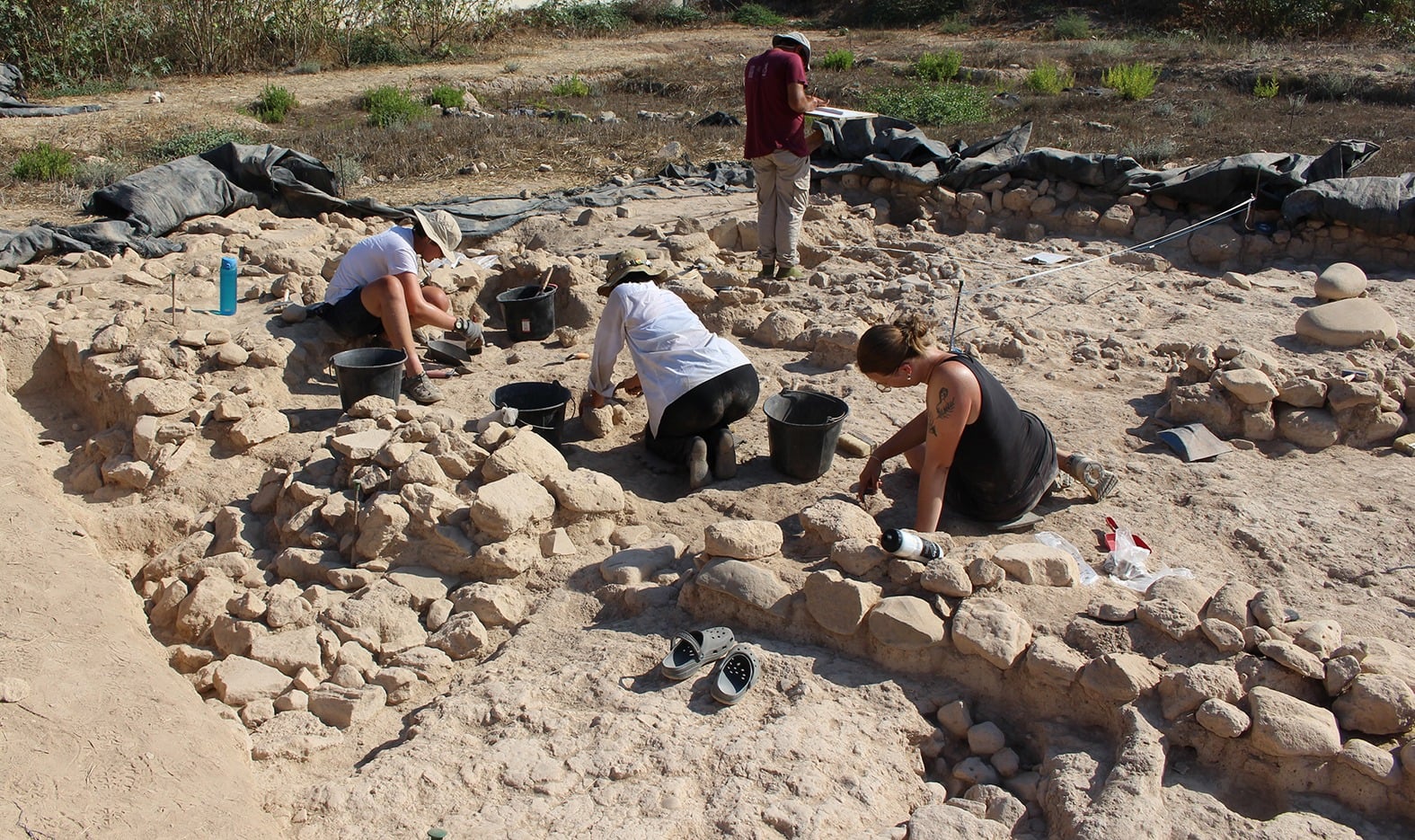
Members of the excavation team work across the Bronze Age workshop complex at Kissonerga-Skalia. Credit: Department of Antiquities, Cyprus
Archaeologists in Cyprus have uncovered new evidence of a Bronze Age workshop at Kissonerga-Skalia, a prehistoric site north of Paphos that preserves one of the richest records of Cyprus Bronze Age life.
Researchers say the latest archaeological excavation reveals a large industrial complex where production, heating, and material processing once took place. The project is led by Dr. Lindy Crewe of the Cyprus American Archaeological Research Institute. Her team focused on layers showing steady development from the early third millennium BCE until the site’s abandonment around 1600 BCE.
Excavators recorded building phases, activity zones, and domestic debris that show how the community adapted its homes, tools, and infrastructure as it expanded.
Settlement growth and a major transformation
The settlement took shape during the Philia phase, following earlier activity at nearby Kissonerga–Mosphilia. By the Middle Bronze Age, the community had developed into a significant regional center. Excavations reveal that around 1750 BCE, its residents began a major construction project that reshaped the northern slope of the site.
Archaeologists found that earlier domestic structures were dismantled and reused to create an artificial terrace covering about 1,200 square meters (12,900 square feet). This engineered platform became the foundation for a large architectural complex made up of thick walls, roofed rooms, and open courtyards with hard clay or gypsum floors.
Researchers say the scale and organization of the complex reflect broader shifts across the eastern Mediterranean, where maritime networks expanded, and specialized craft production became more common.
Evidence points to an industrial workshop
Nothing found inside the complex suggests domestic living. Instead, installations linked to heating, grinding, storage, and material processing show that this was an industrial zone—effectively a Bronze Age workshop in Cyprus operating on a significant scale. The design and equipment indicate planned production rather than household activity.
The complex was occupied only briefly. The settlement was abandoned early in the Late Cypriot period, leaving its final phase sealed and exceptionally well preserved. Researchers consider this an unusually intact glimpse into a short-lived industrial operation.
Courtyard study reveals major heating installations
This season’s work focused on how open areas of the complex were used, especially a courtyard where a domed oven about 1.5 meters (about 5 feet) in diameter had been found earlier.
New excavation showed the courtyard has a G-shaped layout, and at the short end of this space, archaeologists uncovered one of the season’s most significant finds: a much larger open-air heating installation.
A rare four-meter-wide industrial oven
The newly exposed structure measures roughly four meters (13 feet) across. It was built as a concave, hard-fired hollow lined with mud and lime. Low mudbrick walls likely enclosed it, but the installation appears to have remained uncovered.
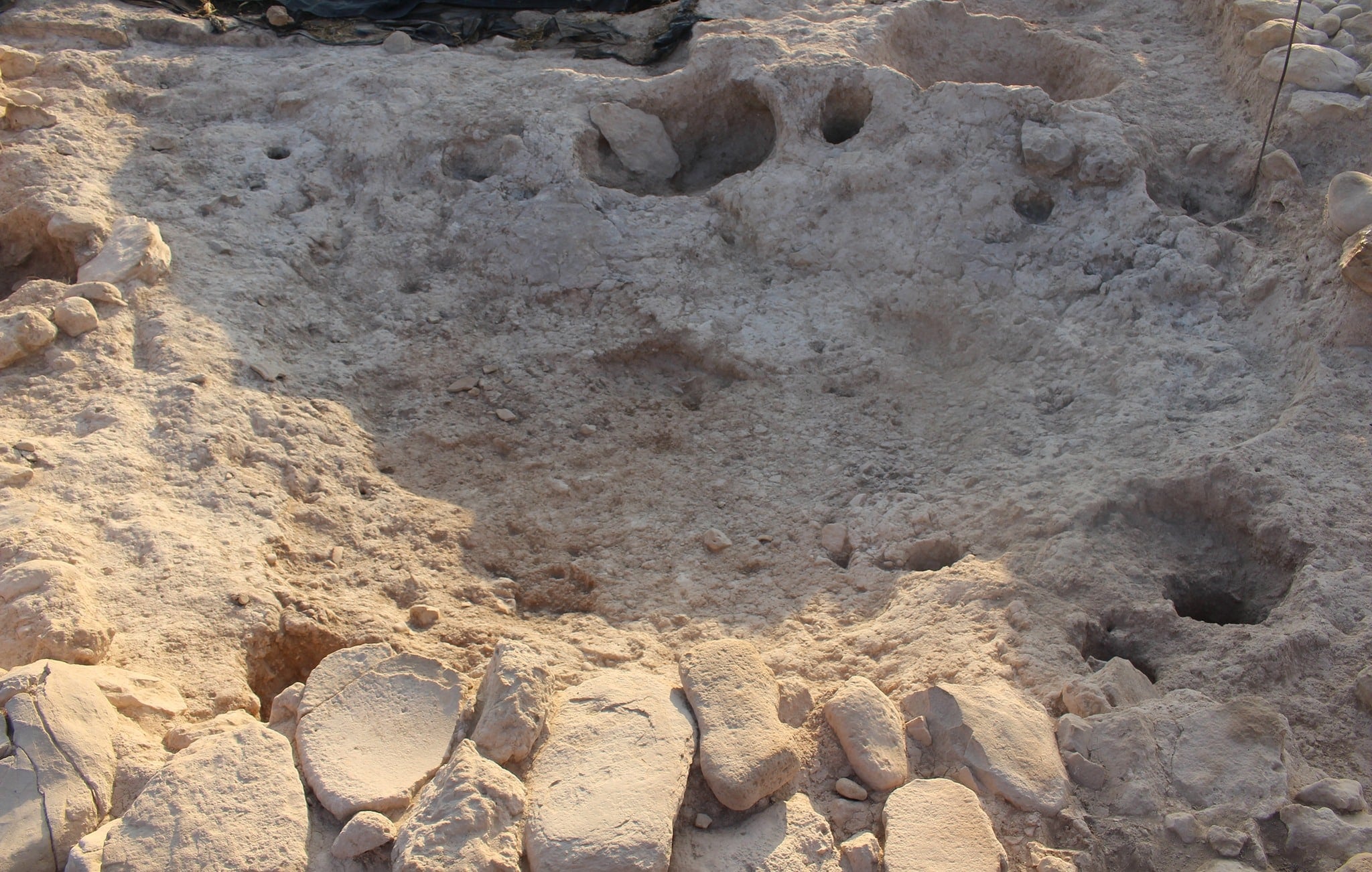
Archaeologists uncovered the large, concave oven at Kissonerga-Skalia. Credit: Department of Antiquities, Cyprus
Inside, excavators recovered stone tools, fragments of plaster or lime, pottery sherds, and animal bones. These materials may represent cleaning episodes or debris from the installation’s final use.
The structure had already fallen out of operation when a new floor was laid over it. It predates the smaller domed oven in the same courtyard, marking it as part of an earlier industrial phase.
Food remains offer clues to Bronze Age practices
Soil analysis provided an unexpected insight. Wet-sieving produced charred wheat grains and terebinth remains, suggesting that foods containing these ingredients were prepared here or burned accidentally.
Researchers say the find offers a rare look at culinary habits within an industrial setting and adds a human dimension to a site undergoing technological and economic change.
A clearer picture of the Bronze Age industry
The discoveries at Kissonerga-Skalia contribute to a growing understanding of Bronze Age workshop activity in Cyprus. Each season reveals more about how its people organized production, shaped their environment, and adapted to changing demands across generations. Researchers say the latest finds strengthen the site’s importance as one of the most detailed prehistoric records on the island.