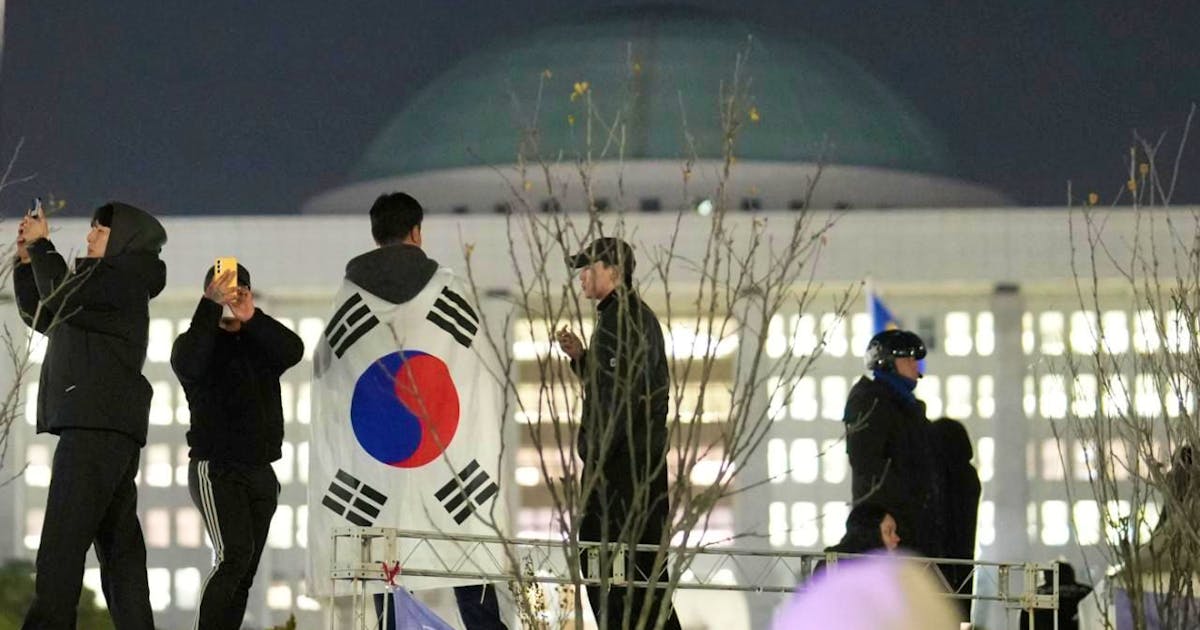
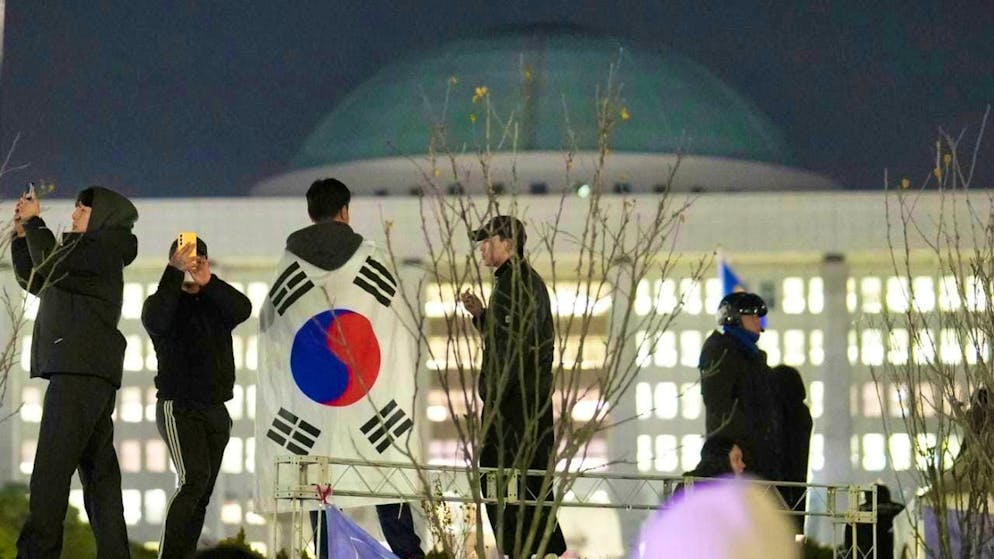
ARCHIVE – A man with a national flag stands on a wall in front of the National Assembly. The President of South Korea has declared martial law. In a speech broadcast live, he accused the country’s opposition of sympathizing with North Korea. Photo: Lee Jin-man/AP/dpa (archive photo)
Keystone
Almost a year ago, South Korea’s then president unexpectedly declared martial law due to alleged communist and anti-state forces in the opposition – and plunged his country into a deep crisis. Today, Yoon Suk Yeol is out of power and charged with treason, and his successor is pursuing a radically different political course in many areas.
What happened 12 months ago?
In the evening hours of December 3, 2024, the conservative Yoon unexpectedly declared martial law in the wake of a budget dispute. In a televised speech, he spoke of wanting to protect the country’s liberal order against a left-wing opposition that was allegedly infiltrated by Chinese and North Korean forces. The former public prosecutor did not provide any evidence for his bold claims.
What followed was probably the biggest crisis for South Korea’s democracy since the country’s first free elections in 1987. During the night, army helicopters landed on the roof of the National Assembly in Seoul and soldiers on the ground completely sealed off the area. Nevertheless, a total of 190 members of parliament managed to call a vote in a cloak-and-dagger operation in which they were able to unanimously suspend martial law. However, this was by no means the end of the spook.
Civil society and large sections of the population feared a return to authoritarian times in South Korea. International investors were concerned about the stability of the East Asian tiger state – and withheld their investments from then on. The reputation of the country, which had previously always been regarded in the West as a political and economic role model in the region, suffered worldwide.
What has changed since then?
The political landscape has changed considerably in the last twelve months. Yoon Suk Yeol was removed from office, arrested and is now facing trial – just like most of his cabinet members and high-ranking military officers. In theory, Yoon could even face the death penalty, as he is accused of a particularly serious offense of “sedition”. The ex-president is expected to spend many years behind bars.
His successor in office since this summer is the former opposition leader Lee Jae Myung, who won the election in June by a comparatively large margin. The 61-year-old, who is often described in the media as a left-wing populist, is considered to be politically diametrically opposed to Yoon Suk Yeol: Lee advocates strong worker protection, renewable energies and always chooses down-to-earth, sometimes controversial language in his messages.
Recovering stock market, but tense mood
At least the South Korean stock market has recovered quickly after the state crisis. In the wake of the inauguration of the new president, who promised to force large companies to be more transparent with reforms and to protect the rights of minority shareholders more strongly, the leading index KOSPI entered a sustained bull market. Since the beginning of the year, it has risen by more than 60 percent – more than any other leading index of a G20 country in the same period.
However, the mood among the population remains tense: Food prices are high, housing costs are rising rapidly, particularly in the Seoul metropolitan area, and the labor market has also shown signs of weakness recently.
South Korea is also facing huge structural challenges: The ageing population is progressing faster than in almost any other industrialized country, and the birth rate of 0.7 is one of the lowest in the world. In addition, the economy, which is heavily dependent on exports, is suffering disproportionately from US President Donald Trump’s tariff policy. South Korean companies are also struggling with increasing competition from China.
New foreign policy course
While the conservative Yoon has shown a clear edge towards North Korea, his successor Lee Jae Myung is pursuing a soft policy of rapprochement. Seoul is attempting to revive civil society and cultural contact between the two countries, which has recently come to a complete standstill. So far, however, North Korean ruler Kim Jong Un has given the cold shoulder.
In geopolitical terms, Lee Jae Myung has so far hardly shown a clear line. Amid heightened tensions, he is trying to improve relations with all sides – with China, Japan and traditional ally the USA.
Society remains divided
The South Korean population is traditionally divided into two camps: Around half of society favors conservative, market-friendly policies and strong ties with the US. The left-wing camp, on the other hand, is close to the trade union movement, wants a rapprochement with North Korea and is critical of the USA as a protective power. The polarization is also reinforced by South Korea’s presidential system – similar to the United States, where Democrats and Republicans are bitterly opposed to each other.