
On a day marked by torrential rain and an explosion of dance and music that defied the inclement weather, Pope Leo XIV set foot on Lebanese soil on November 30, 2025, inaugurating his long-awaited apostolic journey to this nation emblematic of interfaith dialogue. Following a welcoming ceremony at Beirut-Rafic Hariri International Airport and private meetings with President Joseph Khalil Aoun, the Speaker of the National Assembly, Nabih Berri, and Prime Minister Nawaf Salam, the Pontiff proceeded to the Presidential Palace. There, in the historic 25th of May Hall, before civil authorities, representatives of civil society, and the diplomatic corps, he delivered a speech that resonated like a hymn to peace: not as a mere abstract ideal, but as a burning desire, a daily vocation, and a divine gift that urgently needs to be cultivated in times of crisis.
“Blessed are the peacemakers!” exclaimed Leo XIV as he opened his address, invoking the Beatitudes to emphasize that peace transcends words and becomes concrete action. In a Lebanon plagued by decades of political, economic, and social instability—exacerbated by the proximity of regional conflicts and a “hemorrhage” of young people emigrating in search of better opportunities—the Pope painted a hopeful portrait of a people who “do not give up, but rather, in the face of trials, always know how to rise again with courage.” This resilience, he affirmed, is the first pillar of true peacemakers: a tenacity that does not fear apparent defeats nor succumb to disappointments, but embraces reality with perseverance and hope.
The scene was as symbolic as it was moving. Despite the heavy rain, thousands of Lebanese gathered along Beirut’s avenues to welcome the Pope in his popemobile, waving Vatican and Lebanese flags in a gesture of fraternity that stood in stark contrast to the shadows of global uncertainty. President Aoun, in his welcoming address, implored the world: “Holy Father, we implore you to tell the world that we will not die, we will not leave, we will not despair, and we will not surrender.” He recalled the unwavering faith of a people who, in their Christian and Muslim diversity, defend freedom and dignity under a Constitution that promotes equality and openness. After signing the Book of Honor and symbolically planting a “Cedar of Friendship”—the Lebanese national tree, an emblem of longevity and hospitality—the exchange of gifts gave way to an expectant audience, where the Pope delivered his message with the profound insight of one who understands the wounds of a broken world.
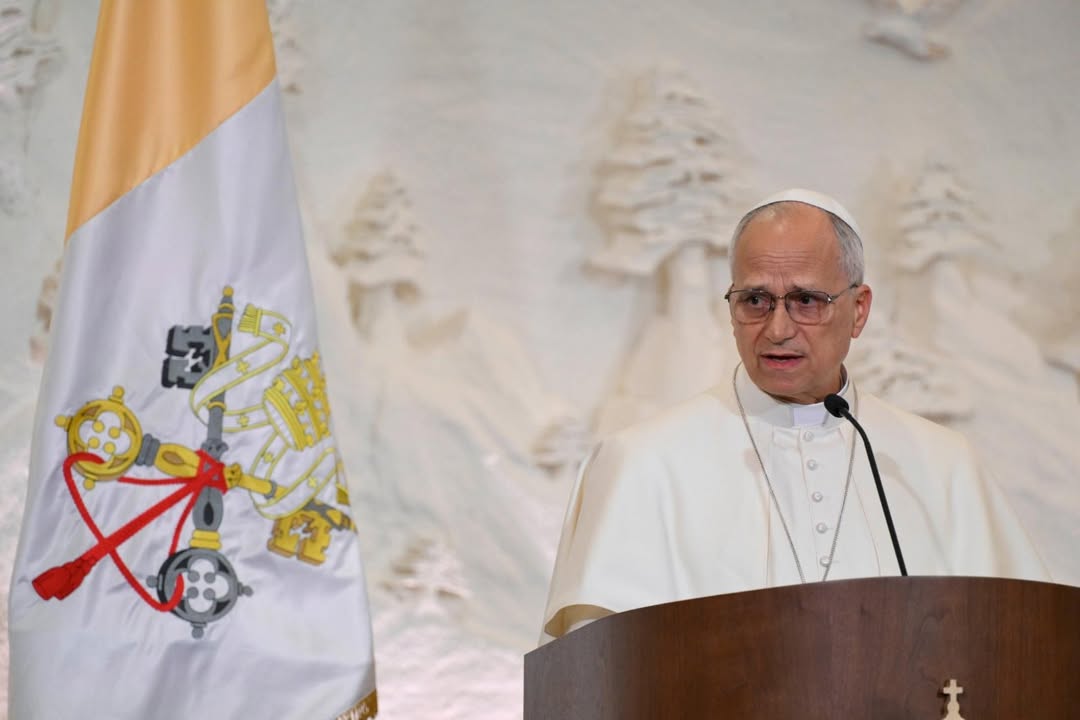
At the heart of his address, Leo XIV outlined three essential characteristics for forging peace in “complex, conflictive, and uncertain” contexts such as Lebanon and so many other corners of the world, where rampant “pessimism” and a “killing economy” undermine the common good. First, reconciliation: an arduous path that demands confronting personal and collective wounds that “take many years, sometimes entire generations, to heal.” “There is no lasting reconciliation without a common goal, without an openness to a future in which good prevails over the evil suffered or inflicted,” the Pope warned, recalling that truth and reconciliation “only grow together.” He urged institutions to prioritize the common good “over partial interests,” rejecting isolation in their own suffering or in sectarianism that fragments society. In a nod to his encyclical Fratelli tutti , he stressed that local identity and global openness are “two inseparable and equally vital poles” for any nation.
The second theme was the value of remaining in one’s homeland, a sacrifice that Leo XIV elevated to a heroic virtue. Acknowledging the pain of the Lebanese diaspora—which enriches the world but leaves the country bleeding—the Pope lamented how “uncertainty, violence, poverty, and many other threats” drive young people and families to leave. “The Church does not want anyone to be forced to abandon their homeland,” he declared firmly, encouraging the creation of conditions that will allow young people to return or remain, transforming Lebanon into “a land full of life.” Addressing the leaders directly, he urged them: “Never separate yourselves from your people and place yourselves at the service of your nation—so rich in its diversity—with commitment and dedication. May you speak one language: the language of hope that brings everyone together in a constant process of new beginnings.”
The special tribute to women did not go unnoticed, with the Pope describing them as “essential workers for peace.” “They have a specific capacity to safeguard and develop deep connections with life, with people, and with places,” he affirmed, highlighting their role in social, political, and religious renewal. Together with the strength of young people, they represent a “factor of true renewal” in a world that needs to build bonds instead of breaking them.
In closing his address, Leo XIV invoked Lebanon’s rich cultural tradition of music and dance, which burst forth in the ceremony with vibrant performances despite the rain. “They are a people who love music, which, on festive days, becomes dance, a language of joy and communion,” he reflected. He likened peace to an “inner movement that overflows outward,” guided by the Holy Spirit: a dance where steps from others are harmonized, without treading on each other’s ground. “Peace is a gift that comes from God and, above all, dwells in our hearts,” he concluded, expressing gratitude to President Aoun and praying that a desire for peace “born of God” would grow in the Lebanese people.
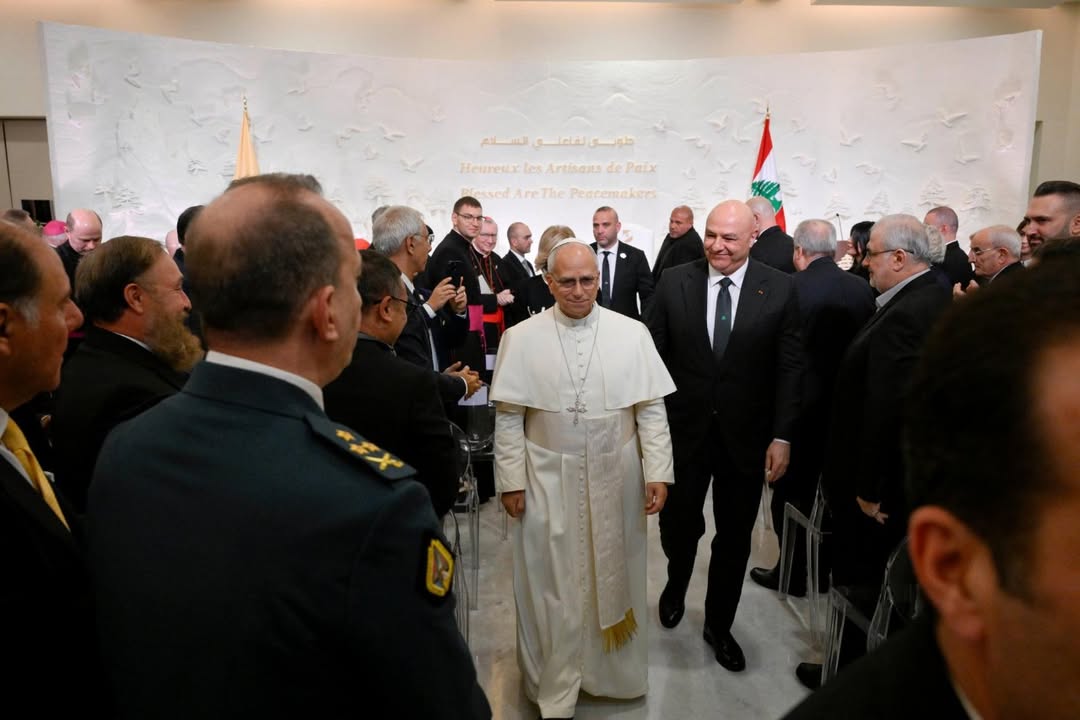
This trip by Leo XIV, the first by a Pope to Lebanon in turbulent times, is not merely a diplomatic gesture, but a prophetic reminder: in a convulsed Levant, peace is built side by side, with truth and hope. As the world watches, Beirut becomes the stage for a universal call: blessed are those who, like this resilient people, choose to begin again.
Full text of the Holy Father’s words:
APOSTOLIC JOURNEY OF HIS HOLINESS POPE LEO XIV
TO TÜRKIYE AND LEBANON
WITH A PILGRIMAGE TO IZNIK (TÜRKIYE)
ON THE OCCASION OF THE 1700th ANNIVERSARY OF THE FIRST ECUMENICAL COUNCIL OF NICAEA
(27 November – 2 December 2025)
MEETING WITH THE AUTHORITIES, REPRESENTATIVES OF CIVIL SOCIETY
AND THE DIPLOMATIC CORPS
ADDRESS OF THE HOLY FATHER
Presidential Palace (Beirut)
Sunday, 30 November 2025
____________________________________
Mr President,
Distinguished Civil and Religious Authorities,
Members of the Diplomatic Corps,
Ladies and Gentlemen,
Blessed are the peacemakers!
It is a great joy for me to meet with you, and to visit this land where “peace” is much more than just a word, for here peace is a desire and a vocation; it is a gift and a work in progress. You are invested with authority in this country, each in your own area and with specific roles. It is in light of this authority that I wish to address to you the words of Jesus that have been chosen as the central theme of my journey: “Blessed are the peacemakers!” (Mt 5:9). Certainly, there are millions of Lebanese, here and throughout the world, who serve peace silently, day after day. Yet you, who have important institutional tasks within this nation, are destined for a special beatitude if you can say that you have put the goal of peace above all else. In this meeting, I would like to reflect with you a little on what it means to be peacemakers in circumstances that are highly complex, conflictual and uncertain.
In addition to Lebanon’s natural beauty and cultural riches, which have been praised by those of my predecessors who visited your country, there is a shining quality that distinguishes the Lebanese: you are a people who do not give up, but in the face of trials, always know how to rise again with courage. Your resilience is an essential characteristic of authentic peacemakers, for the work of peace is indeed a continuous starting anew. Moreover, the commitment and love for peace know no fear in the face of apparent defeat, are not daunted by disappointment, but look ahead, welcoming and embracing all situations with hope. It takes tenacity to build peace; it takes perseverance to protect and nurture life.
Examine your history, and ask yourselves: from where comes that formidable energy that has never left your people downtrodden or without hope. You are a diverse country, a community of communities, united by a common language. I am not simply referring to the Levantine Arabic, by which your great past has left inestimable treasures. Above all, I am refering to the language of hope, which has always enabled you to start again. Almost everywhere in the world around us, a kind of pessimism and sense of powerlessness seem to have taken hold, where people are no longer able to ask themselves what they can do to change the course of history. Major decisions appear to be taken by a select few, often to the detriment of the common good, as if this were an inevitable destiny. You have suffered greatly from the consequences of an economy that kills (cf. Apostolic Exhortation Evangelii Gaudium, 53), from global instability that has devastating repercussions also in the Levant, and from the radicalization of identities and conflicts. But you have always wanted, and known how, to start again.
Lebanon can boast a vibrant, well-educated civil society, rich in young people capable of expressing the dreams and hopes of an entire nation. I encourage you, therefore, never to separate yourselves from your people, and to place yourselves with commitment and dedication at the service of your people, who are so rich in variety. May you speak just one language, namely the language of hope that, by always starting afresh, draws everyone together. May the desire to live and grow in unity as a people create a polyphonic voice out of each group. May you also be helped by those deep bonds of affection that tie so many Lebanese throughout the world to their country. They love their origins and pray for the people of which they still feel a part. They also support them through the many experiences and skills that make them so appreciated everywhere.
This brings us to a second characteristic of peacemakers. Not only do they know how to start over, but they do so first and foremost along the arduous path of reconciliation. Indeed, there are personal and collective wounds that take many years, sometimes entire generations, to heal. If they are not treated, if we do not work, for example, to heal memories, to bring together those who have suffered wrongs and injustice, it is difficult to journey towards peace. We would remain stuck, each imprisoned by our own pain and our own way of thinking. The truth, on the other hand, can only be honored through encountering one another. Each of us sees a part of the truth, knowing one aspect of it, but we cannot negate what only the other knows, what only the other sees. Truth and reconciliation only ever grow together, whether in a family, between different communities and the various people of a country, or between nations.
At the same time, there can be no lasting reconciliation without a common goal, or without openness towards a future in which good prevails over the evils that have been suffered or inflicted in the past or the present. A culture of reconciliation, therefore, does not arise only from below, from the willingness and courage of a few. It also needs authorities and institutions that recognize the common good as superior to the particular. The common good is more than the sum of many interests, for it draws together everyone’s goals as closely as possible, directing them in such a way that everyone will have more than if they were to move forward by themselves. Indeed, peace is much more than a mere balance – which is always precarious – among those who live separately while under the same roof. Peace is knowing how to live together, in communion, as reconciled people. A reconciliation that, in addition to enabling us to live together, will teach us to work together for a shared future side by side. Thus, peace becomes that abundance which will surprise us when our horizons have expanded beyond every wall and barrier. Sometimes we think that, before taking a further step, we need to clarify and resolve everything. Instead, mutual dialogue, even amid misunderstandings, is the path that leads to reconciliation. The greatest truth is that we find ourselves together as part of a plan that God has prepared so that we may become a family.
Finally, I would like to outline a third characteristic of those who strive for peace. Even when it requires sacrifice, peacemakers dare to persevere. There are times when it is easier to flee, or simply more convenient to move elsewhere. It takes real courage and foresight to stay or return to one’s own country, and to consider even somewhat difficult situations worthy of love and dedication. We know that here, as in other parts of the world, uncertainty, violence, poverty and many other threats are leading to an exodus of young people and families seeking a future elsewhere, even though it is very painful to leave one’s homeland. It is certainly necessary to recognize that much good can come to all of you from having Lebanese people spread throughout the world. However, we must not forget that remaining in our homeland and working day by day to develop a civilization of love and peace remains something very valuable.
Indeed, the Church is not only concerned about the dignity of those who move away from their own countries. She does not want anyone to be forced to leave their country. Moreover, the Church wants those who wish to return home to be able to do so safely. While human mobility represents an immense opportunity for encounter and mutual enrichment, it does not erase the special ties that unite each person to certain places, to which they owe their identity in a very special way. Moroever, peace always grows in a concrete living context, made up of geographical, historical and spiritual bonds. We need to encourage those who foster and nurture them, without giving in to sectionalism or nationalism. In his encyclical Fratelli Tutti, Pope Francis indicated the way forward: “We need to have a global outlook to save ourselves from petty provincialism. When our house stops being a home and starts to become an enclosure, a cell, then the global comes to our rescue, like a ‘final cause’ that draws us towards our fulfilment. At the same time, though, the local has to be eagerly embraced, for it possesses something that the global does not: it is capable of being a leaven, of bringing enrichment, of sparking mechanisms of subsidiarity. Universal fraternity and social friendship are thus two inseparable and equally vital poles in every society” (n. 142).
A challenge, not only for Lebanon but for the entire Levant, is what can be done to ensure that young people in particular do not feel compelled to leave their homeland and emigrate? How can we encourage them not to seek peace elsewhere, but to find guarantees of peace and become protagonists in their own native land? In this regard, Christians and Muslims together, and all religious and civil components of Lebanese society, are called to play their part, and to commit themselves to raising awareness of this issue within the international community.
In this context, I would like to emphasize the essential role of women in the arduous and patient endeavour to preserve and build peace. Let us not forget that women have a special capacity for peace-making, because they know how to cherish and strengthen the profound bonds with life, people and places. Their participation in social and political life, as well as in their own religious communities, represents a factor of true renewal throughout the world, as does the energy that comes from young people. Blessed, therefore, are the peacemakers, and blessed are the young people who remain or who return in order that Lebanon may once again be a land full of life.
I conclude by drawing inspiration from another precious feature of your tradition, which stretches back thousands of years. You are a people who love music. On feast days, this becomes a dance, a language of joy and communion. This aspect of your culture helps us to understand that peace is not only the result of human effort, however necessary. Indeed, peace is a gift that comes from God and which, above all, dwells in our hearts. It is like an interior motion pushing outwards, enabling us to let ourselves be guided by a melody greater than ourselves, namely that of divine love. Those who dance move lightly, without trampling on the earth, harmonizing their steps with those of others. So it is with peace, which is a journey inspired by the Spirit, and causes our hearts to listen, making them more attentive and respectful towards others. May this desire for peace, which comes from God, grow among you; for even today, peace can transform the way you look at others and the way you live together in this land, a land that God deeply loves and continues to bless.
Mr President, Distinguished Authorities, I thank you once again for your welcome. Please be assured of my prayers, and those of the whole Church, for your delicate service to the common good.