‘May love triumph over hatred, unity over division, and may we no longer be ground down under the weight of injustice,’ he tells faithful at Shrine of Our Lady of Lebanon
He also visits shrine of Saint Charbel at Monastery of St. Maron, the first pope to do so
BEIRUT: On the second day of his three-day visit to Lebanon, Pope Leo XIV prayed “for peace in this country and the countries of the Middle East.”
His itinerary on Monday included a visit to the Monastery of St. Maron in Annaya, Mount Lebanon, marking a historic moment as he became the first pope to visit the shrine of Saint Charbel, revered patron saint of the Maronite community.
Many Christians and Muslims visit the holy site seeking intercessions or the healing of incurable diseases. Charbel, a Maronite monk and priest who was born Youssef Antoun Makhlouf in Lebanon in 1828 and died in 1898, was canonized in 1977 by Pope Paul VI.
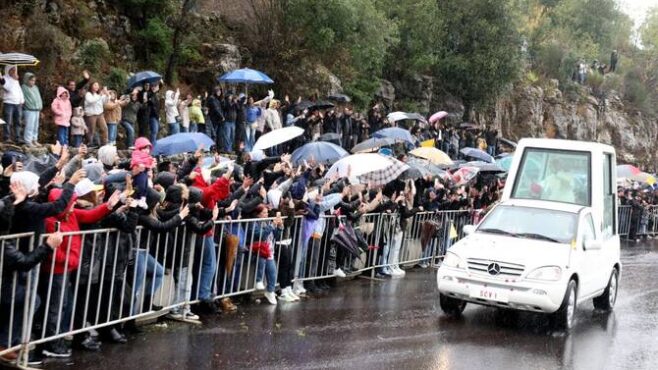
Despite the cold weather and heavy rain, thousands of people of all ages gathered from early morning to greet the pope, lining roads leading from the coastal city of Byblos to Annaya. They came from Lebanon and other countries. Security, enforced by the Lebanese army, was tight.
President Joseph Aoun and his wife formally welcomed the pope, who acknowledged the crowds from his “popemobile” vehicle as the sound of applause, church bells and chants filled the air along the 3 kilometer route to the monastery.
Aoun was joined by Maronite Patriarch Bechara Al-Rahi and the superior general of the Lebanese Maronite Order, Abbot Hady Mafouz, as well as other prominent political, religious and social leaders.
At the monastery, a site central to Maronite heritage and the location of Saint Charbel’s tomb, the pope knelt in prayer and lit a candle he brought as a gift from Rome for the people of Lebanon and Christians worldwide.
In a speech at the shrine, Pope Leo said that Saint Charbel had lived in Annaya “hidden from view and in silence. However, his reputation spread throughout the world, teaching prayer to those whose lives were devoid of God, demonstrating silence to those consumed by noise, modeling humility for those craving recognition, and exemplifying poverty to those chasing riches. This combination of radical witness and humble service carries a message for all Christians.”
He emphasized the importance of “communion and unity, beginning with the churches and extending to the universal church,” adding: “There is no peace without repentance of the heart.”
The pope then visited the Shrine of Our Lady of Lebanon in the town of Harissa, where he met Catholic leaders, including bishops, as well as priests, nuns, other religious figures and laypeople engaged in pastoral service.
The pope made his way, with some difficulty, to the altar at the site through a capacity crowd of about 2,700 worshippers who had traveled from Lebanon, Syria, Jordan, Europe, and as far afield as America and Australia.
Men and women recounted stories of human suffering caused by war, displacement, migration, imprisonment and violence. In response, the pope called for “love to triumph over hatred, forgiveness over revenge, service over domination, humility over pride, and unity over division, so that we are no longer ground down under the weight of injustice and exploitation.”
He continued: “Even when people betray us, as we have heard, and unscrupulous institutions exploit the despair of those who have no other choice, we can return and fill our hearts with hope for a better tomorrow, despite the harshness of the present we must face.”
During all of his public appearances in Lebanon and his preceding visit to Turkiye, his first official foreign trip since becoming pope in May, Leo has stressed the important need to promote the involvement of young people in the church, including in ecclesiastical roles.
“Even amid the ruins of a world suffering from painful failure, it is essential that we offer them real and practical prospects for advancement and growth in the future,” he said.
The Pope later held a closed meeting with Catholic patriarchs at the Papal Embassy in Harissa. And at Martyrs Square in downtown Beirut, he held talks with more 300 religious leaders and dignitaries. The event also featured a screening of a documentary about peaceful interfaith coexistence and dialogue, and speeches by faith leaders. It culminated with the pope planting an olive tree as a symbol of peace.
During the event, he emphasized Lebanon’s role as a beacon of interfaith harmony. “The eyes of the world are turned towards the Middle East, the cradle of the Abrahamic religions, and towards the arduous journey and constant pursuit of the gift of peace,” the Pope said.
Acknowledging regional conflicts, he added: “Amidst these challenges, we can find meaning in hope and consolation when we focus on what unites us: our shared humanity and our faith in a God of love and mercy.”
Lebanon, he noted, proves that “fear, mistrust, and prejudice do not have the final say, and that unity, communion, reconciliation, and peace are possible.” Citing the Second Vatican Council’s Nostra Aetate document from 60 years ago, the Pope urged religious leaders to be “peacemakers: to confront intolerance, turn a blind eye to violence, reject exclusion, and illuminate the path to justice and harmony for all, through the witness of your faith.”
His day ended with a gathering of young people from Lebanon and other nations at the Maronite Patriarchate in Bkerki. More than 12,800 people of various Christian denominations, including Catholics, Maronites, Orthodox, Protestants and Evangelicals, had registered to attend, along with representatives of Islamic communities.
The Pope, traveling through cheering crowds in an open vehicle that broke from protocol, addressed them in English: “The future is in your hands, and you have a historic opportunity to change it. Love can heal everyone’s wounds, and blessed are those who bring peace and make it.”