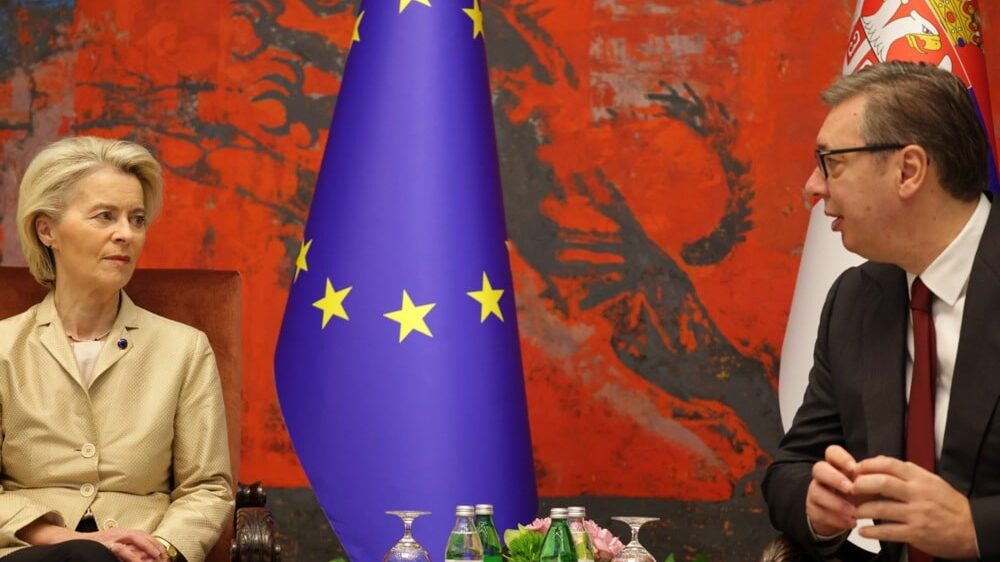
On the one hand, recent developments on the enlargement front have compelled the European Commission and the European Parliament to take a position.
The unveiling in early November of the European Commission’s 2025 Enlargement Package and country reports paints a bleak picture over Serbia’s democratic health, but also over the EU’s intentions towards Belgrade. Many have pointed towards the harsher tone in this year’s European Commission feedback – especially in the fields of freedom of expression, freedom of assembly and government transparency. However, it remains to be seen whether real repercussions will be felt on the ground. As previous iterations of the country reports have come to show, no serious political follow-up is expected vis-à-vis Serbia’s political elites, whose relations with the EU are primarily driven by the member states’ vested interests.
It is notable that since the start of the student-led protests over a year ago, no EU flags have been waved on the streets, roads and campuses of Serbia. In none of these scenarios has the EU been counted upon. This, under normal circumstances, would come as an alarming sign of Brussels’ waning influence in the Western Balkans or confirmation of the excessively repeated mantra that the EU is “losing its credibility” in the region. However, these are not normal circumstances – and haven’t been for a very long time. It is clear that we have arrived at a point where counting on the EU as a moral compass and a liberal-democratic beacon has, unfortunately, become a thing of the past.
It can’t be that leaders in Brussels haven’t noticed what is happening in Serbia. The pacific and dignified outlook of the first student protests in the immediate wake of the canopy’s collapse was swiftly put to the test when demonstrators were attacked by masked thugs, which gave way to numerous episodes of police violence.
Since then, Serbia’s authorities have escalated their physical crackdown against students and demonstrators, crossing all imaginable lines – including the alleged use of as-yet-unidentified sonic weapons, coordinated hooligan attacks and instances of rape threats to students. Local elections held on November 30 in the municipalities of Mionica, Secanj and Negotin, won by Vucic’s Serbian Progressive Party (SNS) but with smaller percentages of votes compared to previous local elections, were marred by numerous incidents, including the obstruction of election observers and physical attacks on members of the public. And in Belgrade, noisy tank parades and the establishment of the counterfeit pro-government “Caciland” tent camp have become a part of the city’s landscape with the clear intention of spreading fear among the population.
Far from buying into the threats and the extortions, Serbian demonstrators remain hopeful and determined. As calls for new elections become louder, a vast majority of protestors and sympathisers understand the critical importance of their own actions. But with the ultimate sense of awareness that, as far as the EU is concerned, nobody in Brussels will come to their rescue, the final reckoning is that only Serbia can save itself.