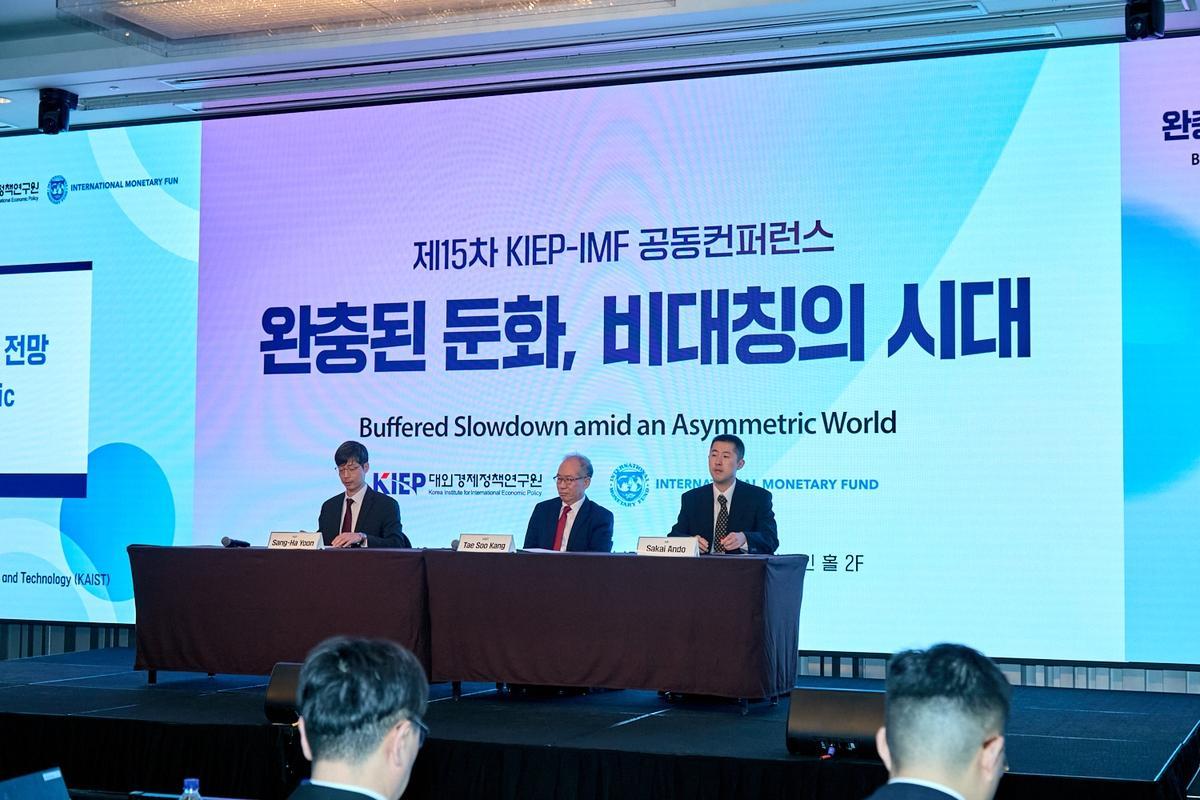
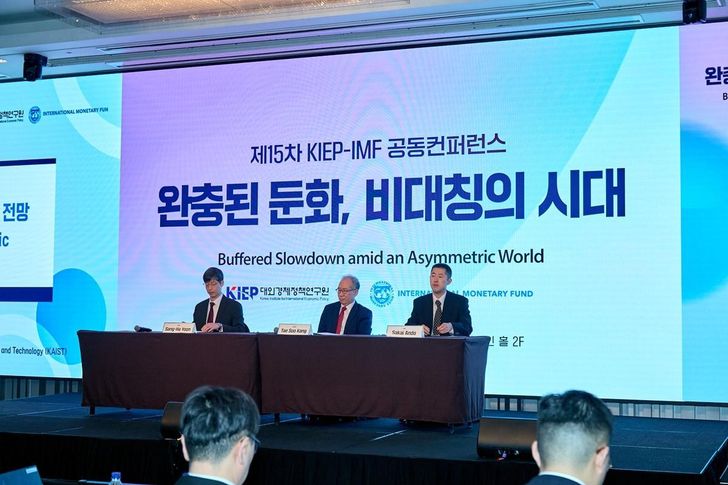
Sakai Ando, right, an economist in the International Monetary Fund (IMF)’s Asia and Pacific Department, speaks during an annual conference co-hosted by the Korea Institute for International Economic Policy (KIEP) and the IMF in Seoul, Tuesday. Courtesy of the KIEP
An economist from the International Monetary Fund (IMF) said Tuesday that while Korea’s economy is beginning to show signs of a rebound, downward pressures continue to challenge Asia’s fourth-largest economy, even as the broader Asian market is expected to experience a modest slowdown next year.
The assessment was made during an annual conference co-hosted by the Korea Institute for International Economic Policy (KIEP) and the IMF in Seoul, under the theme “Buffered Slowdown amid an Asymmetric World.”
According to the KIEP, the event was organized to examine structural changes affecting the global economy, including persistent trade tensions, the normalization of monetary policies in major countries and geopolitical risks, while discussing potential future policy directions.
During the session, Sakai Ando, an economist in the IMF’s Asia and Pacific Department, projected that the Asia’s economic growth rate would gradually slow from 4.5 percent in 2025 to 4.1 percent in 2026.
For Korea, the IMF forecast growth of 0.9 percent for this year and 1.8 percent for next year.
“Growth has been resilient in the first half of the year despite trade shocks, with a positive surprise,” Ando said, citing robust exports, policy easing and a strong technology cycle, particularly in semiconductors, a key Korean export.
He, however, highlighted major regional risks, including sudden shifts in new trade and tariff policies, reduced fiscal capacity to respond to crises, concentrated investments in technologies such as artificial intelligence (AI), and potential financial market disruptions that could curb investment.
“Risks are also tilted to the downside, reflecting trade tensions,” he added.
The economist further noted that monetary easing is appropriate in most countries, including Korea.
He also emphasized that fiscal support should be sustainable and underpinned by structural reforms.
Regarding the Bank of Korea’s potential policy easing amid a weak Korean won, Ando suggested that targeted market interventions could be appropriate in some cases.
“General principle of monetary easing is appropriate if inflation is below target. When it comes to foreign exchange concerns, for instance, intervention is one way to control foreign exchange,” he said.