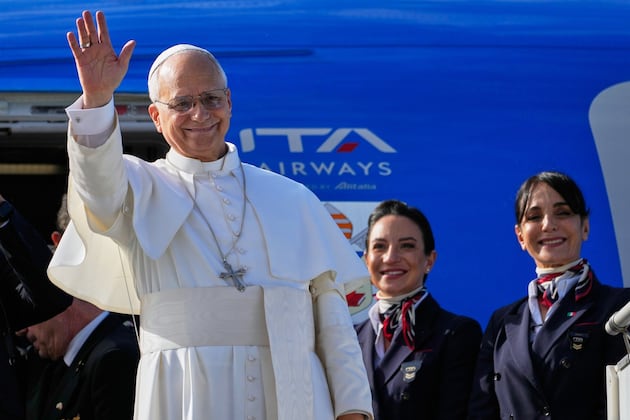
Pope Leo XIV concluded his six-day visit to the Middle East — his first foreign trip as pope, with stops in Turkey and Lebanon. On Dec. 2, thousands gathered along Beirut’s waterfront for a Mass, many arriving before dawn.
In Turkey, he visited the Blue Mosque in Istanbul and led prayers at the Armenian Apostolic Cathedral in Istanbul, signaling solidarity with efforts toward unity with other Christian minority communities in Turkey.
Throughout the trip, Pope Leo preached a message of peace and reconciliation, especially in Lebanon, as Israeli strikes continue to threaten the fragile truce with Hezbollah, a Shiite Muslim political and militant organization based in Lebanon.
In Beirut, Pope Leo visited a psychiatric hospital and silently prayed at the site of the 2020 port explosion, which killed over 230 people and wounded about 7,000, according to the Catholic News Agency. He met with families of the victims and gave a homily during a Mass at the Beirut waterfront.
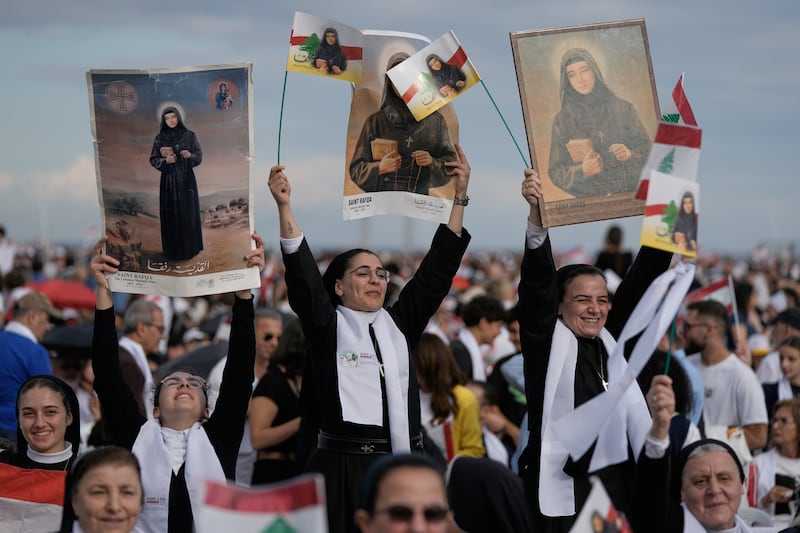 Nuns hold up images of Lebanese Maronite nun Saint Rafqa as they wait for Pope Leo XIV to celebrate a Holy Mass at Beirut waterfront, in Beirut, Lebanon, Tuesday, Dec. 2, 2025. | Bilal Hussein, Associated Press
 Here are 3 things that Pope Leo said during his addresses in Turkey and Lebanon:‘The paths to follow’
On Nov. 28, Pope Leo visited the archaeological site of the First Council of Nicaea, currently Iznik, Turkey, where Christian leaders met in 325 and produced the creed still used today. At the lakeside ruins, he prayed with Ecumenical Patriarch Bartholomew, the head of the Eastern Orthodox Church — an intentional gesture underscoring Christian unity.
“We must strongly reject the use of religion for justifying war, violence, or any form of fundamentalism or fanaticism,” Pope Leo said in his speech, according to NPR. “Instead, the paths to follow are those of fraternal encounter, dialogue and cooperation.”
During a meeting with Turkish authorities and diplomats in Ankara, Pope Leo called on the guests to preserve diversity and fight against growing polarization.
“Uniformity would be an impoverishment,” he said. “Indeed, a society is alive if it has a plurality, for what makes it a civil society are the bridges that link its people together. Yet today, human communities are increasingly polarized and torn apart by extreme positions that fragment them.”
Christians in Turkey are committed to contributing to the country’s unity, the Pope said, and consider themselves part of Turkish identity.
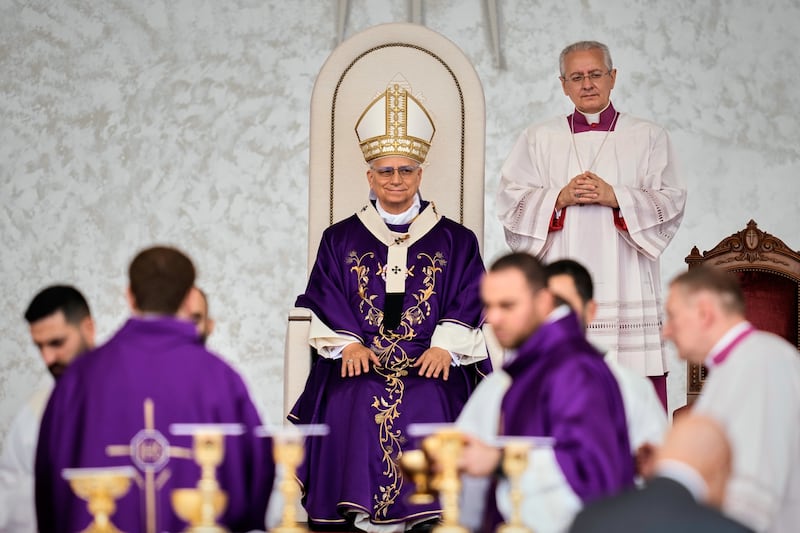 Pope Leo XIV sits as he celebrates a Holy Mass at Beirut waterfront, in Beirut, Lebanon, Tuesday, Dec. 2, 2025. | Bilal Hussein Associated Press
 ‘Listen to the cry of your peoples’
In Lebanon, Pope Leo addressed nearly 150,000 people gathered at the Beirut Waterfront, calling for unity among Christians and Muslims.
During his homily, he spoke about gratitude and perseverance amid hardship, comparing the hope offered by Jesus Christ to “a small shoot, a small branch sprouting from a trunk sprouting from the trunk.”
“Gratitude must not remain an introspective and illusory consolation. It must lead us to a transformation of the heart, a conversion of life and a realization that God has made us precisely to live in the light of faith, the promise of hope and the joy of charity,” he said. “As a result, we are all called to cultivate these shoots, to not be discouraged, to not give in to the logic of violence and the idolatry of money, and to not resign ourselves in the face of the spreading evil.”
At the end of the Mass, Pope Leo urged Christians in the Middle East to reject revenge and division, calling instead for coexistence and reconciliation. He said he was praying for regions suffering from conflict — including the Middle East, Guinea-Bissau and Hong Kong — and appealed to Lebanon’s leaders to “listen to the cry of your peoples who are calling for peace.”
‘May the attacks and hostilities cease’
During the Farewell Ceremony at Beirut’s airport on Dec. 2, Pope Leo again turned to the theme of peace.
“We hope to involve the entire Middle East in this spirit of fraternity and commitment to peace, including those who currently consider themselves enemies,” he said, closing his six-day apostolic journey.
He went on: “May the attacks and hostilities cease. We must recognize that armed struggle brings no benefit. While weapons are lethal, negotiation, mediation and dialogue are constructive. Let us all choose peace as a way, not just as a goal!”
He also invoked Saint John Paul II’s 1997 words: “Lebanon is more than a country; it is a message!” He added: “Let us learn to work together and hope together, so that this may indeed become a reality.”