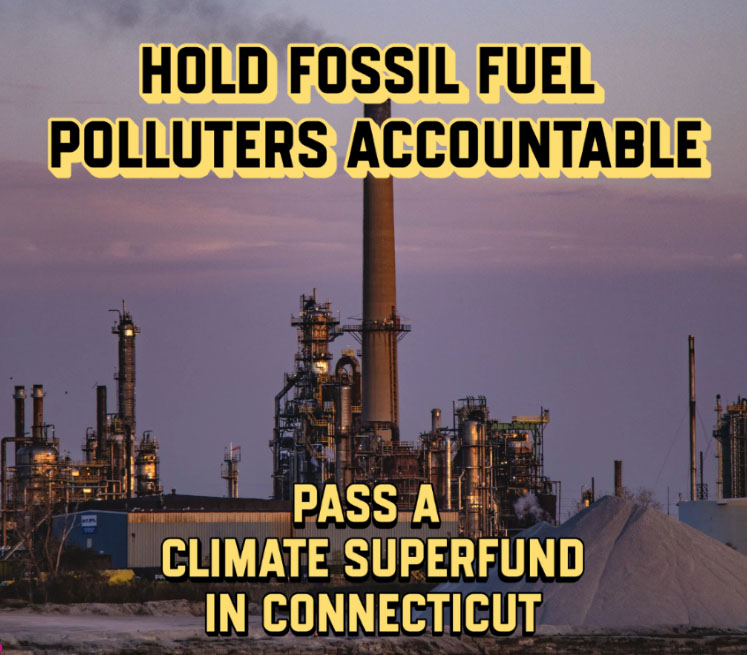
The principle behind the Climate Superfund is simple: we must make fossil fuel companies pay for the climate damage they have created, rather than leaving those costs to our neighbors and families.
Without a Climate Superfund, Connecticut will continue to build financial burdens from climate change, including disaster relief, infrastructure repairs, and public health costs that will disproportionately impact low-income and vulnerable communities.
Critics of the Climate Superfund often raise the concern: won’t the fee to fossil fuel companies simply be passed along to residents in the form of higher energy bills? That’s an important question to address, and one that several economists have already answered.
As Nobel Prize–winning economist Joseph Stiglitz explained in a letter to New York’s governor, the Climate Superfund fee is based on companies’ past pollution, not their current production. That means it’s considered a fixed cost, which is something oil companies can’t simply pass on to consumers without risking their profits. In other words, this policy makes polluters pay their fair share for the damage they’ve already done without raising gas prices for the rest of us.
Additionally, the global prices of crude oil is set through supply and demand in a global market. Even large fossil fuel companies cannot raise pump prices in Connecticut without losing market competitiveness or incentivizing consumers to change behavior.
In New York, the Climate Superfund bill will raise $3 billion annually over 25 years without increasing energy costs to residents. When similar settlements have occurred, including the federal Superfund law for toxic waste, there was no evidence of increased costs for customers.
The Climate Superfund will advance clean, affordable energy in Connecticut. Many households, especially in low-income communities, already spend a disproportionately large share of their income on utilities. A superfund can increase the state’s capacity for financial aid, such as utility assistance to alleviate energy poverty. Additionally, if funds from the climate superfund are directed towards retrofits, weatherization, and clean heating technology in low-income communities, this could help lower long-term energy costs and reduce energy burdens.
The Climate Superfund should be designed to provide stronger governance in how funds should be spent including prioritized funding for environmental justice neighborhoods and community engagement in project selection. This helps advance “energy democracy,” where communities have a voice in how funds are spent and can shape their local energy systems.
Some communities in Connecticut are disproportionately impacted by sea-level rise, flooding, heat waves, and storm damage, including those communities with older infrastructure, coastal neighborhoods, and low-income populations. A Climate Superfund recognizes these inequities and seeks to remediate historic harms by directing resources to mitigation, adaptation, and resilience projects that keep people safe and help our communities thrive.
Opponents to the Climate Superfund believe that this is a tax that will impact consumers and businesses. However, these claims are based on the assumption that firms can freely pass these costs onto energy users. This has not been shown in existing superfund models.
Additionally, some critics argue that this bill is not constitutional since the government cannot retroactively charge companies after the fact. However, long-standing ‘polluter pays’ principles in U.S. law have been upheld in court, including the federal superfund law (CERCLA) that has followed this model for toxic waste sites since the 1980s. Additionally, the superfund is not a ‘punishment,’ but rather a cost recovery mechanism to fix public harms from climate damages, and it is proportional based on each company’s share of historic greenhouse gas emissions.
Connecticut is already paying for climate change through storm and flood costs, infrastructure damage, and public health impacts like asthma. These costs fall most heavily on taxpayers, especially households that already face high financial burdens.
The Climate Superfund provides an alternative to make polluters pay, not residents. If Connecticut acts now by passing this state legislation, we can build more climate-resilient towns and cities without increasing environmental burdens to those that can least afford them.
Join our efforts by signing our petition at act.sierraclub.org and urge our state leaders to pass a Climate Superfund.
Sydney Collins is an environmental activist in New Haven.
–