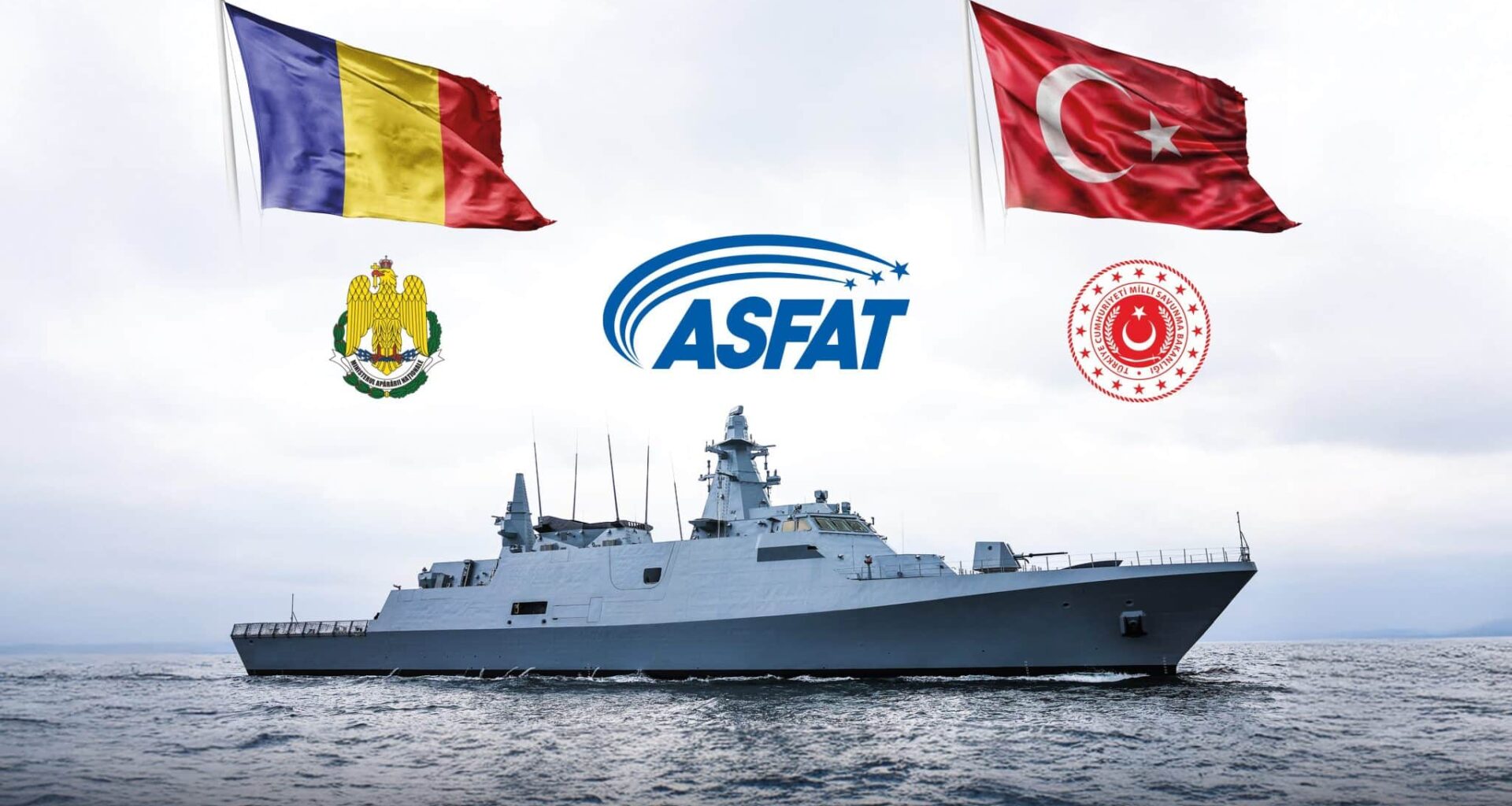
Turkish defense contractor ASFAT announced the signing of a contract with Romania’s Ministry of National Defence for the sale of TCG Akhisar (P-1220), the lead vessel of the Turkish Navy’s Hisar-class offshore patrol vessels, for approximately €223 million.
Story by Tayfun Ozberk, additional reporting by Xavier Vavasseur
The signing ceremony of the intergovernmental contract for Romania’s acquisition of the HISAR-class light corvette from Türkiye took place on Wednesday, December 3, at the headquarters of the Romanian Ministry of National Defense.
“The entry of a new ship into the service of the Naval Forces is a concrete step, a step that strengthens our defense capacity in the Black Sea. We are not just talking about military equipment, but about the security of Romania and about respect for our military who need the best conditions to carry out their missions.“
Ionuț Moșteanu, Romania’s Minister of Defence
Romania’s interest in the Hisar-class vessels had long been known, and reports on the subject had frequently surfaced in the media of both countries. However, the Romanian Ministry of National Defence’s press release issued today (03 December) confirming the contract, along with ASFAT’s social media posts, marked the first official statements on the matter.
The deal represents a notable achievement for Türkiye’s indigenous shipbuilding program, which has evolved considerably over the past two decades. TCG Akhisar is the lead vessel of the Hisar-class OPV project which was launched in September 2023 in Istanbul Naval Shipyard and started sea trials in December 2024. The second vessel of the project, TCG Koçhisar (P-1221) is currently undergoing harbor acceptance tests at Istanbul Naval Shipyard following its launch in September 2023. The vessel is expected to commence sea trials in the coming months, with delivery to the Turkish Naval Forces projected for March 2026.
It is worth noting that the Hisar-class vessels are derived from the Ada-class corvette design developed under the Turkish Navy’s MILGEM program and are intended to be configured as offshore patrol vessels. However, Romanian authorities refer to the platform as a light corvette, as its planned armament configuration will differ from the standard OPV variant.
Romania’s acquisition addresses a critical capability gap in its naval forces, which have operated aging platforms for years. The Hisar-class vessel will provide Bucharest with a modern, multi-role platform capable of intelligence, surveillance, and reconnaissance operations, search and rescue missions, counterterrorism activities, and maritime interdiction.
Romania’s previous attempts at corvettes procurement
Romania previously held a corvette procurement competition involving Dutch shipbuilder Damen and France’s Naval Group. For the record, Romanian authorities announced in 2019 the selection of Naval Group and its partner local shipyard Santierul Naval Constanta (SNC) for the programme to build four new corvettes. The deal also includes the modernization the in-service T22 frigates and the creation of a maintenance and training centre. However the deal never came into force, despite a letter of intent signed three years ago.
Following delivery, TCG Akhisar will undergo additional outfitting to integrate systems specified by the Romanian Naval Forces. The most significant modification involves the installation of Norwegian-made Naval Strike Missiles (NSM). Romania has already contracted for NSM Coastal Defense Systems, with deliveries expected in 2025, and the decision to arm the corvette with the same weapon system reflects a strategic choice for standardization and interoperability.
With existing export programs delivering MILGEM-derived corvettes to Pakistan, Ukraine, and Malaysia, Türkiye has established itself as a credible supplier of modern naval vessels to allied nations seeking capable platforms at competitive prices.
Türkiye’s Hisar-Class OPV Project
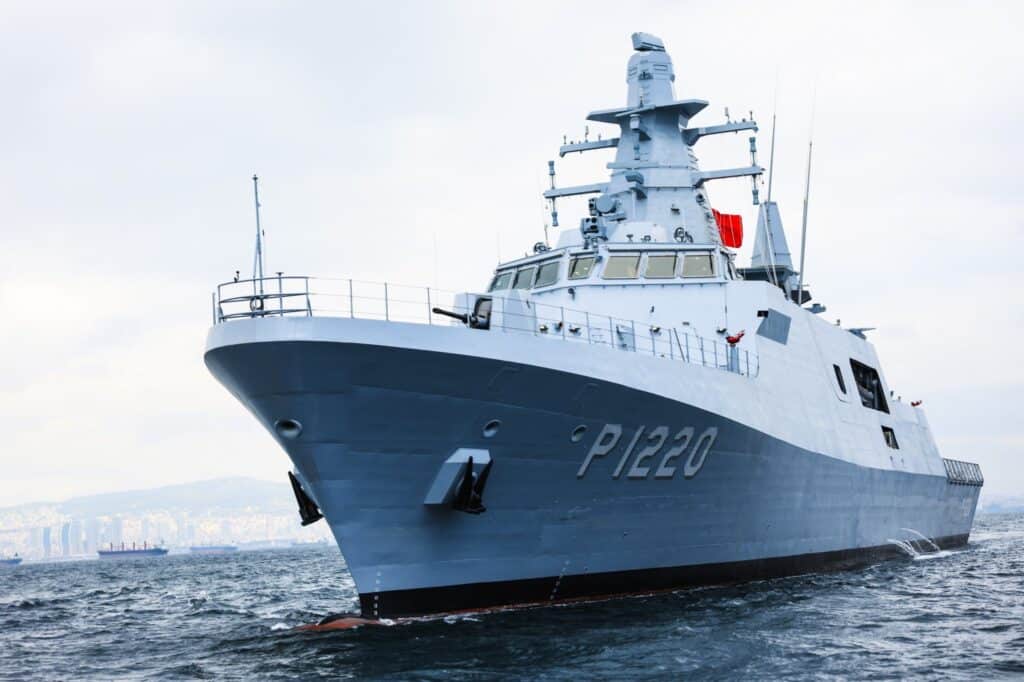
The first Hisar-class OPV TCG Akhisar during sea trials (ASFAT photo)
The Hisar-class offshore patrol vessel program represents an evolution of Türkiye’s broader MILGEM (National Ship) initiative, which began in the mid-1990s with the objective of developing indigenous naval platforms. The Hisar-class derives from the Ada-class corvette design but incorporates significant modifications to reduce construction time and costs while optimizing the platform for patrol and constabulary missions rather than high-intensity anti-submarine warfare.
The most substantial design change involves the propulsion system. While Ada-class corvettes employ a CODAG (Combined Diesel and Gas) arrangement with gas turbines for high-speed operations, the Hisar-class utilizes a CODELOD (Combined Diesel-Electric or Diesel) system. This configuration sacrifices several knots of maximum speed—24 knots versus the Ada-class’s 29 knots—but provides significantly improved fuel efficiency and extended range, increasing endurance by 50 percent compared to the earlier design.
The Hisar-class also adopts a “fitted for but not with” approach, allowing for modular installation of weapons and sensors as they become available or as operational requirements evolve. This design philosophy reduces initial acquisition costs and provides flexibility for future upgrades. The Turkish Navy has ordered ten Hisar-class vessels, with construction distributed among Istanbul Naval Shipyard and a consortium of private Turkish shipyards including Desan, Dearsan, and Özata.
Future vessels in the class are planned to receive enhanced armament, including vertical launch systems for HISAR-D missiles, though the first two ships lack this capability in their initial configuration.
Specifications:
Overall length: 99,56 meters
Beam: 14,42 meters
Draft: 3,77 meters
Maximum speed: 24 knots
Displacement: 2300 tons