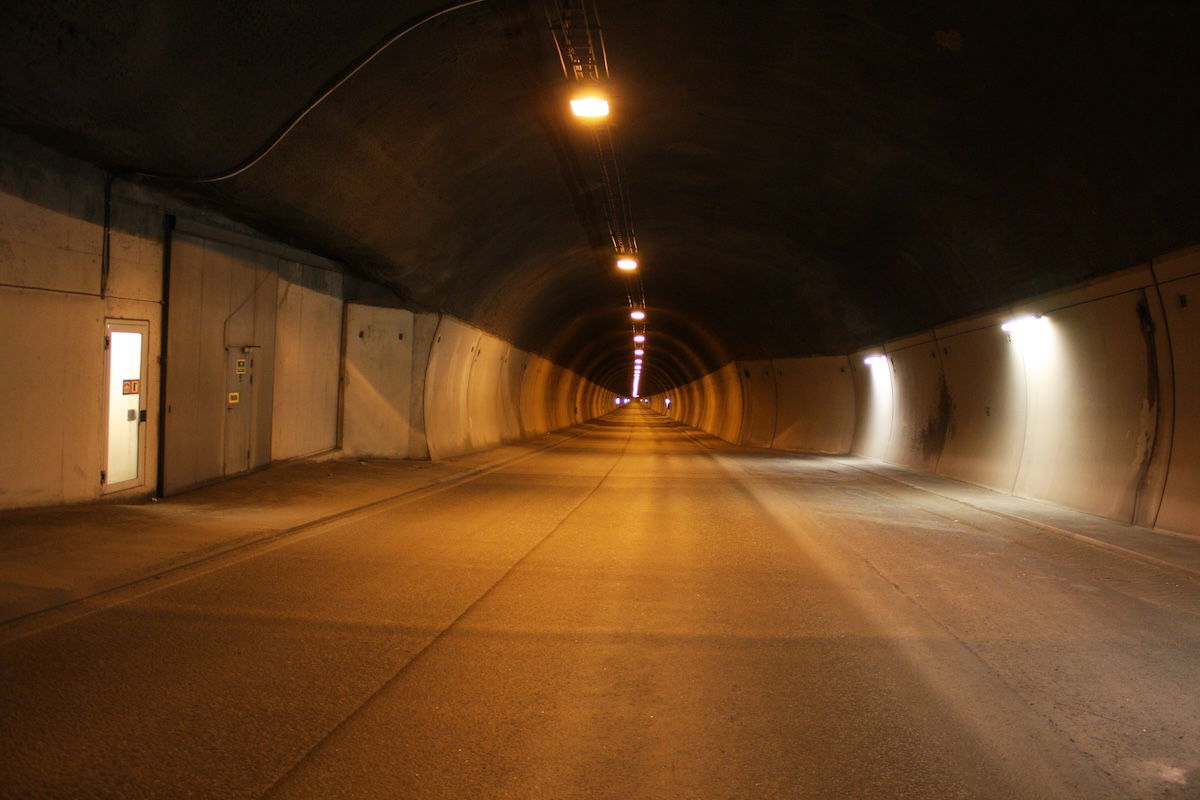
Norway builds world-leading undersea tunnel to transform west coast travel.
Photo Credit: Snurre86 / Wikimedia Commons
NORWAY is undertaking a massive engineering challenge, which has been under construction since January of 2018: The country is building the longest and deepest undersea road tunnel, which is poised to slash the travel time between major Norwegian cities and to become part of the E39 main road along its western coast.
A twin-tube triumph for Norway, connecting the western coast
The twin-tube tunnel, called Rogaland fastforbindelse, or Rogfast for short, is a 27-kilometre tunnel that is set to reach 392 metres below sea level at its deepest. The Rogfast tunnel, which will connect the Stavanger and Haugesund regions, is set for completion in 2033, and its total cost will be approximately 25 billion Norwegian kroner, or €2.1 billion.
In addition to reducing the travel time by 40 minutes between the second and fourth largest Norwegian cities by population, Bergen and Stavanger, respectively, the undersea tunnel will replace current ferry connections and make daily commutes much easier, according to Anne Brit Moen, a project manager at Skanska AB, the Swedish multinational construction company that is building the northern part of the tunnel (the deepest section and currently 9 kilometres long).
Most Read on Euro Weekly News
The existing E39 main road spans more than 1,100 kilometres through Norway and Denmark. Today, it takes more than 21 hours to drive the full length of the road, and the journey includes seven ferries. The Rogfast tunnel is set to form a crucial part of the region’s infrastructure. It will be a major component of Norway’s west coast corridor, connecting major Norwegian cities including Kristiansand, Stavanger, Haugesund, and Bergen.
The tunnel, in addition to slashing commute times and forming a better connectivity along Norway’s west coast, also aims to reduce emissions on Norway’s western coast.
Rogfast’s considerable challenges, met with state-of-the-art technology
Rogfast will feature a two-tube structure, each carrying two lanes of traffic with cross passages and a central emergency corridor. Halfway through the tunnel, drivers will find an enormous underground double roundabout, located 260 metres below sea level, that will provide access to the Norwegian island of Kvitsøy, the nation’s smallest municipality.
To protect drivers and motorists from air pollution, Rogfast also will use a longitudinal ventilation system that will be powered by jet fans.
Advanced technology is needed to construct the industrially challenging structure. Workers are using laser scanners, for example, to ensure near-perfect alignment between segments, which are excavated from both ends and meeting in the middle. Rogfast requires a precision within a margin of error of just 5 centimetres, making it one of the most challenging and strict tunnel projects ever attempted.
Grouting and sealing methods are also being used by engineers to keep the tunnel dry and stable, and avoid the constant risk of leakage from the seawater. According to Moen, the project has already experienced a number of saltwater leaks.
A vexing construction schedule, with conflicting completion ETAs
The tunnel’s construction was temporarily halted in 2019 due to rising costs and contract complications, but resumed in late 2021. Though the project is currently slated for completion in 2033, less than a decade from now, conflicting reports state that the tunnel is not expected to be completed before 2050.
Rogfast, though it will inevitably end jobs due to the ferry closures, will strengthen access to other jobs for local communities, and is expected to have an overall positive impact on the local economy, the seafood industry, and the local employment rate.
Rogfast ready to overtake Japan’s Seikan Tunnel
Currently, the world’s longest tunnel with an undersea section is the Seikan Tunnel in the north of Japan, a railway-only tunnel that spans just under 54 kilometres in total and whose underwater section spans 23.3 kilometres, nearly half of the total journey. At 392 metres below sea level at its deepest, Rogfast is set to be much deeper than the Seikan Tunnel, which at its deepest is 240 metres below sea level.
The project is set to make an engineering breakthrough not only by Norway’s standards, but by global standards as well, paving the way for new, ambitious, and exciting projects that benefit local residents and the infrastructure of whole coastlines.
Read more news from Norway here.