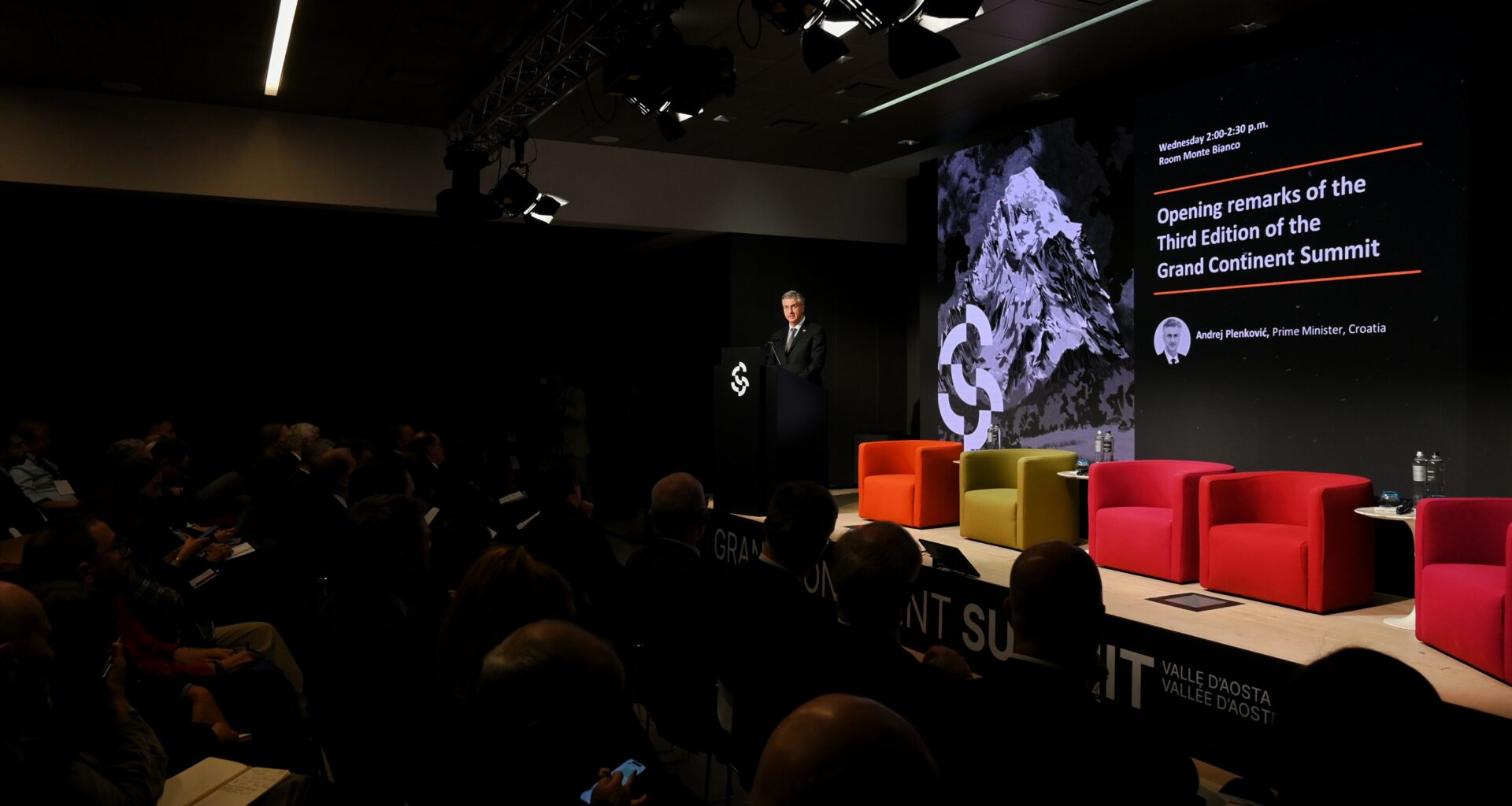
Prime Minister Andrej Plenković participated at the opening of the third Grand Continent Summit. It is a platform for high-level dialogue within Europe and between Europe and the rest of the world, which brings together European decision-makers, academics and leading intellectuals dedicated to the three major transformations of the continent, geopolitical, green and digital, with the aim of addressing the most pressing challenges of our time. He focused his speech on the theme of Europe at a crossroads, which seeks to build strategic sovereignty in multiple dimensions and lead its citizens towards a secure and prosperous future. He presented the Croatian perspective on the key areas and challenges that we must face together and the opportunities that we can seize together.
Croatia is the newest member state of the European Union, and the only one with a recent, real-life experience of a war of aggression strikingly similar to today’s Russian attack on Ukraine, he pointed out in the introductory part of his speech, recalling that just three decades ago, a quarter of Croatian territory was occupied, and we also had to take care of 700,000 refugees – one in seven people in our country.
We had to bear that burden while defending ourselves under an unjust international arms embargo, facing a much larger and more heavily armed Yugoslav Army led by Milosevic’s Serbia, he added.
At a heavy human cost, we liberated most of our territory in 1995 and peacefully reintegrated the rest in 1998. We then rebuilt a country in which 15% of all housing units had been destroyed, with war damage that, relative to the size of our economy, was twenty times greater than the cost of the tsunami in Japan in 2011, he pointed out.
“We restored stability, rebuilt prosperity and ultimately strengthened our security by joining NATO, and our future by joining the European Union – and, in 2023, by entering the eurozone and the Schengen area,â€� the Prime Minister said.
Speaking about the current situation, he pointed out that Croatia is on the verge of OECD membership and has an A-category credit rating, having risen five levels in just seven years, the fastest progress of any European country.
“Today we are a confident European democracy: among the three fastest growing economies in the eurozone in the last four years, one of the top twenty tourist destinations in the world with over twenty million visitors, seventh in the European Union in terms of the share of renewable energy and eighth in the world in implementing the UN Sustainable Development Goals,” he said.
It is from this vantage point, shaped by sacrifice, renewal and successful European integration, that Croatia approaches the challenges that Europe now faces, the Prime Minister added.
Energy as the foundation of European sovereignty
Speaking of energy, he stressed that it is the silent foundation of every comfort, every industry and every freedom we enjoy. Everything we consume has travelled – usually by truck or ship, almost always thanks to oil, he added.
Â
“Without oil there is no transport, and without transport there is no economy. Yet the amount of energy available per citizen in Europe has been falling for two decades – not because we are consuming less, but because Europe is producing far less oil and gas than it used to,â€� he warned. This, he added, acts like a hidden tax on everyday life, fueling insecurity and political frustration.
The Prime Minister said that one of the most accessible and useful responses is building renovation, as around 40% of total energy consumption in the EU is used in buildings – for heating, cooling and electricity – and every kilowatt-hour saved boosts household budgets.
Our vulnerability is increased by our dependence on external suppliers: Europe imports 95% of its oil, almost 90% of its gas and two-thirds of its coal. These are not just climate issues – they affect sovereignty and resilience, he stressed.
Meanwhile, intensifying competition between the United States, China and Europe is turning energy into a strategic battlefield.
“That is why the energy transition is not only a green imperative, but also a geopolitical one. Europe must build an energy system that is cleaner, more efficient and far less exposed to external pressure,� he said, adding that we must expand renewable energy sources, deploy new technologies, modernise infrastructure and increase efficiency.
Croatia is key to the diversification of supply in Central and Southeastern Europe
In the European Union, about a third of electricity comes from fossil fuels, a quarter from nuclear energy, and slightly less than half from renewable sources.
At the same time, he emphasized that Croatia is even more balanced with 54% renewable sources, 26% fossil fuels and 20% nuclear energy from the Krško Nuclear Power Plant.
Croatia considers nuclear energy essential for long-term security and decarbonization. We are also closely monitoring small modular reactors as a future option for Europe, he added.
With its infrastructure, Croatia supports diversification in Central and Southeastern Europe. The Adriatic pipeline is a key alternative for our landlocked neighbors, in addition to meeting Serbia’s needs, it can also fully supply Hungary and Slovakia. Therefore, there is no technical or infrastructural reason for any member state of the European Union to rely on exemptions from sanctions on Russian oil, said the Prime Minister.
Green Transition and Climate – Balancing Ambition with Competitiveness and Security
Speaking on the green transition and climate, the Prime Minister warned that Europe is facing a stark reality as climate change is no longer a distant threat, but a disruption that is already changing our economies, our security and our way of life.
From record-breaking heatwaves to severe droughts and floods, the physical impacts are accelerating – and nowhere faster than in southern Europe, where the Mediterranean is warming 20% ​​above the global average.
This creates a double challenge: Europe must decisively reduce emissions while remaining economically competitive – and it must do so in a way that is socially just and politically sustainable, said the Prime Minister.
The transition itself is not in question, but whether we can do it in a way that strengthens our competitiveness, protects vulnerable citizens and provides certainty for investors.
“This must be fair and feasible, with predictable regulation and adequate support for households and businesses. The main obstacle lies in our dependence on imports of critical minerals and rare earths. A green and digital Europe cannot rest on fragile supply lines; we must diversify sources, ensure reliable partnerships and build resilience across the value chain,” he said.
Security in the Age of Revisionist Power
Prime Minister Plenković also spoke about the issue of security in the changed global circumstances.
Pointing out that Europe today faces the most dangerous security environment since the end of the Cold War, he recalled that Putin launched six major military aggressions since he came to power – starting with the second Chechen war, followed by the invasion of Georgia, the illegal annexation of Crimea, the war that began in Donbass, the intervention in Syria to support the Assad regime and finally the full invasion of Ukraine.
In addition to open military aggression, Russia has also carried out hostile and destabilizing actions throughout Europe and beyond. It carried out cyber attacks on European Union countries and the USA. They attempted and supported a coup in Montenegro and sabotaged ammunition warehouses in the Czech Republic. Through a paramilitary group, they have fueled instability in Libya, the Central African Republic, Mali and Sudan – and, more recently, through the Russia’s Africa Corps, in Niger.
“This is not a series of isolated crises, but a deliberate strategy of coercion and territorial revisionism. It reflects a single, coherent strategic objective: to overturnw the international order based on the rule of law and replace it with a world governed by power alone,” he said, adding that in such a world, borders can be changed by force, and weaker states can no longer rely on collective security or the principle that territorial conquest will not be recognized.
Ukraine’s Heroic Resilience, Courage and Determination
The Prime Minister warned that undermining this foundation would shatter the European security architecture that has prevented wars of aggression for decades.
“And we would be naive to believe that the invasion of Ukraine in 2022 will be the last attempt to redraw borders by force,” he added.
In this context, he praised Ukraine’s extraordinary resilience, saying that it is heroic because for almost four years, Ukrainians have resisted a much larger aggressor with exceptional courage and determination.
And despite Russia’s efforts, its progress remains limited, he added.
“Ukraine is Europe’s first line of defense. And it is important that we continue to support it. If a peace agreement is eventually reached, it must be acceptable to Ukraine and must include security guarantees robust enough to prevent Russia from restarting the war after rebuilding its forces”, Prime Minister Plenković said, adding that Europe must also play a central role in all future security arrangements and cannot be excluded from decisions concerning the security architecture of our continent.
Sanctions are one of the most effective tools to limit the Russian war machine
At the same time, Russia is trying to regain legitimacy on the international stage, advocating for the lifting of sanctions by promising lucrative contracts to foreign companies, Prime Minister Plenković said.
Â
“Sanctions remain one of the most effective tools to limit the Russian war machine, and any easing must be conditional on genuine, verifiable changes in behavior,� he argued.
He warned that Putin allocates around 40% of the federal budget, and more than 10% of Russia’s total GDP, to the military and the broader security apparatus. He added that intelligence-based estimates show that Russia produces between three and four and a half million artillery shells per year, potentially three times more than the combined production of the European Union and the United States.
And although its navy and air force cannot match NATO’s, he pointed out, Moscow retains a significant advantage: a large, battle-hardened land army and a rapidly growing drone industry to which Europe must adapt.
Croatia is becoming a global leader in the production of FPV drones and demining machines
Drones have become a defining feature of modern warfare, said Prime Minister Plenković and added, in this context, that Croatia contributes to Europe’s resilience and strategic autonomy by becoming a global leader in the production of FPV drones produced without critical Chinese components.
We are also working with the Netherlands and Latvia under the new European Drone Coalition to jointly manufacture and procure battle-proven FPV systems, he added.
He also pointed out that, thanks to our innovative companies, Croatia also holds 80% of the global market for remote-controlled demining machines, which is another key capability for modern conflicts.
“This deteriorating security environment compels us to place deterrence, defense and resilience at the center of our efforts. This is both an existential and geopolitical necessity if Europe is to shape its own future and not adapt to the strategies of others,” the Prime Minister asserted, adding that resilience today spans crisis management, hybrid threats, disinformation, critical infrastructure and energy security and requires the approach of the entire society – public, private, academic and civil.
We have tripled our defense budget and remain committed to NATO goals
The Prime Minister emphasized Croatia’s support for Europe’s growing responsibility for its own security, and its strategic autonomy, within the framework of the European Union and NATO, which allow us to pool resources, avoid duplication and ensure interoperability.
He emphasized that Europe must also fulfill its obligations regarding defense spending.
In this context, he pointed out that Croatia has tripled its defense budget in the last decade and remains committed to achieving 2.5% of GDP by 2027 and 3% by 2030.
In addition, he added, we are modernizing our armed forces by fully transitioning to Western technology, citing, for example, the acquisition of Rafale fighter jets, Black Hawk and Kiowa Warrior helicopters, Bradley vehicles, Patria aircraft carriers and Bayraktar drones. We are now in the process of purchasing Leopard tanks, HIMARS missile systems and CAESAR howitzers, he said, and announced investments in the navy.
He added that Croatia has been allocated a provisional amount of 1.7 billion from the SAFE instrument.
“Our combat air force is now the most modern between Germany and Greece,” the Prime Minister said.
He reported that a mandatory two-month accelerated military training program is being introduced from January.
The next multi-annual financial framework must ensure adequate funding for defense, research and innovation in order to protect our technological sovereignty, said Prime Minister Plenković.
“We must strengthen Europe without weakening NATO, which remains the cornerstone of our collective defense,” he said.
Croatia also consistently emphasizes the strategic importance of stability in the Western Balkans, he added.
Competitiveness in a fragmented world
Speaking about Europe’s competitiveness, Prime Minister Plenković pointed out that our global rivals are innovating faster, investing more and expanding more efficiently.
An example is visible in new technologies, he added, noting that while Europe leads in ideas, others often lead in their deployment.
To respond, Europe must reduce fragmentation, unleash innovation and complete the single market, the Prime Minister argued.
Key priorities include smarter regulation that improves competitiveness, then unlocking the full potential of the single market, reducing the innovation gap, addressing demographic challenges and developing a skilled, adaptable workforce for the green and digital transitions, and maintaining climate ambitions while balancing growth and sustainability.
For Croatia, membership in the European Union has been a strong driver of convergence – our GDP per capita has increased from 62% of the EU average in 2016 to 77% in 2024, he said.
One of Europe’s biggest challenges is demography
He also addressed the demographic challenge, saying that our societies are aging, while our workforce is shrinking.
Fertility rates remain far below the replacement level of 2.1, he said, recalling that the EU average was only 1.47 in 2022, which is equal to the current rate in Croatia, while no European country reaches 2.1; even those remain at around 1.8.
At the beginning of the 20th century, Europe accounted for a quarter of the world’s population, and today we are around 7.5%, and the European Union barely 5.5% of the world’s population.
In the meantime, global dynamics are changing dramatically, the Prime Minister said, pointing out that in the last decade, Africa’s population has grown from 1.25 to 1.55 billion, by 300 million, while the European Union has remained at around 450 million inhabitants.
He added that Africa is predicted to reach 2.5 billion inhabitants by 2050, while the European Union is expected to remain at around 450 million.
In this context, he stated that Croatia had almost 4.8 million inhabitants before the war, in 1991, while today it has just over 3.8 million. Therefore, he added, we are investing enormous efforts in various demographic policy measures in order to slowly begin to reverse negative trends.
Â
He recalled that Croatia has recognized the strategic importance of demography at the European level, and in 2019, at the Croatian initiative, a European Commissioner for Demography was elected for the first time.
We believe in the full potential of Europe
Finally, he referred to the strategic advantages of the European Union.
He believes, he emphasized, that the European Union should continue with deeper integration and added that at this moment he sees more political will to complete some of the accession processes, of course while fulfilling all the necessary criteria.
We are at a defining moment that will shape the continent, he said.
He stressed that strategic sovereignty is not about giving up openness, but rather what allows Europe to remain open on its own terms, confident in its ability to protect its interests and uphold its values.
Building this sovereignty requires credible defence, reliable and affordable energy, a competitive and green industrial base, world-class research and innovation, resilient supply chains and a digital sphere based on European standards.
This deeper integration, he added, will reduce our dependence in areas that leave us vulnerable.
“That is why the moment that lays ahead of us should not inspire fear, but it should provoke resolve. The resolve to make courageous choices, invest in our common future and trust in Europe’s full potential“, the Prime Minister concluded.