By Caroline Stauffer
TORONTO, Dec 3 (Reuters) – Spain will use only about a quarter of European Union loans meant to help EU members recover from the 2020-21 pandemic as its fast-growing economy can issue debt without EU curbs and deadlines, its economy minister told Reuters on Wednesday.
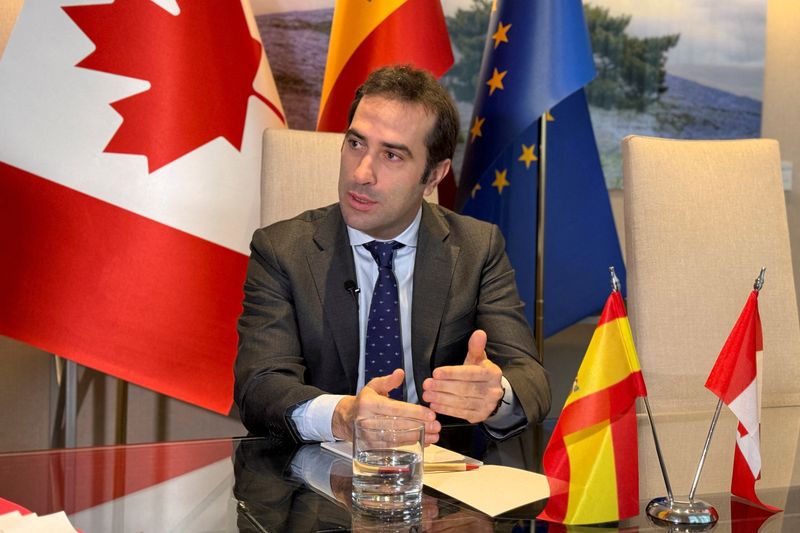
While Spain has been spared any noticeable direct impact from U.S. President Donald Trump’s tariffs on the EU, it is still working to diversify trade and investment relationships, Carlos Cuerpo said during a visit to Canada.
Countries including Italy, Poland and Spain have yet to use EU recovery funds that include grants and loans and must be implemented by August 2026, subject to EU regulations.
Spain was one of the main recipients and had been due to receive around 160 billion euros ($187 billion) – roughly half in grants and half in loans.
“Financially, there is no advantage for us to go for those loans, because we can do it ourselves with our own issuance of debt,” Cuerpo said.
Spain’s economy has by far outgrown its European peers in the past two years, diminishing its public debt burden as a share of GDP.
He said Spain had focused on the direct EU transfers to boost sectors including green energy, and might ultimately spend just around 25% of the loans.
“We will be closing these negotiations with the (European)Commission in the next few days, but it will be around that figure, yes, maybe a bit higher,” Cuerpo said.
Since the exposure of Spanish exports to the U.S. market is lower than that of other EU partners, Cuerpo said, “there is no significant impact” at the macroeconomic level from the U.S. tariffs, but did not rule out that a “potential impact might come from an indirect channel, from France, from Germany”.
The EU signed a deal with Trump involving a baseline tariff of 15% on most EU goods. The International Monetary Fund has said Spain is less affected than other large EU economies.
Meanwhile, Cuerpo said he thought bilateral trade with Canada could be doubled and voiced confidence a trade agreement between the Mercosur bloc of South American countries and the EU would be signed before the end of the year.
(Reporting by Caroline Stauffer; editing by Andrei Khalip and Mark Heinrich)