From the Council on Foreign Relations’ [Task Force Report on U.S. Economic Security](https://on.cfr.org/3KdLsNz):
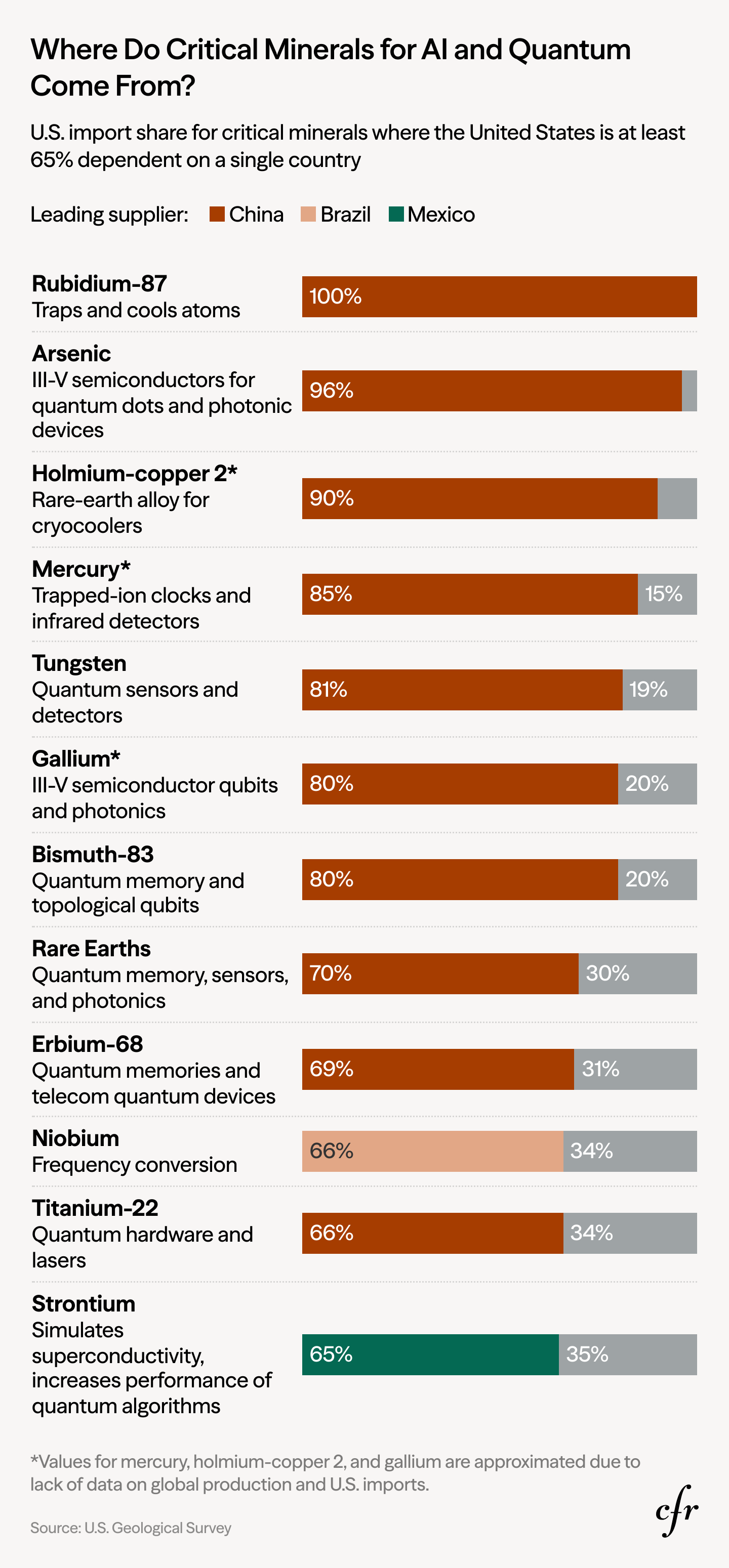
China’s near monopoly on critical minerals extraction and refining is a significant risk, given the importance of those inputs for semiconductor manufacturing and data center components. The United States relies on China for 70 percent of its rare earths and nearly 100 percent of its heavy rare earths, which together are used for polishing semiconductor wafers and as insulation for advanced chips, among other applications. The United States is completely dependent on China for all of its arsenic and holmium copper, which are critical for producing silicon chips and quantum cryocoolers, respectively. Though other countries, including the United States, boast significant critical mineral reserves, they do not have scaled infrastructure to refine mineral concentrates into usable compounds. China’s vast refining and processing capacity, therefore, poses an additional challenge to de-risking efforts, as minerals mined elsewhere often pass through China.
Source: U.S. Geological Survey
Tool: Datawrapper
That Jumper movie was right on the money. Need to find me a Chinese wife
My understanding is if we want to supply these ourselves we can, it just has been easier / more profitable to buy from China.
The moment the US decides to strategically bring back the mining and refining of rare earth metals, environmentalists will try and stop them because of how pollutant the extraction and refinement it causes. I hope this doesn’t happen but China did make the sacrifices to completely corner the market.
We can mine them ourselves. But let’s first schedule our subcommittee for environmental protections of small rivers and ponds
We don’t need large quantities of rubidium though? Like it’s literally just gonna be 1 atom per qubit in the end.
These all seem to be about quantum computer hardware and none of them seem to have anything to do with AI
The USA has to develop clean mining solutions. How? Ask AI on a quantum computer. Or, get 3-4 smart people in a room and come up with a real plan.
This has a little silly. For example, China controls 69% of erbium-68 production… But it’s for “quantum memories” and “telecom quantum devices”. But how much material is actually demanded for these alleged industries? Are we talking 1 ton? 10 tons?
Why do I care if China controls the majority of the production for an element that we don’t actually need or demand very much of? Add absolute demand in tonnage terms and maybe this would be informative. To me, this image is more beautiful than it is insightful.
You can basically rephrase Jared Harris’s speech about why Chernobyl happened for why this is the case: because it’s cheaper. China is happy to build up US dollars and the US (corporations) are happy to get cheaper materials. It’s about the second-tier of simplest macroeconomics examples that there is, after t shirts and shoes etc.
refining rare earth elements into concentrations of 95% or so is easy. Enriching them to desired industry concentrations of 99.5% or so is energy and capital intensive, not to mention the “effluent stream”. You gotta have the close-by ore resource, low energy costs and effective access to transport infrastructure; rail, truck and maritime. But you gotta have the ore resource/reserve. China can manipulate these markets because they have some of the richest carbonatite deposits in the world.
I don’t know much about the ratios of what’s mined where, so that part of the chart might be right. The rest is super misleading.
The almost magical claims about what some of these materials can be used for is so laughably incorrect that including Vibranium (“absorbs kinetic energy and vibrations”) and Kryptonite (“poisonous to Kryptonians”) would not have reduced the accuracy of this chart. Strontium “simulates superconductivity, increases performance of quantum algorithms?” Everyone who read that is dumber for having been exposed to it. And second, the production numbers are meaningless without context of industry demand. Is one of the *many* uses of the (very common) element mercury in trapped-ion clocks? Yes. Could one satisfy the world’s demand of mercury for that use with the amount of mercury scavenged from one antique thermometer? Also yes. Is that completely meaningless in terms of the 1,200 tons of mercury produced each year? Emphatically yes. (Also, it’s not even clear yet if trapped-ion clocks will be very useful; they could very well be an evolutionary dead end for which the demand is close to zero.)
It’s a symbiotic relationship. Without the US consumer the Chinese economy would collapse. No one is going to dig in their backyard unless there is demand for it.
![[OC] The U.S. depends on China for 70% of the rare earths used in AI and quantum](https://www.europesays.com/wp-content/uploads/2025/12/czlcznwnr15g1-1440x1024.png)
13 comments
From the Council on Foreign Relations’ [Task Force Report on U.S. Economic Security](https://on.cfr.org/3KdLsNz):
China’s near monopoly on critical minerals extraction and refining is a significant risk, given the importance of those inputs for semiconductor manufacturing and data center components. The United States relies on China for 70 percent of its rare earths and nearly 100 percent of its heavy rare earths, which together are used for polishing semiconductor wafers and as insulation for advanced chips, among other applications. The United States is completely dependent on China for all of its arsenic and holmium copper, which are critical for producing silicon chips and quantum cryocoolers, respectively. Though other countries, including the United States, boast significant critical mineral reserves, they do not have scaled infrastructure to refine mineral concentrates into usable compounds. China’s vast refining and processing capacity, therefore, poses an additional challenge to de-risking efforts, as minerals mined elsewhere often pass through China.
Source: U.S. Geological Survey
Tool: Datawrapper
That Jumper movie was right on the money. Need to find me a Chinese wife
My understanding is if we want to supply these ourselves we can, it just has been easier / more profitable to buy from China.
The moment the US decides to strategically bring back the mining and refining of rare earth metals, environmentalists will try and stop them because of how pollutant the extraction and refinement it causes. I hope this doesn’t happen but China did make the sacrifices to completely corner the market.
We can mine them ourselves. But let’s first schedule our subcommittee for environmental protections of small rivers and ponds
We don’t need large quantities of rubidium though? Like it’s literally just gonna be 1 atom per qubit in the end.
These all seem to be about quantum computer hardware and none of them seem to have anything to do with AI
The USA has to develop clean mining solutions. How? Ask AI on a quantum computer. Or, get 3-4 smart people in a room and come up with a real plan.
This has a little silly. For example, China controls 69% of erbium-68 production… But it’s for “quantum memories” and “telecom quantum devices”. But how much material is actually demanded for these alleged industries? Are we talking 1 ton? 10 tons?
Why do I care if China controls the majority of the production for an element that we don’t actually need or demand very much of? Add absolute demand in tonnage terms and maybe this would be informative. To me, this image is more beautiful than it is insightful.
You can basically rephrase Jared Harris’s speech about why Chernobyl happened for why this is the case: because it’s cheaper. China is happy to build up US dollars and the US (corporations) are happy to get cheaper materials. It’s about the second-tier of simplest macroeconomics examples that there is, after t shirts and shoes etc.
refining rare earth elements into concentrations of 95% or so is easy. Enriching them to desired industry concentrations of 99.5% or so is energy and capital intensive, not to mention the “effluent stream”. You gotta have the close-by ore resource, low energy costs and effective access to transport infrastructure; rail, truck and maritime. But you gotta have the ore resource/reserve. China can manipulate these markets because they have some of the richest carbonatite deposits in the world.
https://en.wikipedia.org/wiki/Carbonatite
I don’t know much about the ratios of what’s mined where, so that part of the chart might be right. The rest is super misleading.
The almost magical claims about what some of these materials can be used for is so laughably incorrect that including Vibranium (“absorbs kinetic energy and vibrations”) and Kryptonite (“poisonous to Kryptonians”) would not have reduced the accuracy of this chart. Strontium “simulates superconductivity, increases performance of quantum algorithms?” Everyone who read that is dumber for having been exposed to it. And second, the production numbers are meaningless without context of industry demand. Is one of the *many* uses of the (very common) element mercury in trapped-ion clocks? Yes. Could one satisfy the world’s demand of mercury for that use with the amount of mercury scavenged from one antique thermometer? Also yes. Is that completely meaningless in terms of the 1,200 tons of mercury produced each year? Emphatically yes. (Also, it’s not even clear yet if trapped-ion clocks will be very useful; they could very well be an evolutionary dead end for which the demand is close to zero.)
It’s a symbiotic relationship. Without the US consumer the Chinese economy would collapse. No one is going to dig in their backyard unless there is demand for it.
Comments are closed.