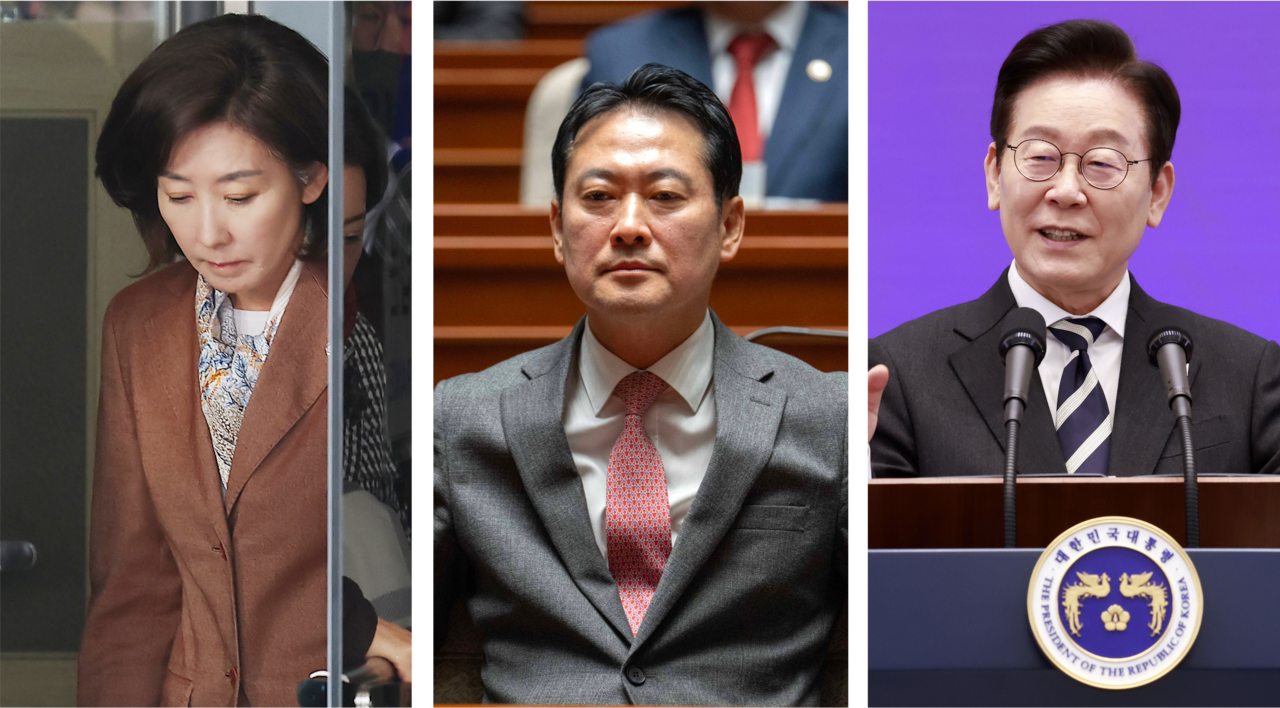
 From left: Rep. Na Kyung-won of the People Power Party; Rep. Jang Dong-hyeok, chair of the People Power Party; and President Lee Jae Myung. (The Korea Herald DB and Yonhap)
 References to Nazism and Adolf Hitler are appearing with increasing frequency in South Korea’s political discourse — raising concerns among foreign residents and scholars that such rhetoric must be used with far greater caution.
On Thursday, Rep. Jang Dong-hyeok, chair of the main opposition People Power Party, likened President Lee Jae Myung to Adolf Hitler during a party leadership meeting, accusing Lee of pursuing authoritarian rule.
“He is threatening the public by invoking Nazi war criminals,” Jang said at the National Assembly in Seoul. “It is no coincidence that Hitler comes so easily from the mouth of a president who dreams of becoming a ‘Fuhrer.’”
Jang’s remarks came two days after President Lee ordered the Justice Ministry to remove the statute of limitations on prosecuting crimes involving state violence, stating that those responsible for abuses of power should be punished “like Nazi war criminals.” Lee’s comments were widely interpreted as a warning of further prosecutions of those involved in former President Yoon Suk Yeol’s failed martial law attempt on Dec. 3 last year.
“Those who violate human rights under the authority of the state must continue to bear responsibility for as long as they live, just as Nazi war criminals were brought to justice,” Lee said during a Cabinet meeting Tuesday. “That is the only way to prevent a recurrence.”
Foreign observers — especially those from European countries, where references to Nazi Germany carry deep historical sensitivity — expressed concern that such terms are being used more casually in Korea than they should be.
Cornelia Roth, a German professor of German language and culture at Yeungnam University, said the frequent use of such expressions risks diminishing the historical gravity of Nazi crimes.
“As a German, it is shocking,” she told The Korea Herald. “Using these words carelessly can weaken the enormity of what the Nazis did — genocide and world war. Making ‘Hitler’ and ‘Nazi’ casual terms in everyday political fights could normalize them among the public.”
“Germany has made great efforts to move beyond its image as a perpetrator state,” she added. “Yet we already see far-right groups with neo-Nazi tendencies in our parliament. It’s time for South Korea to reconsider the power language holds.”
Her colleague, Franck Reynaud, a French professor of French language and literature at the same university, said his first reaction to hearing that the president was called Hitler was, “Oh my God.”
“In Europe, calling someone Hitler is the worst thing you can say,” he said. “I don’t fully understand Korean politics, but people should realize how strong these words are. Even if French President Emmanuel Macron is not popular among everyone, very few would call him Hitler.”
Reynaud added that he was surprised by what he perceives as Korean indifference toward such comparisons.
“We grow up learning how horrific the Nazis and Hitler were,” he said. “Because Korea has not directly experienced that brutality, perhaps it feels less serious here. But if someone in France said that, there would be a huge backlash.”
This is not the first time Nazi references have surfaced in local politics.
Rep. Na Kyung-won, a five-term lawmaker of the People Power Party, recently described a Democratic Party-backed bill establishing a special court to handle cases related to Yoon’s martial law declaration as “a special tribunal of the Nazi era.”
The bill — which would assign dedicated judges and panels at major courts in Seoul and extend the maximum pretrial detention period from six months to one year — passed the Legislation and Judiciary Committee on Dec. 3. Na argued that the ruling bloc is seeking to secure guilty verdicts for political purposes.
Meanwhile, Choi Chang-ryul, a professor of political science at Yongin University, said Nazi analogies may seem extreme but could reflect the seriousness of what might have occurred had the martial law attempt succeeded.
“Punishment comparable to that for Nazi war criminals may be necessary,” he said. “Imagine if Yoon’s martial law declaration had worked — how serious the consequences could have been.”
He added that while foreigners may think Koreans use the term “Nazi” lightly, the country has its own history of confronting authoritarian brutality.
“Koreans experienced military dictatorship and tragic events like the 1980 Gwangju Democratization Uprising,” he said. “One might say Koreans do not fully grasp the Nazi era, but that does not mean they don’t understand the dangers of extreme politics.”
Choi also noted that the People Power Party’s own use of Nazi-related language reflects how the party — which lost power in large part due to the martial law episode — is moving toward more hard-line, far-right politics.
Nonetheless, Jeong Ho-jin, vice executive chairman of the Korea–Israel Friendship Association, said Korea must remain cautious, especially given its diplomatic standing in the international community.
“As we all know, Nazism involved hatred toward a specific people and led to genocide,” he said. “Especially at a time when Korea is aspiring to play a greater role globally, political leaders — as intellectuals — should be careful in choosing their words.”
flylikekite@heraldcorp.com