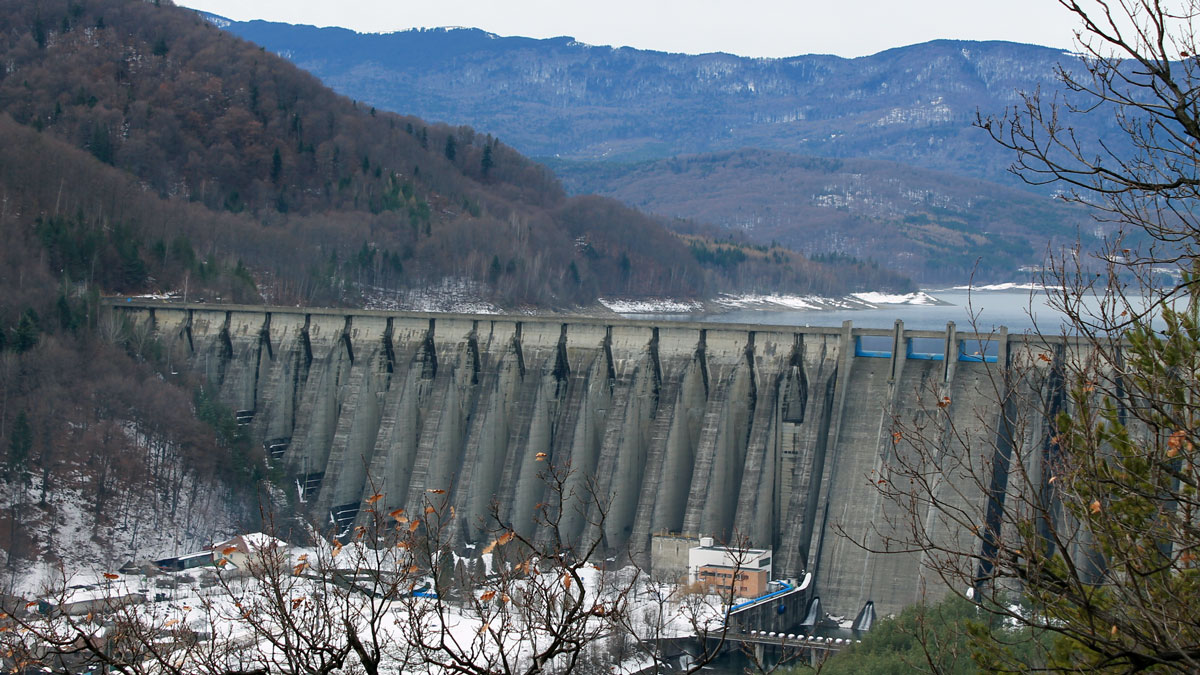
In recent years, several hydropower plant projects in Romania have become a subject of controversy between authorities, energy companies, and environmental organizations. The latest situation was caused by the Romanian President sending the law allowing the completion of hydropower plants that are in various stages of construction to the Romanian Constitutional Court (CCR), which amounts to a further delay.
President Nicusor Dan has referred to the Constitutional Court the reduction of protected areas and the elimination of environmental assessment for entire categories of energy projects.
“The law sent for promulgation raises constitutional issues and contravenes Romania’s obligations as a member state of the European Union. This allows for the reduction of protected areas and the elimination of environmental assessments for entire categories of energy projects or those declared by the Supreme Council of National Defence to be of interest to national security.
The unconstitutionality complaint emphasizes that the law:
Infringes upon the fundamental right to a healthy environment, guaranteed by Article 35 of the Constitution. Contravenes European Directives on habitat protection and environmental impact assessment, which do not allow general or automatic derogations for energy or military projects. Eliminates the environmental assessments and compensatory measures required by the European Union, reducing the level of biodiversity protection and exposing Romania to the risk of infringement proceedings.
Romania’s energy independence is a particularly important goal, but it must be achieved in a sustainable manner, and the country has a constitutional and European obligation to protect its natural heritage and guarantee every citizen the right to a healthy environment.
Adopting rules that weaken these guarantees would be a dangerous step backwards, contrary to the rule of law.”
The reasons cited mainly relate to the protection of biodiversity and compliance with European legislation on protected natural areas. However, a major problem with the current debate is the incomplete and limited nature of the environmental analyses used in the assessment of these projects.
Shortcomings in standard environmental assessments
Laws must be implemented fairly and enforced unequivocally. The problem with current environmental analyses is that they have a fragmented view.
The environmental assessments cited focus almost exclusively on the immediate area of the dam and related works. They measure the specific impact on habitats, forests, or fish species, but do not take into account the cumulative effects on the environment of the entire river basin and, implicitly, on the human communities (part of the environment) that depend on water reserves, as a result of the decrease in water resources.
Thus, current environmental analyses overlook the fact that a hydropower plant is not just an energy facility, but a multifunctional hydrotechnical infrastructure with positive regional impacts. Limiting the perspective to the dam area leads to incomplete conclusions and, often, to decisions that can have long-term negative consequences on the environment in a wider area, which should be considered in environmental analyses.
Regional benefits ignored in current approaches
A hydropower plant, especially when more than 90% complete, brings multiple socio-ecological benefits:
Water security for hundreds of thousands of people — providing drinking water, industrial water, and water for agriculture. Combating drought and regulating river flows by retaining water during rainy periods and releasing it in a controlled manner during dry periods. Flood prevention and protection of downstream communities. Supporting irrigation and agricultural production, especially in areas with moisture deficits. Production of clean, stable, and zero-carbon energy. Creating a more humid and stable microclimate, beneficial for forests and wildlife. Development of local tourism through the creation of reservoirs and recreational areas.
These benefits are not usually analysed in standard environmental assessments, even though they define the real impact of the development on the environment and society.
Fair solutions in sustainable assessment
There is a clear methodological imbalance in the conduct of environmental analyses.
In accordance with European nature conservation directives, impact studies focus on protecting species and habitats. However, a sustainable assessment must include all ecological and socio-economic dimensions in order to avoid disproportionate decisions.
In many cases, stopping or abandoning work on a hydropower plant that is 90–95% complete does not restore the original ecosystem, but leaves behind an unstable area with erosion, open galleries, degraded concrete, and the risk of secondary pollution. Therefore, non-completion may cause more harm to the environment than controlled completion of the works, followed by compensatory measures to restore habitats.
The environmental analysis of a hydropower project must take into account not only its specific impact, but also the historical moment of its construction. A hydropower plant that existed before the declaration of the protected area cannot be treated as a new construction, but as a reality already integrated into the system.
Therefore, the right solutions are not about stopping or demolishing, but about modernization and ecological compatibility — so that public investment, hydrological security, and nature protection can coexist.
Need for an integrated approach in environmental impact assessments
To ensure a balanced decision between nature protection and public interest, Romania needs an integrated environmental analysis that:
Assesses the effects at the level of the main river basin, not just at the local level. Includes the social, climatic, and economic benefits of the projects. Imposes modern compensatory measures: ecological corridors for fish, replanting, green buffer zones, permanent biological monitoring. Allows for the technological modernization of facilities to reduce ecological impact (minimum ecological flow, turbines with passage for fish fauna, etc.).
Sustainability does not just mean stopping what affects nature in a purely theoretical way (nature has often proven to be adaptable) but intelligently managing what already exists.
In the context of climate change, drought, and the need for green energy, hydropower plants can be part of the solution—if they are designed, completed, and operated responsibly.
By adopting an integrated vision of the environment, Romania can balance the protection of ecosystems (real ecosystems, not those limited to extremely small areas or zones) with sustainable development, the hydrological safety of its communities, and ensuring water supplies in a future marked by increasingly frequent droughts and extreme weather events.