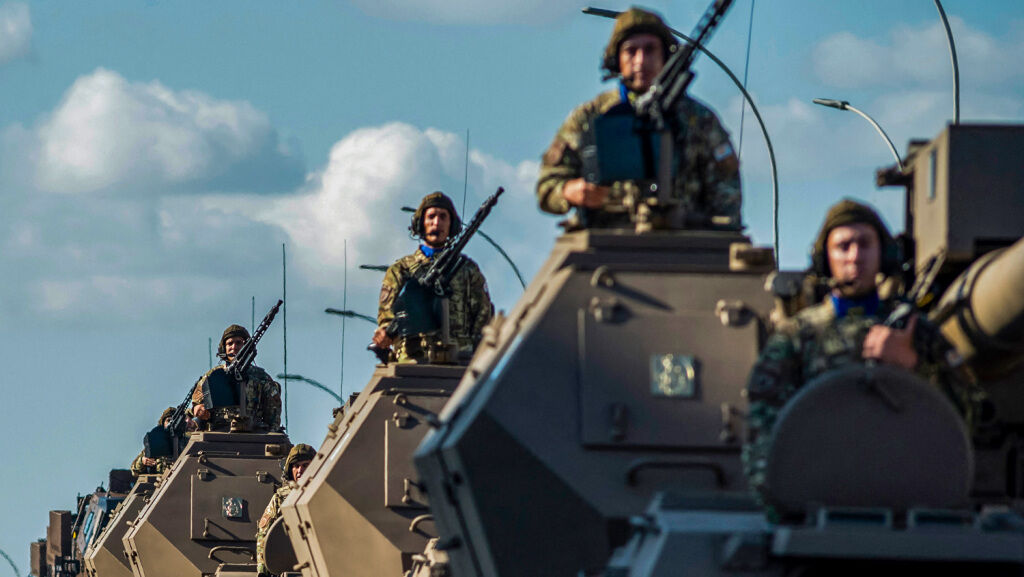
Cyprus is going on a massive military spending spree as it prepares to assume the rotating presidency of the European Council in January. It’s all part of a program that will draw the European Union closer to the Middle East.
Cyprus wants to buy $1.4 billion worth of weapons under the EU’s Security Action for Europe (safe), the Defense Ministry announced this week. safe’s long-maturity loans are empowering Cyprus to go on a massive military spending spree. For the United States, Russia or Germany, $1.4 billion wouldn’t represent much. Cyprus’s annual defense budget, however, is just over $580 million—so this is a massive investment.
Phileleftheros reported that the list of defense equipment that has yet to be approved by the EU includes armored personnel carriers, drones, bullets, missiles for battle tanks, artillery and mortars. It also includes upgrades to Cyprus’s two military bases: the air base in Paphos and the naval base at Mari.
The Associated Press reported in May: “Cyprus is in the process of modernizing its defensive capabilities to bring it up to modern European and nato standards after years of relying on mainly Soviet-era, Russian-made weaponry.”
The article highlighted Cyprus’s newly acquired Airbus H145 helicopters. Airbus’s senior vice president for the H145 program, Daniela Dudek, said it is the “most military-capable aircraft in its category” and “even more advanced than what we currently have in Germany.”
In August, Cypriot Defense Minister Vasilis Palmas told the Cyprus News Agency that Cyprus is working with the U.S. and the EU to upgrade two military bases to support the country’s “increasingly important regional role, particularly given recent developments.” Palmas was referencing the conflict between Israel and Hamas and Lebanon. He added that Cyprus’s geographic location strengthens its strategic position as a “bridge between the Mediterranean and Europe.”
Germany is also increasing its involvement in military cooperation with Cyprus. At a November 14 joint press conference with German Chancellor Friedrich Merz, Cypriot President Nikos Christodoulides outlined a few critical examples:
Joint search-and-rescue exercises
Stationing military supply aircraft
Hosting German forces who evacuated people from the Middle East
Additionally, German troops have been stationed in Cyprus since 2006 as part of the United Nations Interim Force in Lebanon. And this is just the beginning, Christodoulides said:
We want to strengthen the competitiveness, security and strategic autonomy of the European Union. Germany’s role is, of course, crucial to these key priorities.
To understand Cyprus’s increased military mindset, we have to understand its relationship with Germany.
Dependent on Germany
After Germany bailed out Cyprus following its financial crisis in 2012–2013, Trumpet editor in chief Gerald Flurry wrote: “The government of Cyprus no longer rules its own country.”
Another issue that gives Germany leverage over Cyprus is the division of the island between the area controlled by Greek Cypriots and the self-declared Turkish Republic of Northern Cyprus. International lawyer and secretary general of the United Cyprus Republican Party Nikolaos Komnenos told the Trumpet: “For Cyprus, Germany is a key partner in terms of pressuring Turkey for a solution.”
But whatever Germany’s diplomatic favors may entail, they come with a price. The island is forced to accept closer military ties with Germany, whether the population wants it or not.
This militaristic focus is evident even in the appointment of Germany’s new ambassador to Cyprus, Hans-Peter Jugel, who took the position in August. Komnenos noted: “He is a career diplomat and officer of the German Army, very highly positioned in different quarters. So this is another sign of deepening military cooperation between Germany and Cyprus.”
Another example Komnenos highlighted is Hans-Peter Bartels, the former Armed Forces commissioner of the German Bundestag, who now sits on the board of directors of Theon International. Headquartered in Nicosia, Theon International develops and manufactures customizable night-vision and thermal-imaging systems for military and security applications.
Focus on the Middle East
Christodoulides told “The Rest Is Politics: Leading” podcast in June: “If we want to have a geopolitical European Union, you need to be in a position to deal with Ukraine, but also with the Middle East.”
In the interview, he noted that Cyprus will use its EU presidency to facilitate this. However, this is not a new idea. Germany has long planned to use Cyprus for exactly this purpose. Back in 2010, we wrote on theTrumpet.com:
European elites are gearing for the projection of EU power into the Middle East and Persian Gulf so as to immobilize Iranian-led resistance to this vision and take possession of vital Gulf oil resources. As an EU member nation, Cyprus offers a key forward geostrategic military base and virtual island aircraft carrier for these coming missions. Due to the proximity of Cyprus to the whole Middle East region, European fighter jets can very easily cover much of the region without refueling and just about all of the region with mid-mission air refueling or from local bases or aircraft carriers.
The geostrategic position of Cyprus—located at the crossroads to the Agean and Mediterranean seas and Suez, possessing good sea ports, airports and radar surveillance systems to survey the skies across the Middle East, Persian Gulf and North Africa—makes it a great watching post over all of Middle East Islam. Cyprus is very strategic to any power seeking to ensure that the sea gates of Suez, Bab el-Mandeb and the Strait of Hormuz remain open to the vital flow of crude oil, other resources and foodstuffs to Europe and for EU exports to flow south to the great markets of Asia.
In just the past two years, the Middle East has witnessed the war between Israel and Hamas, the violent overthrow of Syria’s dictatorial Assad regime by other extremist groups, U.S. air strikes on nuclear facilities in Iran, and numerous other conflicts. Tensions in the region are so high that even the slightest provocations could ignite a major conflict.
Yet the EU has played no constructive role in solving these problems. That’s why Christodoulides intends to increase the EU’s focus on the region with military preparedness.
Who is to say that this involvement will make the volatile region less volatile or the bloody conflicts less bloody? Many biblical prophecies warn of great conflict in the region, a clash between the militaries of Catholic Europe and radical Islam. Based on these prophecies, Mr. Flurry has warned that Germany will use Cyprus as a military base of operation. He said in 2013 Key of David program:
The radical Islamic movement is doing everything they can to get control of Jerusalem, which is one of their most holy sites. But Europe, also the Holy Roman Empire, also wants to get control of Jerusalem. It’s the Crusades all over again.
Daniel 11:40 prophesies of this clash, which Cyprus will likely be in the middle of: “And at the time of the end shall the king of the south push at him: and the king of the north shall come against him like a whirlwind, with chariots, and with horsemen, and with many ships; and he shall enter into the countries, and shall overflow and pass over.” In the November-December 2019 Trumpet, Mr. Flurry explained:
The modern “king of the north” is Germany and the Holy Roman Empire. The modern “king of the south” is Iran and radical Islam. When these two powers war, Germany and the Holy Roman Empire are going to win.
Then, after conquering radical Islam, this European empire will “enter also into the glorious land”—speaking of Jerusalem (verse 41). Europe has had its sights on that city for centuries. It views Cyprus as an important waypoint in the path there.
Unless our world repents of the spirit of war and other sins, the Bible reveals that this conflict will get so bad that Jesus Christ Himself will have to intervene to stop it. You can read this astounding prophecy in Matthew 24. To learn more about Cyprus’s role in these end-time events, read “Why Germany Conquered Cyprus.”