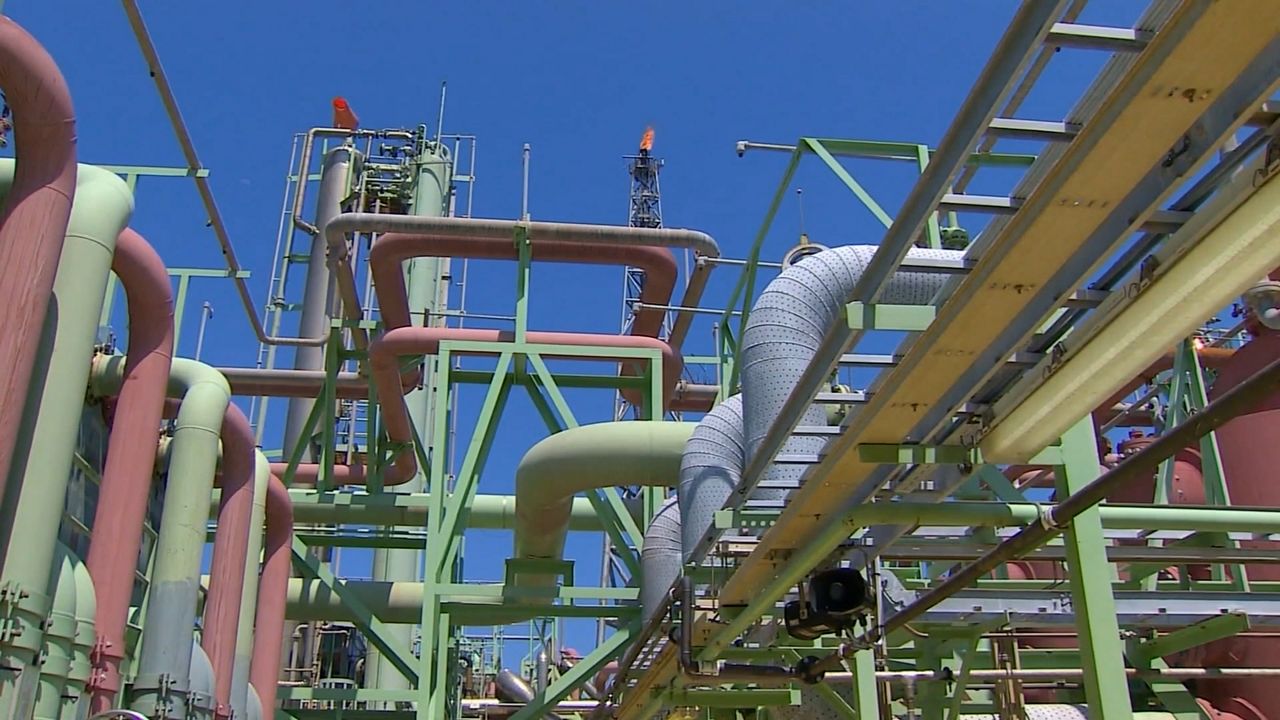
WASHINGTON, D.C. — As the Trump administration tries to steer the U.S. away from developing new renewable energy projects, the International Energy Agency predicts global demand for petroleum oil will continue to grow through 2050. Meanwhile the number of U.S. oil refineries has fallen by nearly half, from 254 in 1982 to 132 today.
Rep. Bob Latta, R-Ohio, who chairs the Energy Subcommittee of the House Energy and Commerce Committee, introduced legislation aimed at increasing oil refinery capacity. He said the U.S. needs more capacity to keep gasoline prices in check.
What You Need To Know
Rep. Bob Latta, R-Ohio, introduced legislation aimed at increasing petroleum oil refining capacity
Critics of the bill said it favored the fossil fuel industry
The International Energy Agency predicts that President Trump’s policy of de-emphasizing renewable energy sources will contribute to the world warming 1.5 degrees Celsius from pre-industrial temperatures within a decade
“For instance, right out in California they’re down about 13 refineries, and they used to have 40. They’re talking about taking two more that might be closing in California. You might have $7 a gallon gasoline,” Latta said.
The REFINER Act would require the National Petroleum Council to submit a report to Congress with recommendations for increasing refining capacity. The bill recently passed the House with the support of 205 Republicans and 25 Democrats, including Ohio Democrats Greg Landsman and Emilia Sykes.
Critics of the bill argued any report created by an industry group would be inherently biased.
“I know my Republican colleagues want to pretend that this is a simple, unbiased study bill, but it’s not,” Rep. Kathy Castor, D-Ohio, said in remarks on the House floor before the vote on Nov. 20. “The bill asks the National Petroleum Council, a council that is made up of members from the oil and gas industry, to create a report that says that the United States needs more oil and gas.”
Latta countered that refiners themselves have a better handle on how to improve their capacity.
“Who knows better the situation out there? The people who are actually refining it. You know, we don’t have that expertise,” Latta said.
At an Energy Subcommittee hearing Latta led Dec. 2, Democrats added that focusing energy policy on fossil fuels—such as oil—over renewable sources would weaken the country’s energy reliability. Republicans argued that fossil fuel energy sources are more reliable because they can generate power at any time, unlike some renewable sources like solar and wind.
The International Energy Agency predicts that President Donald Trump’s policy of de-emphasizing renewable energy sources will contribute to the world warming 1.5 degrees Celsius from pre-industrial temperatures within a decade. That would pass the target maximum set by the Paris climate agreement, from which the president announced in January that the U.S. will again withdraw.