
Electricity and gas prices for households will increase from January 2026, but the size of the rise will depend heavily on whether a household qualifies for the government’s energy-aid scheme (energopomoc). The regulator says that those receiving support will see only modest changes, while households without state assistance will face significantly higher bills.
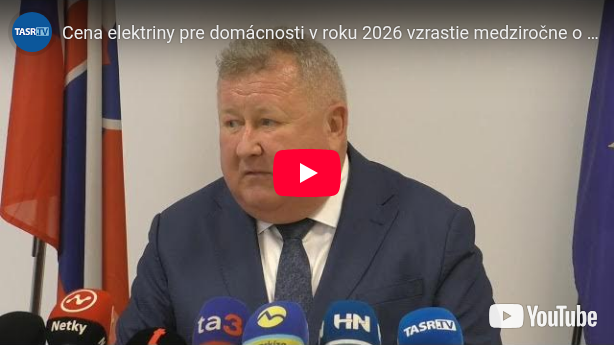
According to Jozef Holjenčík, head of Slovakia’s energy regulator ÚRSO, the cost of the electricity commodity on the market has risen sharply and is now trading anywhere between €100 and €405 per megawatt-hour (MWh). He said that without regulatory intervention, this would result in much higher bills for all households.
ÚRSO therefore adjusted distribution and transmission fees so that the price increase is softened for households with state support. Households without energopomoc, however, will pay the full market-based electricity price.
Different electricity prices for different households
The government has approved a price cap of €72.70/MWh for households that receive energy aid. This is higher than the current €61/MWh but still far below the expected market price.
For households without energopomoc, ÚRSO’s pricing decree assumes a much higher commodity price of €103.94/MWh, reflecting actual market conditions.
After all additional charges are included (such as distribution fees), the regulator estimates that:
Because an average Slovak household consumes around 2.2 MWh of electricity per year, this means a yearly difference of roughly €137 between subsidised and unsubsidised households.
Related article
Slovak households to receive energy aid also in 2026
Read more
How much more will households pay? (for those receiving aid)
ÚRSO estimates the following annual increases for 2026:
Tariff D1 (small flats, low consumption): +€47.21 per year
Tariff D2 (common for cooking and water heating): +€104.76 per year
Two-rate tariff for family houses with electric heating: +€67.53 per year
Households not receiving state aid will see higher increases because they must pay the market price for electricity.
Related article
Slovakia unveils new energy aid law – but critics fear ‘giant data hub’
Read more
Gas prices: biggest impact on households using gas for heating
Gas distribution charges remain almost unchanged. However, overall gas prices will rise for homes not covered by energopomoc. Households with aid will not see major increases.
Expected yearly increases for households without energopomoc:
Gas for cooking only (Tariff D1): +€12 per year
Cooking + water heating (Tariff D2): +€173 per year
Heating + cooking + hot water: +€360 per year
The final figure may still change because one part of the gas price — the fee for using the transmission network — has not yet been approved.
Heating and water: no major changes expected
ÚRSO rejected claims that heating or water prices would rise dramatically.
District heating prices should stay close to 2025 levels, with only a very small annual increase (around €4 on average). Actual heating costs will still depend on weather conditions.
Water and sewage prices are being adjusted for 14 water companies, mainly due to higher operating costs, including energy. A typical household may again see an increase of around €68 per year in 2026, similar to the rise seen in 2025. The regulator emphasised that these changes are not caused by the recently introduced two-part tariff, which combines a fixed fee with a fee based on consumption.