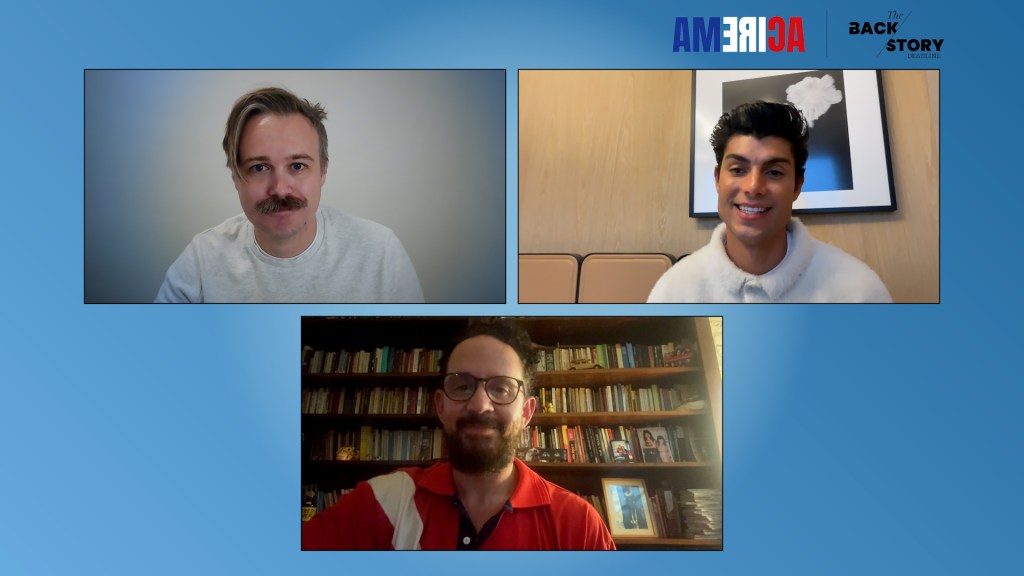
With their Oscar-contending live-action short America, Brazilian filmmaker Aly Muritiba and actor-producer Luca Castellani set out to portray the immigrant experience through an uncommon lens, exposing the vulnerabilities immigrants often carry as they placed their focus on a tragic love story.
The film follows Tom (Castellani), a Brazilian immigrant bartender who frequently slips away during his shifts to have sex with American men. Tom frames these encounters as a form of “ancestral vengeance,� in an articulation of the sense of frustrated powerlessness many immigrants feel. Yet beneath the bravado is a man who believes he’s unworthy of love — who feels deeply vulnerable, in a country where immigrants are too often profiled, targeted, and erased. Everything changes for Tom when he meets and falls in love with the all-American cowboy Josh (Cheyenne Jackson), even if their romance is doomed to end in tragedy, with one of his lovers — a police offer turned homicidal by jealousy — to blame.
For Muritiba, the project was born from conversations with Castellani about his experiences in the U.S., even if the film isn’t any kind of literal representation of them. Within days of their meeting, Castellani was sent a script and fell in love, seeing the project as a means of creating opportunity for himself, in an industry where opportunity is in short supply.
“Just to look at the big picture, we Latino actors represent 4% only of the total bookings in Hollywood for actors, total number of roles. So that’s a very small number. And I just thought, I can’t just sit at home and wait for somebody to cast me and be part of this small percentage of actors who are being cast,� Castellani says in an interview with Muritiba for Deadline’s The Backstory. “I could go and start to create opportunities for other Latino actors and create opportunities for myself.�
While Tom’s aforementioned sexual escapades in the restaurant bathroom could easily be misread, from Castellani’s perspective, they emerged from a painful truth. “I think when Tom was f*cking all those guys in the bathroom, it was the only place that he felt empowered. I don’t think he had any power there, but he thought so,� the actor says. “He thought he had power over those guys. He felt empowered, he felt like he mattered in a way. Because it was the only moment and the only place in his life where he had control over any situation.�
To the actor, Jackson’s Josh is the symbolic opposite of the police officer who [SPOILER ALERT] ends his life — who feels spurned by Tom when the bartender begins placing his full focus on his new lover. Josh represents the promise of America — and the responsibility of Americans at a time when the lives of immigrants are under threat. Castellani recalls a simple, profound moment in the film when Josh places his cowboy hat on Tom’s head. “It’s like he’s saying, ‘You belong here. I’ll protect you. My rights are your rights,’â€� he says.
Castellani continues, “It’s up to the American people now to take their hats and put [them onto] those immigrants’ heads and say, ‘I’ll protect you. I’ll stop ICE from doing all these atrocities that they are doing to attack immigrants. I’ll ask for due [process] because Americans have the voice, the power to do so.�
America was a big endeavor for Castellani, who had emotionally weighty material to work with in his first outing as a lead actor. The actor says that it was generosity on Jackson’s part that kept grounded him through scenes requiring total emotional surrender. His most difficult moment — a climactic final scene shot under severe time constraints — became a turning point. He had to fight hard for a second take, though eventually, he got it. And when Muritiba called cut, the entire crew cried, so raw was his performance.
Muritiba recalls telling Castellani afterward, “Congratulations, now you are a real actor.�
In reflecting on takeaways from the film, Castellani says, “I hope this film gets to teach people, especially [in] America right now with what’s going on, about tolerance, about unity, about what it means to love and to protect our community and our society. It shows very clearly that things can go really wrong, and it’s up to the American people. It’s up to Americans now to protect immigrants, and it’s up to Hollywood now to highlight those stories.�
View our full conversation with Muritiba and Castellani above.