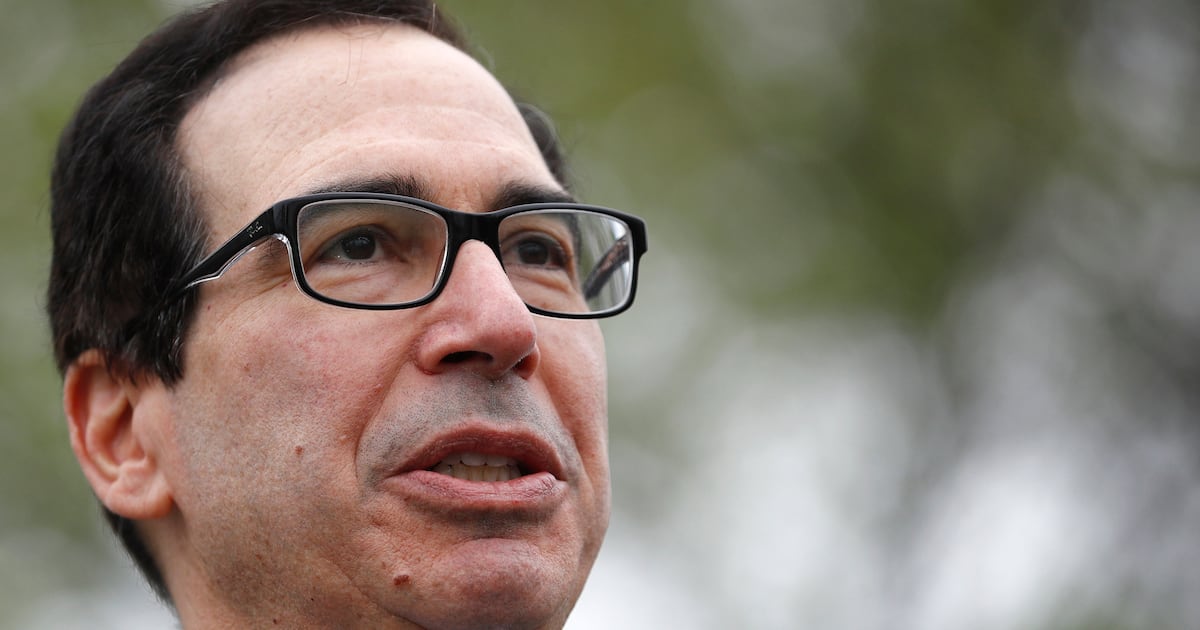
With the US Federal Reserve set to meet next week, America’s former treasury secretary has weighed in from Abu Dhabi, telling The National that the central bank failed post-pandemic to lower rates quickly enough.
“The Fed was late in raising rates [during Covid],” Steven Mnuchin said at the Milken Institute Middle East and Africa Summit.
“I think, because of that, they’ve been slow in lowering rates. I expect they’re going to lower rates again. I think the terminal rates are going to be between three and three and a half per cent, and I think we’re going to get there pretty quickly.”
The 12-member Federal Open Market Committee is set to meet on December 9 and 10 and is reportedly deeply split on the direction rates should take. Mr Mnuchin, like his former boss, US President Donald Trump, is critical of the Fed and its chairman, Jerome Powell.
“I think you go back to Covid, we needed to spend a lot of money, or I think we would have had a worldwide depression,” he told The National.
“But clearly, at the end of the first term, we should have stopped spending. And then the Democrats went out and spent several trillion dollars more … and the Fed was wrong.”
Despite his reservations, Mr Mnuchin remains upbeat about the direction of the US economy.
“I really do believe artificial intelligence is going to be transformational in everything we do,” he said. “I think there’s a very strong tailwind because of all the capex spending associated with AI and data centres and chips.”
But while not concerned about an AI bubble, he warned that not all tech companies will come out winners.
“I wouldn’t say I’m worried about a bubble,” he said. “I’m worried that the valuations in certain ways may be way too high, and I think particularly for companies that need to continue to raise cash, as I look at companies like Microsoft and Amazon and Google that throw off tremendous amounts of cash, they have to invest a lot of money in AI and data centres. I see a little bit of an arms race that, you know, there’s not going to be five or six different models at the end.”
Mr Mnuchin said he believes there are opportunities for economic growth in the Middle East.
“I think for the first time in a long time, you’re seeing the situation in Syria dramatically better. You’re seeing, hopefully, the situation in Lebanon get better, the situation in Gaza,” he said.
“I think you’re seeing a lot of really interesting things. And some of the larger economies, like Egypt and Saudi where you have very large populations, you’re really beginning to see economic growth.”
As Mr Trump’s first treasury secretary, Mr Mnuchin successfully led trade talks with China. Asked if he was worried about how that relationship has fared during the US President’s second administration, Mr Mnuchin said he sees America and China as very different economies with different challenges, particularly when it comes to the ageing Chinese population.
“Over the next 10 years, the Chinese population is going to shrink by hundreds of millions of people,” he said.
“As China shrinks its population, you’re going to have an ageing of the population and a real economic problem there paying the cost for the ageing. There was a time when people thought China is going to overtake the US as the largest economy, being the most powerful. I don’t see that occurring.”