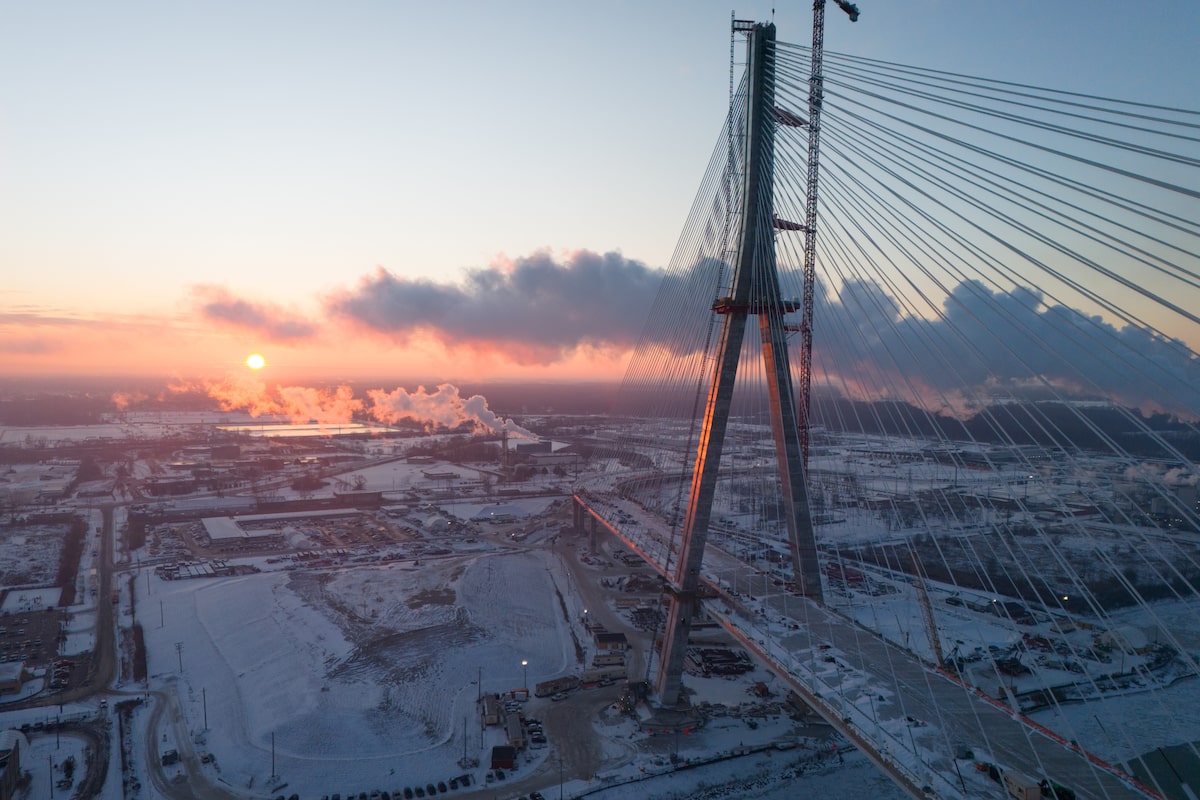
The Detroit side of the Gordie Howe International Bridge that will connect Windsor, Ont., and the Motor City, is pictured in January.IAN WILLMS/The New York Times News Service
The Gordie Howe International Bridge has been beset by construction delays and cost overruns. But now the reckless trade policies of U.S. President Donald Trump risk making it a bridge to nowhere.
Connecting Windsor, Ont., and Detroit, the 2.5-kilometre bridge – described as a “state-of-the art” border crossing between Canada and the United States – is finally expected to open in early 2026.
Although the exact date remains a mystery, it is inauspicious timing, especially for the Canadian government, which is footing the entire bill for the $6.4-billion project.
Drop in passenger and commercial traffic amid the Trump administration’s trade war with Canada, coupled with the threat of more American antics ahead of the USMCA review, will hurt Ottawa’s ability to recover the cost through tolls.
The promise of Windsor’s $6.4-billion Gordie Howe bridge to the U.S.
There is no denying that cross-border travel is in a slump.
Canadian-resident return trips by car tumbled by 30.5 per cent on a year-over-year basis in October, according to national data from Statistics Canada. The federal agency noted it was the 10th straight month of such declines.
U.S. resident trips to Canada by car, meanwhile, dipped by 0.7 per cent in October, registering the ninth straight month of year-over-year contractions.
Waning commercial traffic, though, was affecting Windsor-Detroit even before Mr. Trump’s return to the White House.
More than 2.2 million trucks used the Ambassador Bridge in 2024, down 11.14 per cent from 2023, according to the Bridge and Tunnel Operators Association.
Statistics for 2025 are not yet available, but it is evident that U.S. tariffs are harming the auto sector in Windsor and other Ontario cities.
A key economic benefit of the Gordie Howe International Bridge was supposed to be improved cross-border flows of auto parts, according to a 2021 report by the Cross-Border Institute at the University of Windsor.
So, is there a contingency plan to encourage the bridge’s use if trade tensions continue putting the brakes on traffic?
Neither the responsible federal department nor the Windsor-Detroit Bridge Authority, the Crown corporation in charge of the project, would say.
“Canada views the Gordie Howe International Bridge as a long-term, strategic investment that will drive trade and economic growth for decades,” said Caleb Spassov, a spokesman for Housing, Infrastructure and Communities Canada.
“While short-term conditions can fluctuate, we remain confident in the project’s long-term value and resilience of cross-border trade.”
Builders of Windsor’s Gordie Howe bridge are just metres away from scoring a key goal
WDBA deflected when asked if there are concerns about bilateral trade tensions depressing usage of the bridge.
“It would be inappropriate for WDBA to comment on overall Canada-U.S. relations,” director of communications Tara Carson said.
That leaves taxpayers guessing about the extent to which the project’s economics have been marred by the tariff chaos − another bitter pill to swallow after more than seven years of construction and rising costs.
The bridge’s toll rates, which have yet to be announced, will be based on vehicle classification, including height and number of axles, according to the WDBA. (There will be no tolls for users of the bridge’s pedestrian and bike path.)
Still, it would be helpful to know how they compare with those of the nearby Ambassador Bridge, which is raising both its commercial and auto toll rates on Jan. 1.
“The Gordie Howe International Bridge will operate under a user-pay model to ensure the long-term sustainability of the crossing, including recovery of Canada’s investment and funding ongoing operations and maintenance,” added Mr. Spassov, the federal department spokesman.
“This framework is central to ensuring that the bridge operates efficiently without increased costs to Canadian taxpayers.”
Canadian taxpayers, though, may still find themselves on the hook for other costs.
The Moroun family, the American billionaires who own the Ambassador Bridge, have launched a legal action against the Canadian government, arguing that it has the exclusive right to collect tolls in the area.
The allegations have not been tested in court, but a judge in the Ontario Superior Court of Justice ruled in October that the case should proceed to trial.
Canadians also have other reasons to worry ahead of the 2026 review of the U.S.-Mexico-Canada Agreement. The Globe and Mail reported Tuesday that the U.S. may announce its withdrawal from the trilateral deal as a bargaining tactic.
Such an outcome would further harm the financial prospects of the Gordie Howe International Bridge.
Canadians are owed transparency from Ottawa.
At a time when the Carney government is embarking on more major projects, taxpayers deserve clear answers on whether they risk losing money on this costly public investment.