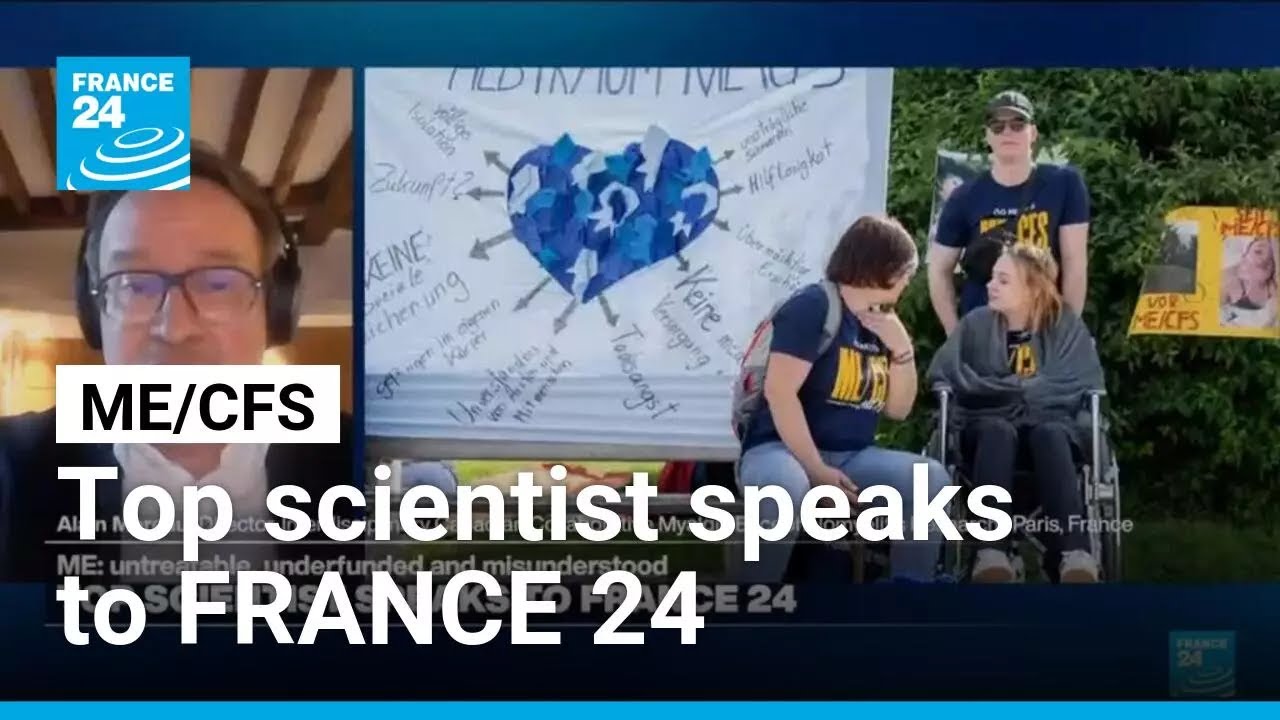
Unraveling chronic fatigue syndrome: Insights from top scientist on myalgic encephalomyelitis
Now let’s talk about myalgic and syphalomiolitis or me, also known as chronic chronic fatigue syndrome. Campaigners reckon the disease now affects more than half a million people in France. That’s because cases have shot up since the co 19 pandemic with long co one of the causes. Symptoms range from constant exhaustion to life-threatening debilitation. We’re joined now by one of the world experts in the field, Alan Morrow, director of the interdisciplinary Canadian collaborative Emmy research network. Thanks for speaking to France 24. Thank you very much for this opportunity. So if I’ve understood correctly, you have helped advance the science on this particularly with your work on the genetic signature of me. Just explain how that’s changed our understanding. Yes. And fact is more related to the epigenetics. So, so which is a bit slightly different than genetics. So, epigenetics means that there are alteration affecting the expression of genes but they are not caused by mutations or any variation in the it’s it’s due to different mechanism and we discovered a few years ago that circulating microRNA small non-cutting RNA uh are uh express a different signature in ME patient which allowed us to develop a the first diagnostic test that allow a repeat uh confirmation of a diagnosis of ME but also we are able now to trans to to discriminate who is suffering of ME versus other condition like fibomia and sometime and at least in 50% of the cases am patients also um display a fibrill measure as a coorbidity. So you may have both. So having having a clear diagnosis uh and diagnostic tools that can rapidly from a blood sample allowed such uh confirmation uh is a gamecher uh for clinician as well as for patient. So that will stop the medical events and and expedite the um the diagnosis and eventually will assist us in the way that we we can screen for therapeutic solutions. So the hope is that patients can now go and get a blood test and be diagnosed with me and they can tell people this is a disease I’ve got you know all of this about you just need to get off uh off the sofa and you know go for a bit of exercise. they can say no this is a diagnosed disease I’ve got and this is something that I’ll be suffering uh with for a long time ex exactly and and and and I want to be really straight uh me is a physical disease is not a somatic condition uh suffering of uh from different system from uh dystomia that will affect um your your vascular tone and and sometime some patient will develop which is very debilitating to sleep disturbance, immune disturbances as well as uh other effect that may affect also your neuroendocrine system. So it’s it’s a real disease and and we we can through our deep phenotyping protocol we are seeing changes affecting the brain like change in oxygen level the cognition so they have some memory issues that we can monitor especially when we introduce a provocation maneuvers that allowed us to create postal males which is the uh cardinal symptom of this condition. So these are the strides that you’ve made and the scientific community has made but what are the research priorities now what do we not know that we need to know? Yes. So first of all uh just on the clinical level or even if you look at the molecular disease the patients are not the same. So we we are seeing at least five subgroups of patients and and these groups are very important because they are associated with some some uh uh more predominant uh predominant symptom like there is a subgroup a cluster that is more associated with brain fog and another group with more let’s say uh endotel vascular dysfunction. So it’s important to recognize that at the early stage of the disease as possible because we we we can work more closely with clinicians and figure out solution often at this stage right now to reposition or repropose existing drugs that go indication. Whatever your version of me though you must get very frustrated if you’re a patient where you hear that the main treatment at the moment is just to try and manage your energy levels. Yeah. And see this is uh often referred to pacing. So so pacing is a very effective way to to protect your energetic envelope but you have to make choice. So if you wants to go to the restaurant with friends even if if it’s a just short diner you you may stop all your activities before and after for a week for a week. So, so it’s not a long-term solution really. So, so that’s why it’s important to to to to really use what I call precision medicine and and adopt for the right patient at the right time the right drugs that can really target a specific mechanism. And we have though we have done those step recently uh especially this year with with some recent publications that we identify some other biomarkers that are probably the causal factors and and and we can modulate those factor and that should long-term uh prevent crashes. So what we need right now is to find additional partners from the private sectors to to uh support us to translate the diagnostic panel from the bench to the clinics. And this is an extra step needs additional funding and we need to have expert in in in in in the adoption of clinical uh diagnostic tests uh as well as to lo a new clinical trial but not blindly just using precision medicine principle where we we can I think have have a better success to to uh bring something useful for many patients. Okay. Adam Morrow, thank you so much for speaking here on France 24. That’s one of the top experts in the world on the disease me.
Myalgic encephalomyelitis (ME), also known as chronic fatigue syndrome, affects over 500,000 people in France, with cases rising significantly since the Covid-19 pandemic. Alain Moreau is one of the world’s top scientists on the question. The director of the interdisciplinary Canadian collaborative myalgic encephalomyelitis research discusses advancements in research, including the genetic signature of ME, current research priorities, and the gap between scientific understanding and public perception.
#health #scientist #ME
🔔 Subscribe to France 24 now: https://f24.my/YTen
🔴 LIVE – Watch FRANCE 24 English 24/7 here: https://f24.my/YTliveEN
🌍 Read the latest International News and Top Stories: https://www.france24.com/en/
Like us on Facebook: https://f24.my/FBen
Follow us on X: https://f24.my/Xen
Bluesky: https://f24.my/BSen and Threads: https://f24.my/THen
Browse the news in pictures on Instagram: https://f24.my/IGen
Discover our TikTok videos: https://f24.my/TKen
Get the latest top stories on Telegram: https://f24.my/TGen
2 comments
The Internet and all Internet communication companies operate in the United States of America and under the laws of the United States of America. I have been robbed on the Internet. So the United States of America government should pay for all my losses. This is the reason for my repetition: I only want my money and other related items. The Internet Center and the United Nations Center for Human Rights are on the territory of the United States of America. I will only keep quiet by taking my property from the United States of America between 2004 and 2025. I do not know anything else. My location and my identity on the Internet are completely known. The blocking of my Google account or other accounts is not a reason for me to lie. Google and Microsoft and Yahoo and Meta and Twitter and X are lying. I only want my money. As soon as I receive it, I will go to the best courts, with all the evidence I have.
Yes i appreciate that they are talking about the syndrome that has been provoked to me by the romanian doctors intentionally but what am i going to do now? Thursday i have received the envelope from ECHR and they have rejected my last lawsuit. That was my last hope to save myself and my unborn children. My father was killed, i don't have an income. Where am i going to treat myself? Here in Romania the doctors would probably try to kill me if i go to them…
Comments are closed.