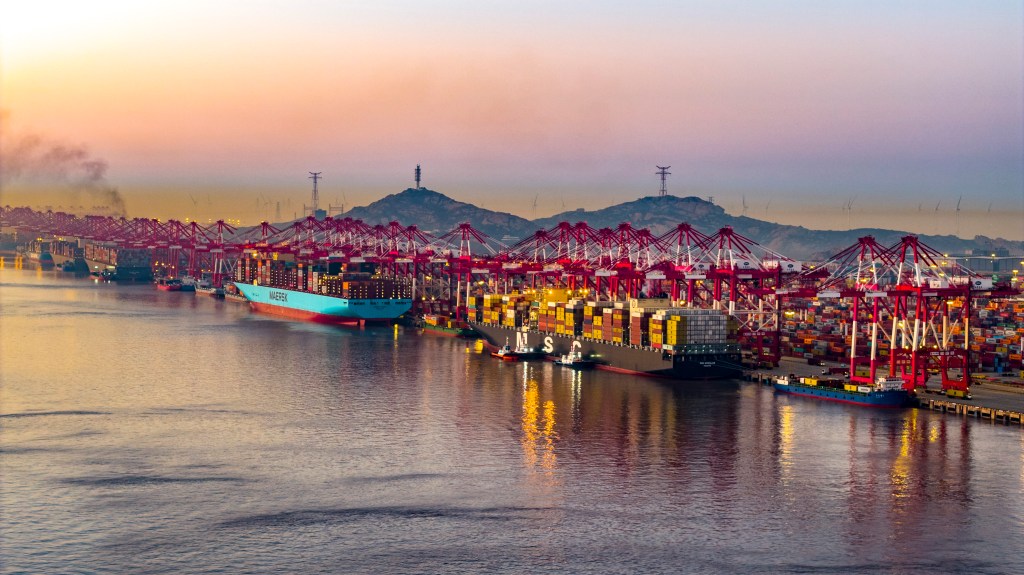
A trade war with the U.S. did not stop China’s biggest ports from setting records for container handling in 2025—all with one month still in play.
The two top port complexes in the country, the Port of Shanghai and the Port of Ningbo-Zhoushan, set annual volume records after just 11 months, topping a combined 90 million in 20-foot equivalent units (TEUs).
The Port of Shanghai handled its 50 millionth TEU on Nov. 26, a full 26 days earlier than it did in 2024, according to a statement from the gateway. With the milestone, the port is on pace to rank first in global container throughput for the 16th consecutive year. In 2024, the Chinese port handled more than 51.5 million TEUs, well outpacing the 41.1 million TEUs that went through the second-busiest seaport, the Port of Singapore.
The Shanghai port did not break out exact numbers for November, and has not given a projection for December, or for the full year. The port said container throughput exceeded 46 million TEUs in the first 10 months of the year, a 6.5 percent jump from 2024 numbers. That would put estimated November container movement within the range of 4 million TEUs.
In a statement, port operator Shanghai International Port Group, Ltd. attributed the growth to “moving beyond standalone equipment automation” toward a new stage of “intelligent collaboration” throughout the port’s wider ecosystem.
“With deep application of cutting-edge technologies (e.g., F5G, digital twins, and high-precision positioning), remote operation, unmanned transport and intelligent scheduling have become routine, marking a fundamental shift from ‘human-controlled’ to ‘AI-controlled’ practice,” the operator said in a statement. “This smart transformation, powered by homegrown technologies, not only drives breakthroughs in terminal efficiency but also showcases China’s fully autonomous and reliable port-technology capabilities to the rest of the world.”
This year, the Port of Shanghai has added 12 new international routes, covering 50 major ports worldwide, while increasing shipping transshipment efficiency by 22 percent.
As for the Port of Ningbo-Zhoushan, 2025 was a banner year as well, with the seaport seeing throughput surpass 40 million for the first time on Tuesday.
According to port owner Zhejiang Seaport Group, the Ningbo-Zhoushan gateway’s operations have accelerated from an annual 30 million TEUs in just four years.
“The port started relatively late in container operations, but it has developed very rapidly,” Tao Chengbo, chairman of Zhejiang Seaport Group, said in the statement.
For November, container throughput increased nearly 11 percent to 4.5 million TEUs over the year-ago month.
Both ports are deepening their collaboration with each other amid the external trade tensions. The Shanghai and Ningbo-Zhoushan ports generated 18 percent year-over-year growth in annual throughput for cargo passing between both gateways, according to a report from Hong Kong-based publication Bastille Post Global.
The high growth numbers at Shanghai and Ningbo-Zhoushan come amid expectations of a monthly rebound in exports out of China. Outbound shipments in November were expected to have risen by 3.8 percent by value from the year prior, according to the median forecast of 20 economists in a Reuters poll.
This follows a surprise 1.1 percent export decline for October, in which China dealt with not only its usual year-over-year double-digit dips in cargo headed for the U.S., but weakening strength from other partners like the E.U., the Association of Southeast Asian Nations (ASEAN) and Africa, among others.
As for imports entering China, inbound cargo is forecast by the Reuters poll to increase 2.8 percent, up from the paltry 1 percent year-over-year gain the month earlier.
With China expected to reveal official customs data in the coming days, eyes are also on freight rates that have spiked for cargo exiting the country over the past week.
According to data from Drewry’s World Container Index (WCI), spot ocean freight rates rose 7 percent to $1,927 per 40-foot container after three weeks of decline, mainly due to rate hikes on trans-Pacific and Asia-to-Europe trade routes.
Spot rates from Shanghai to Los Angeles climbed 8 percent to $2,256 per container, while those to New York rose 6 percent to $2,895 on average. And to Europe, spot rates on ships sailing to Genoa increased 15 percent to $2,648 per box, while rates from Shanghai to Rotterdam edged up 4 percent to $2,241.
“Some carriers have adopted a weekly strategy for GRIs. Instead of announcing large hikes that tend to erode quickly, carriers are now introducing smaller, more frequent increases to maintain consistent upwards pressure on spot rates,” said Drewry in a Thursday update, calling the weekly GRI strategy for U.S.-bound cargo “effective.” The container shipping consultancy expects stable rates in the week ahead.