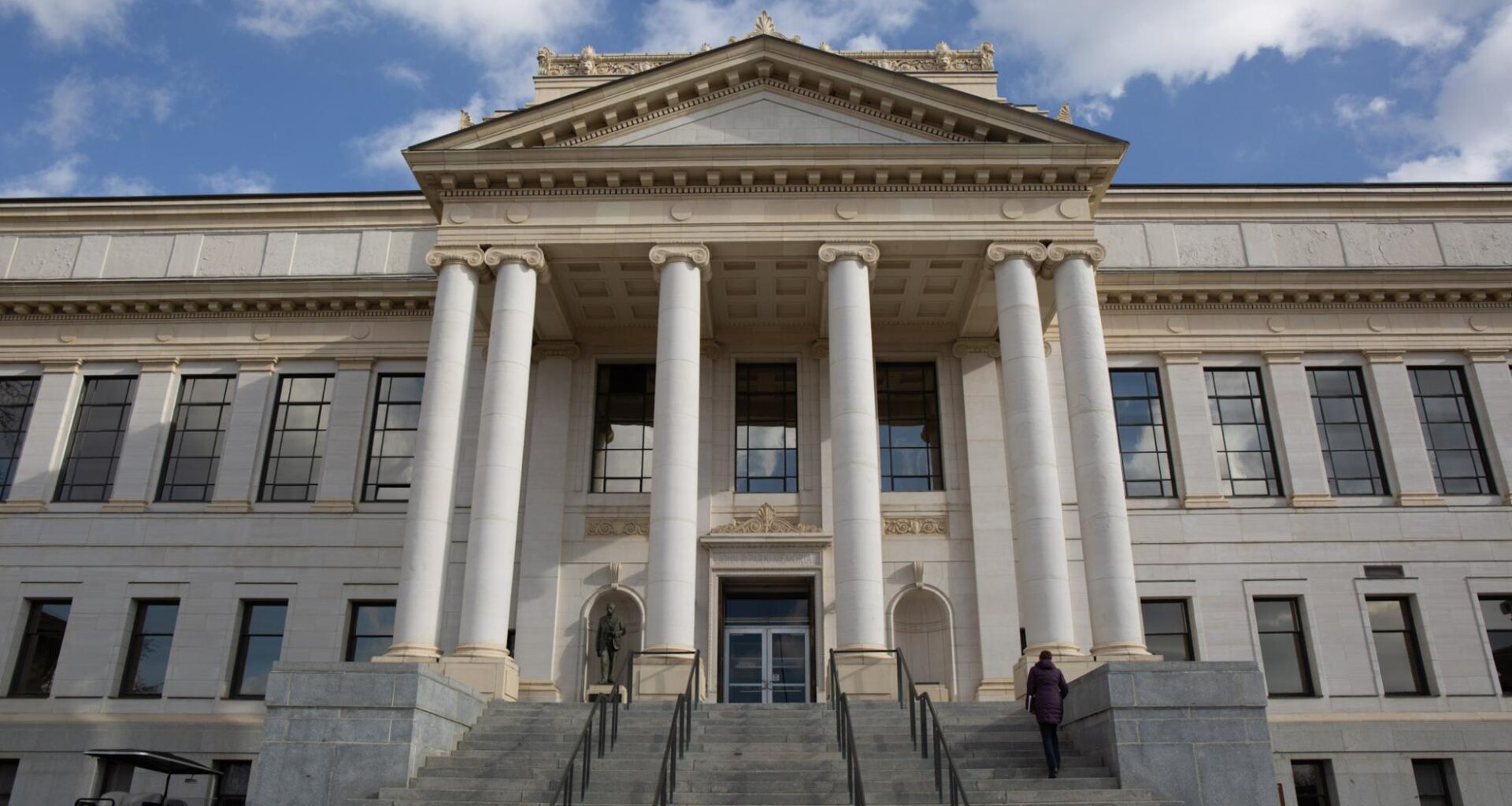
Faculty at the University of Utah say that political pressure and administrative decision making have raised concerns about “fear of speaking out,” leading to what some describe as growing uncertainty in the relationship between faculty and university administration.
In interviews across multiple departments, faculty have said that legislative pressure, a “top-down” administration and limited opportunities for input on university decision-making have shaped campus climate. Administrators have previously said that they must balance feedback from campus constituencies with expectations from state leaders and governing bodies.
However, faculty members who spoke with The Chronicle say that these dynamics left some feeling consultation is inconsistent or irrelevant, and that speaking openly about academic changes could come with risks to their jobs.
“That’s why I’m here talking, as opposed to some of our members,” Carlos Martinez, the president of the United Campus Workers Union (UCW), said. “A lot of people have concerns they want to talk about, but don’t feel confident that if they were to speak out, there wouldn’t be some form of retaliation by their administrators.”
Political pressure and campus climate
Faculty and administrators say that the current campus climate cannot be understood without examining political relations with the state legislature.
“There’s seemingly a lot of political pressure that the university and the administration is under, and that creates a real sense of uncertainty for people,” Martinez said. “They do not want to express themselves in such a way that would get the ire of administration, because administration is so anxious about broader political pressure.”
Martinez says that this growing political pressure “creates a situation that pits administration against their own faculty, grad students and workforce,” as administrators respond to “political operatives who are looking at any opportunity to create political controversy.”
Martinez pointed to the university’s response in the April 2024 pro-Palestine protest as one example. “The anxiety that they were feeling, knowing that these broader political forces demanded that they respond and respond swiftly, made them respond in a very heavy-handed way that hurt a lot of their own students and workforce,” he said.
Other faculty members allege that the U is now closer with the state legislature than with its own faculty. “I think it exacerbates a problem in which administrators are closer to the Utah State Board of Education and closer to legislators than they are to their own faculty members,” Jay Jordan, professor of writing and rhetoric studies, told The Chronicle.
Craig Dworkin, an English professor at the U, told The Chronicle that the legislature’s role in daily functions is a point of concern for faculty. “The legislature and the [Utah System of Higher Education (USHE)] in the administration are more intrusive in the everyday pedagogic activities of faculty,” he said.
Academic Senate President Richard Preiss said that administration must be “conscious” when balancing university affairs and external interests. “It’s one of the roles of university administration to negotiate with the legislature and to be sort of legislative-facing,” he said. “If the idea of higher education that the legislature has is antithetical to the idea that faculty have, it’s very tough to face both of those two constituencies at the same time.”
Priess said that he believes that there is “a lot of behind-the-scenes work to mitigate the damage of a lot of this legislation.” He maintained that, despite faculty criticism, “it’s often a case of ‘it could be worse.’”
Preiss pointed to a recent decision by the Utah Board of Higher Education (UBHE) to increase teaching loads at the U and Utah State University for faculty that are not on tenure track, from nine credits per semester to 12.
According to Preiss, UBHE voted for the change “without discussion,” although there might have been private discussions between USHE and the institutions he is not aware of. “Nonetheless, we have to obey the law. And so now we have to find a way to raise the workload of … career-line faculty who are already doing more teaching,” he said.
Limits of existing feedback systems
Some, like Distinguished Professor of English Katharine Coles, say that recent initiatives to get faculty feedback — such as listening sessions to address faculty concerns or the campus-wide BetterU survey — seem “largely performative,” even though President Taylor is “committed to preserving shared governance.”
“I wouldn’t say the purpose of all these memos, meetings and questionnaires is to waste faculty time, but aside from PR that has been their only visible function,” Coles said in a statement to The Chronicle. “Meanwhile, the staff added to do this work makes the administration even more top-heavy and expensive.”
This BetterU survey, which is already implemented at the university hospital, asked employees questions about experience and support. However, while the survey is anonymous, some sources said the results were sent to department chairs, making their responses not completely confidential.
“I understand the concerns that faculty would have — really any employee would have — about filling out a survey like this, because it seems very broad,” Preiss said. “And in an environment where there’s distrust between employees and management, you might be tempted to feel like it was an exercise in corporate surveillance. I don’t think that’s what it is. I think it’s a very broad instrument, and it’s attempting to do a good thing.”
He said the administration has a right to act in the university’s best interests, but if they use feedback systems, they should also be “prepared to show the data” that show they have “consulted with the population that it’s trying to serve.” And if the administration hasn’t done that, he said, “then students and faculty have a right to be upset.”
Others, like Jordan, said that staff are worried their concerns won’t be taken seriously. “[These surveys] feel like very superficial opportunities to elicit feedback that are just not credible to faculty members,” he said.
“And what’s unfortunate about that is that the more faculty members might feel like ‘it’s not worth my time to do this,’ the more administrators can potentially say, ‘well, obviously they don’t have a problem because they’re not even bothering to do this,’” Jordan said.
Preiss agreed, saying that faculty should not avoid the survey. “I understand the skepticism and I understand some of the concern around it. But, if people avoid it for that reason … the skepticism becomes its own self-fulfilling prophecy. Because you refuse, everybody boycotts the survey, and then [the administration] points to the fact that nothing came of the survey as they see.”
Jordan also referenced a “Coffee, Cocoa and Tea” discussion session that Provost Mitzi Montoya hosted for faculty to express their concerns about legislation. According to Jordan, Montoya left early.
“These Coffee and Cocoa meetings [were], ‘come meet me and tell me what’s on your mind,’ and there were several of us who went. It was planned for an hour and she left after about 15 minutes because she apparently had a conflict,” he said. “So, why bother?”
Preiss said from his experience, listening sessions are not widely supported among faculty. “There was a widely shared sense that feedback was not incorporated in a meaningful way or in a timely way,” he said. “It was also a question of timing, that a lot of these listening sessions were taking place after concrete proposals were already announced and on the table.”
While the intentions are good, some responsibility for faculty trust does fall to the administration, Preiss said. “I think if you are going to hold sessions like that, then you need to be able to demonstrate concrete ways that feedback has been taken up into the decision-making process. It sort of commits you to do it.”
Others, like Chapman Waters, a career-line professor of philosophy, said that he found some listening sessions “helpful at the time.” One about increased credit hours, he said, “was less of a listening session and more about us asking questions, a session where they’re helping clarify things.”
In a later interview, Waters said that particular listening session was less helpful than he originally had thought. “It was helpful in the sense that they did clarify things. But it seems like it’s going to be harder to make [the process] equitable than we originally thought,” he said.
Communication barriers and faculty fear
Micah Rollins, a database analyst for Graduate Admissions, said that certain feedback systems exist more to appease faculty rather than to consider their opinions in the decision-making process. He said that when the colleges of Humanities and Transform merged, Provost Montoya’s office held a “mock vote to create the illusion of legitimacy” for the decision.
Preiss participated in the vote as a member of the College of Humanities, and as Senate President, oversaw the passage of the merger — which was nearly unanimous with zero votes against and only one abstention — through the Senate. Overall, he said he saw “strong support” from both Humanities and Transform faculty, and that “the faculty vote constitutes the decision.”
Conversely, Dworkin said the university described the merger to the public as a faculty-approved decision, when he saw the merger as a “fait accompli” by the time faculty could vote, in part due to legislative pressures. “It doesn’t seem like a full characterization of what actually happened,” he said.
Dworkin added that some university leaders do not speak to faculty as “intellectuals,” but rather with the assumption that faculty will “just passively accept anything we’re told, even if it’s a misrepresentation, even if we know it’s not true.”
Rollins explained how university workers have been “lied to” about the nature of many large decisions, such as mergers and shared services.
“I have learned from this administration that anytime they send out a memo saying they’re not going to do something, it does, in fact, mean they’re planning to do it as soon as they find an opportunity,” he said. “If I got a memo from them that said, ‘Hey, we’re not going to fire anybody,’ I would feel the opposite of confidence.”
Dworkin mentioned the “resignation” of Dr. Hollis Robbins as among the alleged lies the administration has told faculty. “We were told that the dean had just [decided to quit mid-semester],” he said. “We were told that the provost couldn’t possibly explain anything more when, in fact, the provost was the one who had forced her out.”
He also referenced the February Academic Senate meeting, when President Taylor Randall used S.B. 290 and the word “jurisdiction” to halt discussion of former faculty member Michael Vershinin’s resignation.
“What’s most distressing about all of this is the kind of standards that we revere in our scholarship and our teaching,” Dworkin said. “If I just made up the definition of a word in an article, I would be rebuked. If I mischaracterized an event in the way that these events have been mischaracterized in my scholarship, that scholarship would come under attack.”
According to Preiss, many of the administration’s contentious decisions were influenced by legislative demands. “[The university is] attempting to create a lot of change rapidly, and that is always going to create friction. It’s always going to create fear,” he said.
However, he said, people must be willing to advocate for themselves in the Academic Senate. “[Faculty] not only marginalize themselves, but also they make me less effective because I don’t have a sense of what’s animating faculty right now.”
Rollins said that the administration’s legislative constraints are often instrumentalized to make decisions in a top-down manner. “They’re using [funding cuts] as a boogeyman that they can use to force anyone that they want into whatever financial constraints that they want to,” he said.
He added that threats of budget cuts started with less-populated majors, but spread to all departments of the university. “Over the last year, year and a half, it’s been fascinating to watch that same sort of fear grow from those populations that I think were initially seen as more vulnerable and easier targets to spread wider across campus.”
Rollins attributed the communication issues to an attempt to “silo” faculty and “pit colleges against each other” to make events seem isolated.
“If I have a problem with Provost Montoya, then maybe me and her just happen to not get along,” he said. “But if I know that I have a problem, and Physics has this problem, and English has this problem, and Ethnic Studies has this problem, then we start to realize that the problem is not any of us — the problem is with the way that administration is poorly managing the university.”
Waters said that although he believes the administration is fighting for faculty on a legislative level, the lack of transparency is causing skepticism. “Nobody trusts them because they’re exercising the power of the people above them in ways that aren’t good for anyone,” he said.
“They won’t sit down and talk to us and listen to us about these sorts of things,” Waters said. “There are all these decisions where it’s like, this is for your good. They keep telling the students, ‘We’re doing this for your success. We’re doing this to protect you.’ And at a certain point it’s insulting, like ‘Thanks, mommy and daddy.’ You’re protecting us, but you won’t talk to us.”
In a later interview, Waters said a central issue is the uncertainty around the administration’s reasoning and how proposed changes are supposed to pan out. “For instance, when they say the schedule changes are about student success, what they’re saying is true,” he said. “It’s just that what they mean by ‘student success’ doesn’t actually resonate with anybody.”
Shared governance under strain
In a letter to President Randall, the Academic Senate wrote that while they acknowledge the “commitment” to shared governance the administration has shown so far, they have “concerns about the limits and visibility of that commitment.” According to Preiss, the administration is currently working on issuing a formal response.
Christie Toth, an associate professor of writing and rhetoric studies, said that between “limiting” state legislation and how the “institution has taken [it] up,” faculty have “concerns” about shared governance. “There’s been a series of events in the Academic Senate … where faculty have expressed concerns about potential for retaliation in a climate where faculty’s shared governance is under attack,” Toth said.
Shared governance, according to the American Association of University Professors (AAUP), is “the joint responsibility of faculty, administrations, and governing boards to govern colleges and universities.” The union states the “weight of each group’s voice” on issues should only differ based on their experience and responsibility for the matter.
Dworkin said that the prevalence of shared governance on campus has diminished over the years. “What has, I think, changed recently is how uninterested the current administration seems about even speaking with faculty, much less consulting them,” he said. “And I’m thinking of things like the fact that the president has office hours set aside for students, but no time for faculty.”
A recent success of shared governance, according to Preiss, was how the university communicated recent changes to Policy 6-100, a policy that governs scheduling, courses and requirements at the U.
“[Policy 6-100] is a thorough and open and transparent process that has been not just receptive to feedback, but showing how that feedback has been incorporated,” he said. “And I think that, if the university followed that example on everything, it would be fantastic. It doesn’t, and I’m not going to make excuses for why it doesn’t.”
Preiss said that much of the faculty discontent stems from the university’s lack of transparency when making decisions. If communication doesn’t improve, he added, it will only “encourage an antagonistic relationship” between faculty and the administration.
“I think that they are generally acting in the best long-term interests of the university and its research and teaching missions,” Preiss said. “I think they could do and could always do a better job of communicating that, because in the absence of good communication, people will form theories of their own.”
University of Utah administration did not reply for comment.