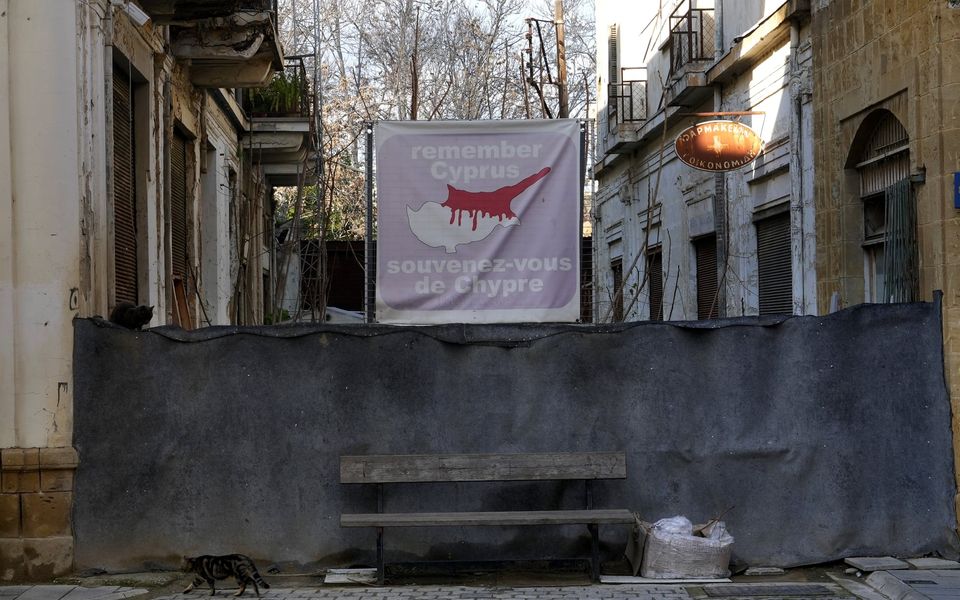
A banner showing the island in division, across the UN buffer zone that divides the Greek- (south) and Turkish-Cypriot (north) controlled areas, in the divided capital Nicosia, Cyprus, on February 2, 2024. [PETROS KARADJIAS/AP]
A treaty can be broken not by words but by permanence – a pact meant to preserve Cyprus’ independence became, in a guarantor’s hands, its undoing. The Treaty of Guarantee was clear in purpose: Britain, Greece and Turkey pledged to ensure the independence, territorial integrity and constitutional order of Cyprus. Each renounced any right to annex or partition the island, and Article IV, which Turkey invokes, permitted unilateral action only to restore lawful order. What happened in 1974 did the opposite. The junta’s coup lasted days; the occupation has lasted 51 years.
Turkey’s military presence is not a right but a breach – a state cannot be both guarantor and destroyer of a constitution, a matter now of law for Europe to uphold. The north of the island – the occupied territories – shows what happens when international law is treated as a menu, not a mandate.
UN Resolutions 541 and 550 declared the so-called “Turkish Republic of Northern Cyprus” – the pseudostate – legally invalid, urged non-recognition and demanded withdrawal. The European Court of Human Rights, in Loizidou and Cyprus vs Turkey, found Turkey exercises effective control and bears responsibility. These binding judicial determinations affirm what the Vienna Convention codifies in Article 60: A material breach allows suspension or termination. Ex injuria jus non oritur – Turkey cannot remain guarantor of an order it destroyed.
Britain’s role matters. In 1974 London held the right, obligation and capacity to act but chose not to. The decision spared a NATO clash but stripped the treaty of credibility. Since then Britain has maintained sovereign bases at Akrotiri and Dhekelia under a separate treaty for military use. Half a century on, as the Union faces a new security reality, a question resurfaces: Can bases on EU soil remain detached from the duty to defend it?
Since 2004 Cyprus has been an EU member-state, and its territory – including the occupied north – is EU territory under suspension of the acquis. Protocol No 10 and the Apostolides vs Orams ruling make this explicit. Cypriot rights and sovereignty are the EU’s. Under Articles 42(7) and 222, aid and solidarity are legal duties. The guarantee has therefore shifted to the Union.
Swift to defend Ukraine, Europe remains a spectator when it comes to Cyprus – proof its response depends less on principle than proximity. If the Union believes its legal order is indivisible, it must treat the buffer zone in Nicosia as seriously as the border in Narva.
Europe’s non-signatory status under the 1960 treaties collapses. The Union has already acted in the Eastern Mediterranean through its Common Foreign and Security Policy, adopting a sanctions framework in 2019 against unauthorized drilling in Cypriot waters. The framework can extend to property appropriation and Varosha; the law exists, only the will is missing. Precedents abound: Russia violated the Budapest Memorandum; Indonesia’s occupation of East Timor met UN non-recognition until independence. States that breach guarantees lose standing; Cyprus deserves no less.
The remedy is not another conference but a redefinition of responsibility: The European Council should affirm that Turkey’s breach ends its guarantor status and that the EU, through Cyprus’ membership, now bears the legal and political duty to safeguard the island’s independence and integrity. This is not a call to arms but to coherence.
In practice, that means expanding the EU sanctions regime to target those enabling administration of the occupied areas; enforcing Cypriot court rulings across the Union; embedding Cyprus’ defense needs within the EU’s Security and Defense Policy; and supporting the UN with measures in Varosha and along the Green Line. These steps require consistency – the currency Europe claims to trade in.
History has delivered that responsibility, and the 1960 pledge, to Europe. A guarantee is not an heirloom; it is a promise renewed by action or dissolved by neglect. In 1960 three powers pledged to preserve Cyprus’ independence. One stood aside, one betrayed, and one – after a brief fall – reclaimed its faith in that promise. Sixty-five years later, Europe carries that promise forward. To honor it is to prove Europe still knows how to defend its own.
Shay Gal is an expert in international politics, crisis management and strategic communications. He advises governments and institutions on power relations, geopolitical strategy and public diplomacy, examining how these forces shape policy and decision-making.