In Korea’s shipbuilding hubs, debate over foreign labor masks long-ignored structural problems
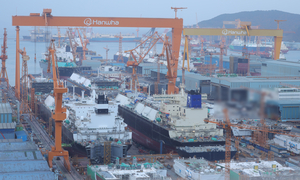
 Hanwha Ocean shipyard in Geoje, South Gyeongsang Province (Yonhap)
Local leaders in Korea’s major shipyard districts are pushing to curb the inflow of foreign workers, arguing that the rapid rise in migrant labor is straining local communities even as shipbuilders accelerate hiring to meet swelling order backlogs.
They say the influx has not led to greater local settlement or spending. At the same time, critics counter that the deeper issue is the shipyard industry’s long-standing reliance on low wages and subcontracted labor — conditions most Korean workers now shun.
Tensions escalated after Ulsan’s Dong-gu Mayor Kim Jong-hoon said some residents felt “as if they are living in Southeast Asia,” a remark widely criticized as fueling antimigrant sentiment in a district where roughly 10,000 of its 150,000 residents are foreigners, a proportion projected to grow.
Although he apologized, Kim continued to question Ulsan City’s approach as Dong-gu — home to HD Hyundai Heavy Industries — experiences a steep rise in the number of foreign workers amid a labor shortage.
Under a new “metropolitan visa” pilot program, Ulsan is bringing in overseas-trained shipyard workers.
“(The program) should be reexamined from the ground up, including whether it might be hindering job opportunities for Korean youth,” he said during a press conference on Dec. 1.
In Geoje, South Gyeongsang Province, where Hanwha Ocean and Samsung Heavy Industries operate large shipyards, Mayor Byun Gwang-yong has likewise asked Labor Minister Kim Young-hoon to lower the E-7 visa quota, which currently permits skilled foreign nationals to make up 30 percent of the workforce.
Their concerns come as national and municipal authorities expand foreign-worker recruitment to ease chronic labor shortages. Ulsan plans to admit 440 skilled foreign workers to HD Hyundai shipyards over the next two years, and the central government raised the E-7 ceiling from 20 percent to 30 percent in 2022.
As a result, foreign populations in shipbuilding hubs have soared. Foreign nationals now account for roughly 25 percent of Korea’s shipyard workforce, according to Jung Heung-jun of Seoul National University of Science and Technology.
Despite a strong industry recovery since 2021, local leaders say rising foreign-worker numbers have not translated into stronger regional economies.
Unemployment remains above the national average — over 5 percent in Dong-gu and more than 3 percent in Geoje. Both districts also face high commercial vacancy rates and population declines nearly four times the national pace.
Residents also say many foreign workers spend little locally, as much of their income is sent home. Experts note that even skilled E-7 workers have limited disposable income because of low base wages, deductions for housing and meals, and sizable brokerage fees.
“Many pay about 10 million won just to come to Korea,” Jung of Seoul National University said. “That leaves very little to spend in the community.”
Officials in Seoul and Ulsan say foreign labor remains necessary because Koreans are increasingly unwilling to take shipyard jobs.
Despite high joblessness in shipbuilding regions, the sector posted a 14.7 percent job-vacancy rate in the first half of 2024, nearly double that of other industries, due to low wages, harsh conditions and pervasive subcontracting.
Labor activists warn that focusing on foreign workers distracts from these structural issues. “Regardless of nationality, the local economy cannot recover if workers don’t earn enough to spend here,” said Lee Kim Chun-taek of a local shipbuilding union.
Experts argue that improving job quality, stabilizing employment and creating conditions for long-term settlement must take priority over expanding visa quotas.
“Subcontracting and low wages discourage Koreans from staying, while foreign workers face short-term stays and depressed conditions,” Jung said. “This weakens not only the local economy but also the accumulation of skilled labor, posing long-term risks to the future of Korea’s shipbuilding industry.”
forestjs@heraldcorp.com