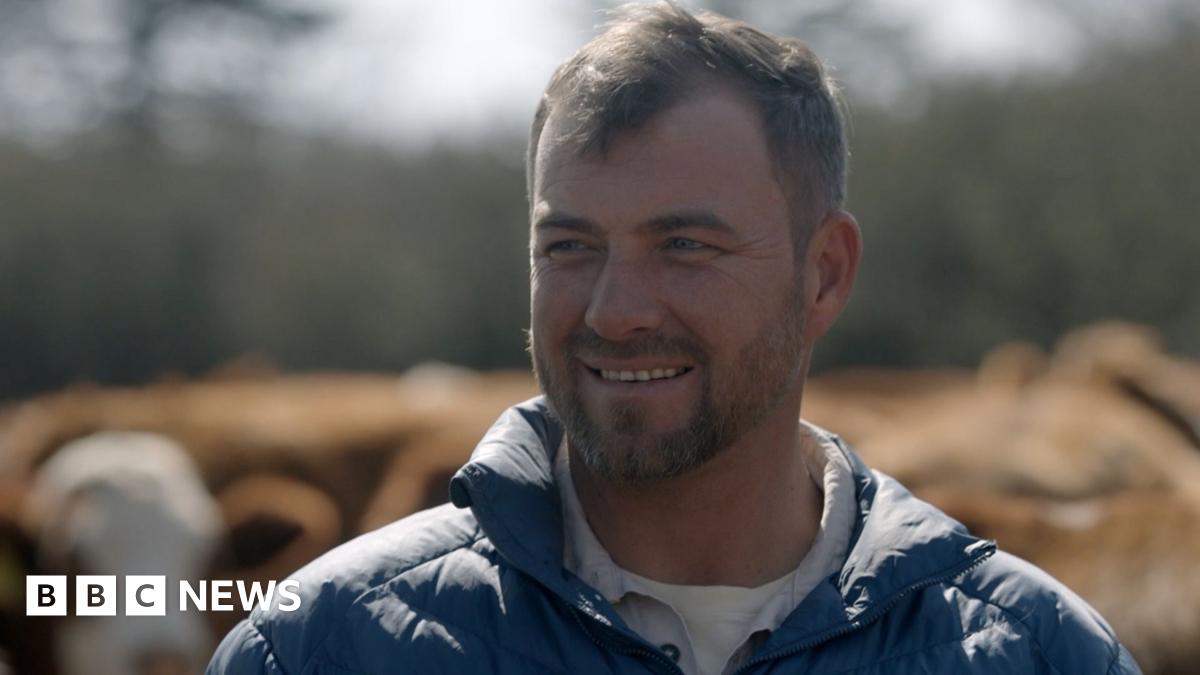
Many farmers, like Morgan Barrett, who is white, employ their own security guards, if they can afford it. He owns a 2,000-acre farm which has been in his family for six generations.
Wrapped up in a thick jacket and hat, he climbs into his car to begin a night patrol. Between Morgan and his neighbours, they are out almost every night. Six of his cattle were stolen the previous week.
“You can call the police, and they may turn up two or three hours later, by which time the thieves will have run away,” he says.
Like Thabo, he doesn’t believe he is targeted because of the colour of his skin.
“I don’t buy that narrative that in this area the attacks are against whites only.”
“If they thought that the black guy had 20,000 rand ($1,200; £880) sitting in his safe, they’d attack him just as quickly as they’d attack the white guy with 20,000 [rand] in the safe.”
Asked about what he thinks of people claiming there is a “white genocide” in South Africa, he says he thinks they “have no real understanding of what a genocide is”.
“What happened in Rwanda is genocide. What is happening to white farmers is very bad, but I don’t think you can call it genocide.”
Trump has repeated the widely disputed claims there is a genocide against white farmers, while South African-born billionaire Elon Musk, has accused South African politicians of “actively promoting” a genocide.
The government here has vehemently denied that Afrikaners and other white South Africans are being persecuted.
The country does not release crime figures based on race, but in May, in order to debunk these claims, Police Minister Senzo Mchunu gave a breakdown of killings on farms.
Mchunu said that between October 2024 and March 2025, there were 18 farm murders across South Africa. Sixteen of the victims were black, while two were white.
Despite these statistics, the theory that white people are being persecuted for their race, once an idea confined to far-right groups in South Africa, continues to be propelled into the mainstream.
Systematic racial persecution is something black people in South Africa, who make up more than 80% of the population, faced for decades.
Under the apartheid system that lasted for 46 years from 1948, the white-minority government legally separated people based on the colour of their skin.
It built on already existing discriminatory legislation.
The right to vote, buy land and work in skilled jobs was reserved for white people. Millions of black South Africans were removed from their land and forced to live in segregated neighbourhoods where education in schools was restricted to maintain racial hierarchy.
The regime was enforced through violence and repression.
Even though apartheid ended in 1994, the profound racial inequalities continue to exist more than 30 years later.
The post-apartheid government did introduce affirmative action policies to try and redress some of the issues, but these have been criticised by some for not being effective and introducing “race quotas”.
Nevertheless, 72% of private farmland is still in white hands, according to the government’s 2017 Land Audit report. That’s despite white people making up just 7.3% of the population.
A land reform programme – based on the principle of willing-seller willing-buyer – has hardly moved the dial. A new law this year does give the state the power to expropriate some privately owned land without compensation for owners, but this is only in rare circumstances, according to legal experts who spoke to the BBC.
And while white farmers own more private land than any other group in the country, victims of farm attacks span across all races.
The political spotlight is on white farmers, yet crime and violence on the ground is indiscriminate.