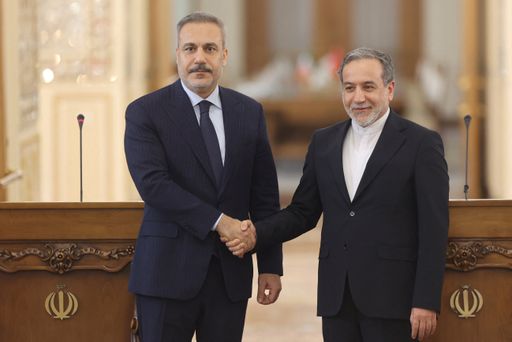
Given Israel’s aggressive actions since the December 8 revolution in Syria and Lebanon, it seems that both Türkiye and Iran are moving toward a more cautious and balancing approach in dealing with Israel’s expansionist policies.
This is especially relevant since Israel carried out its first airstrike on Beirut since the November 27, 2024, Lebanon ceasefire, a worrying development in a volatile region.
In the same week as the visit, Israel reportedly prepared a new military operation in southern Lebanon and Syria.
Additionally, on November 25, Israel simulated an airstrike on Iran’s western region by violating Iraq’s airspace, prompting Iran to carry out its own defence drills.
The US also warned that Iraqi, Iranian-backed militia groups should stay out of any Israeli attacks on Hezbollah in Lebanon.
Despite ceasefire agreements in Lebanon and Gaza, Israel’s continued aggressive behaviour, sovereignty violations, and territorial expansions remain major sources of instability in the region.
These developments are important to consider in the context of this visit.
On a positive note, both sides agreed on the importance of continuing the ceasefire in Gaza, with Türkiye playing a mediator role, and moving to the next phase.
Araghchi also reiterated that Syria’s stability is tied to its territorial integrity, and that Israel remains the biggest threat to this goal.
Chronic regional security challenges
Beyond the Israeli issue, both countries also face chronic security challenges, particularly from terrorist organisations and irregular migration.
Türkiye has started implementing its “terror-free Türkiye” initiative, with the PKK announcing that it has laid down its weapons and disbanded.
However, the presence of terrorist organisations across borders remains a pressing issue, and the region must be cleared of such groups.
In this regard, Araghchi expressed Iran’s support for Türkiye’s efforts to rid the country of terrorism, which is significant in terms of bilateral counterterrorism cooperation.
Similarly, both countries have also discussed how to jointly address the security issues arising from irregular migration, especially from Afghanistan, which has added another layer to their security cooperation.
Despite various disputes over regional matters like Syria, Iraq, and the Zangezur Corridor, Fidan’s visit to Tehran shows that Türkiye and Iran are taking a careful and balanced approach to common security threats.
Both countries are increasingly focusing on areas of shared interest, like energy, connectivity, and transport, while trying to de-escalate tensions in more contentious areas.
Related
In this regard, both Türkiye and Iran, facing shared and urgent security threats, have shown a tendency to separate contentious issues from areas like energy, connectivity, and transport, instead focusing on shared interests to strengthen regional cooperation.
This approach is helping both nations manage the regional competition, particularly after the 2020 Karabakh Victory.
Türkiye’s efforts to build a relationship model with Iran are part of its broader strategy to integrate all regional players into a restructured security framework without excluding or antagonising any countries.
Interestingly, on the day of Fidan’s visit, it was also reported that Saudi Arabia’s deputy foreign minister was in Iran.
This points to a larger trend of regional countries working together to overcome mutual mistrust and build a more integrated and balanced security framework.