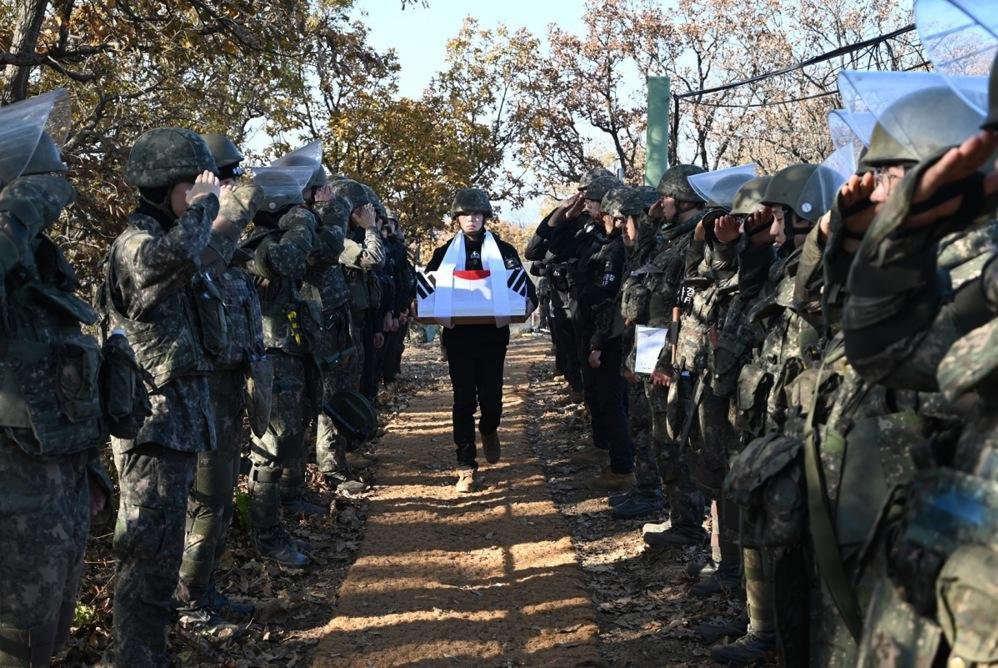
A soldier carries a South Korean flag-draped boxes containing the excavated remains of South Korean soldiers killed in the 1950-53 Korean War at White Horse Ridge in Cheorwon, Gangwon Province, South Korea. Photo by Ministry of National Defense, Republic of Korea/EPA
SEOUL, Dec. 8 (UPI) — The Korean War is often called a “forgotten war.” But anyone who has walked the fog-covered ridges of the Demilitarized Zone knows that it is not forgotten at all. It is quite literally beneath their feet.
On Dec. 1, South Korea’s Ministry of National Defense announced that it had recovered the remains of 25 soldiers and 1,962 personal effects from White Horse Ridge (Baengma-goji), a fiercely contested hill in the central DMZ.
The latest excavation, carried out from mid-October to late November, involved about 100 South Korean troops and personnel from United Nations Command member states. North Korea, despite agreeing in 2018 to conduct joint recoveries, again declined to participate.
White Horse Ridge (Hill 395) is no ordinary battlefield. For nine days in October 1952, elements of the Republic of Korea’s 9th Infantry Division and U.N. forces fought wave after wave of Chinese assaults there.
Official accounts record roughly 500 South Korean soldiers killed, more than 2,500 wounded and nearly 400 missing. Chinese deaths exceeded 8,000. The bombardment was so intense that the hill’s elevation is said to have dropped, its bare slopes resembling a fallen white horse — the image that gave the ridge its modern name.
Given that history, it is hardly surprising that the soil continues to yield the dead. An excavation in 2021 uncovered 67 sets of remains and more than 15,000 artifacts. Much more remains buried there, belonging to all sides of the conflict.
The human toll of the Korean War still defies comprehension. South Korea estimates that nearly 138,000 of its soldiers were killed, more than 450,000 wounded and tens of thousands went missing or were taken prisoner. U.N. forces lost roughly 38,000 troops. Many never received a burial.
In 2000, on the war’s 50th anniversary, the South Korean Army launched a major effort to locate and recover the fallen. Public support was strong enough that the government made the mission permanent in 2005 and established a dedicated excavation unit two years later.
By the end of 2022, more than 13,000 sets of remains had been recovered: 11,313 South Korean, 32 U.N., 773 North Korean and 1,003 Chinese. Yet, the work is growing harder. Development has altered many battlefields; family records are incomplete; DNA matching remains time-consuming and often inconclusive.
Still, returning the dead, identified or not, is a defining obligation of any state that claims to value human dignity.
This is a principle deeply embedded in the world’s advanced democracies. The United States has built a national ethos around recovering missing service members. The POW/MIA flag bears the words “You Are Not Forgotten,” and the teams tasked with this mission operate under an ethic often summarized as “until they are home.”
Britain and France likewise treat the sacrifice of their soldiers as a permanent moral debt — a national trust that must be honored across generations.
Seen against these standards, North Korea’s stance on remains recovery looks painfully backward. The regime agreed on paper to joint excavations in the DMZ, yet it has not taken part in a single operation.
Its behavior stands in stark contrast to the practices of countries like the United States, Britain and France, where honoring those who died in uniform is treated as a basic test of national character. A government that truly respected its fallen would naturally join in the excavation work it already endorsed, rather than leaving others to search alone.
Had North Korea worked alongside South Korean teams, far more of its own war dead would likely have been found. Estimates of North Korean military fatalities during the Korean War vary, but they are generally in the hundreds of thousands, with some studies placing the figure on the high end of that range.
Yet, South Korea has recovered and confirmed just 773 North Korean remains from its territory. South Korean teams, like their American counterparts, pursue the remains of the fallen regardless of former allegiance, acting from a sense of shared humanity rather than ideology.
This history shadows today’s efforts to reopen inter-Korean dialogue. On Tuesday, President Lee Jae Myung, speaking at the inaugural meeting of the 22nd National Unification Advisory Council, called for restoring communication lines frozen for seven years.
He connected easing military tensions, ending the war state and establishing a nuclear-free peninsula to transforming “Korea risk” into a “Korea premium” through peaceful co-existence and shared growth.
This was not his first appeal. In June, on the 25th anniversary of the June 15, 2000, Joint Declaration, he urged reviving the channels created by that accord — the hotlines, ministerial talks and military meetings that once helped prevent accidental clashes. Most have withered under Kim Jong Un, even as North Korea accelerates its nuclear and missile programs.
Rebuilding what was already agreed upon may be the most practical place to begin. Joint recovery of war remains would not solve nuclear tensions, but it would honor the dead, create a rare space for humanitarian cooperation and establish working-level habits of trust that political leaders could later build upon.
White Horse Ridge offers a concrete starting point. This year’s excavation season has ended; winter has hardened the ground. Work will resume in the spring. When it does, North Korea should finally honor its pledge and join South Korean and U.N. teams on the ridge.
The DMZ is often described as a scar of permanent division. It could instead become a symbol of shared responsibility — for history, for truth and for the individuals whose bones still lie beneath its minefields and wild grasses.
More than 70 years after artillery remade Hill 395, the Korean Peninsula remains technically at war. If it was right in 1952 to risk everything for comrades, it is right today to bring those comrades home, no matter how many years have passed and no matter which flag they once saluted.
If it was right then, it is right now.
Nohsok Choi is the former chief editor of the Kyunghyang Shinmun and former Paris correspondent. He currently serves as president of the Kyunghyang Shinmun Alumni Association, president of the Korean Media & Culture Forum, and CEO of the YouTube channel One World TV.