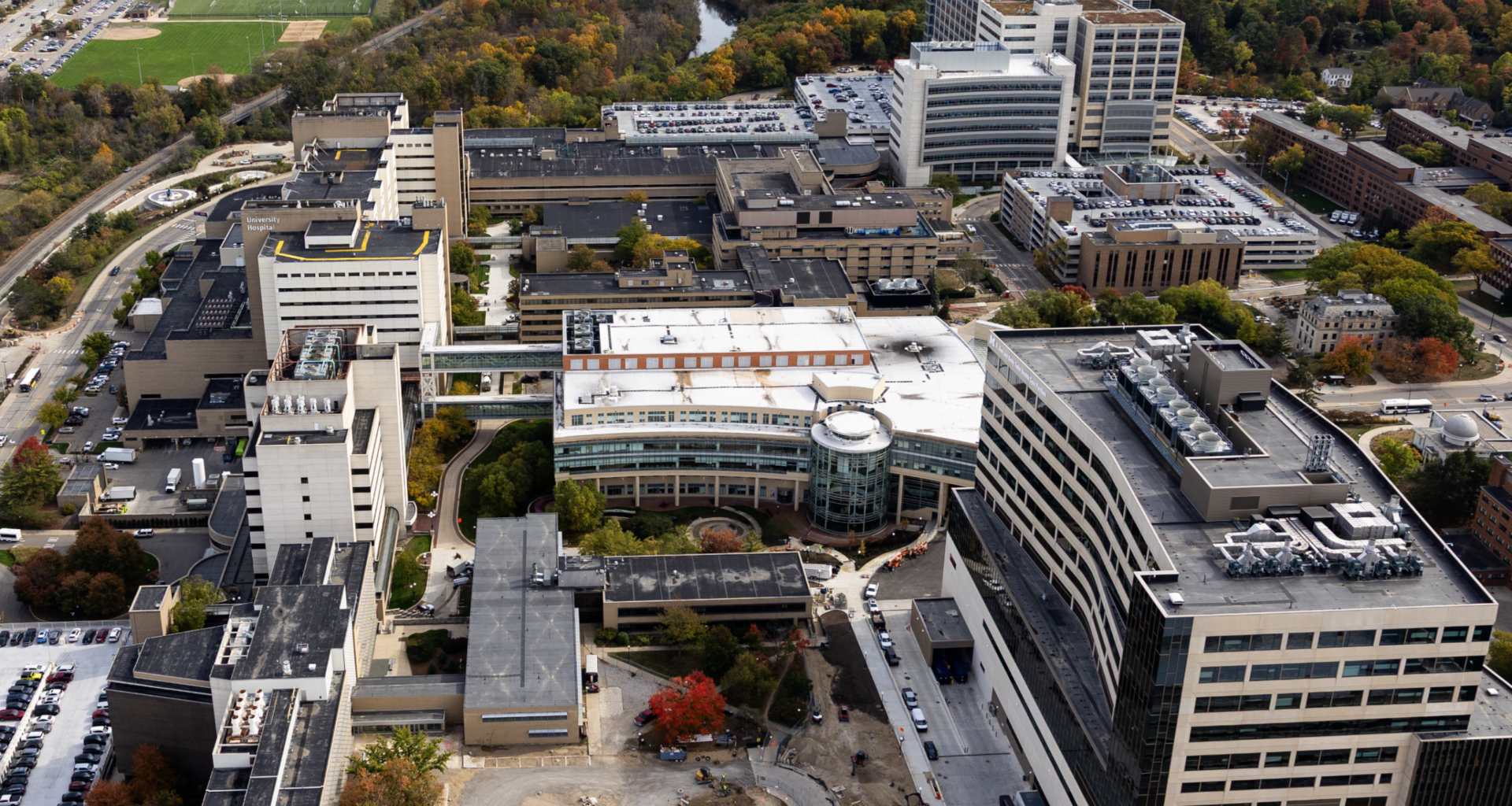
After more than a decade of planning and construction, Michigan Medicine celebrated the grand opening of the D. Dan and Betty Kahn Health Care Pavilion on Nov. 12. Patients started receiving care on Nov. 23, and the pavilion’s operating rooms are scheduled to open on Dec. 8. The $920 million facility, which has 12 stories and holds 264 inpatient beds, was named in honor of established philanthropists D. Dan and Betty Kahn.
Michigan Medicine previously experienced consistently high occupancy in adult inpatient units, with a backlog of patients needing to be transferred from hospitals without high-acuity care and overcrowding in the emergency department.
In an email to The Michigan Daily, Tony Denton, Michigan Medicine senior vice president and chief environmental, social and governance officer, wrote the pavilion was constructed to address the hospital system’s various needs and serve Michigan’s aging population.
“With a rise in the age of the population, we forecasted that patient demands were only going to increase, with more individuals requiring the complex care expertise that our clinical teams provide, particularly in neuroscience and cardiovascular care,” Denton wrote.
Denton wrote the Michigan Medicine team hired about 1,000 new health care workers and other vital hospital staff to support the opening of the pavilion.
“Our plan to build a new inpatient facility was aligned with a parallel track to recruit new staff to complement existing team members to allow the opening of the Pavilion,” Denton wrote. “Given the high demand for healthcare workers, which are in short supply, it was essential to plan early to ensure timely recruitment and hiring of additional employees to optimize the use of the new hospital.”
On Nov. 23, Michigan Medicine leadership and staff transported 186 adult patients from the University Hospital to be the first patients treated within the new pavilion. In an interview with The Daily, Linda Larin, chief operating officer of adult hospitals, said the transfer required multiple practice rounds by the Specialized Workforce for Acute Transport team to ensure the physical transition went smoothly.
“The exact people (moving the patients) did dry runs over multiple weeks,” Larin said. “The first dry run, everyone pointed out what worked, what didn’t work, what needed to be fixed. We did a second dry run where they evaluated that, so that they were completely ready. When they did the actual move, it went so smoothly and it was actually finished ahead of schedule.”
Larin said welcoming new patients into the hospital was incredibly rewarding for all pavilion staff.
“It was magical; it was wonderful,” Larin said. “We had David Miller, who is our executive vice president of medical affairs and CEO, and a whole group of leaders who stood at the intersection in the tunnel for every patient coming through.”
Denton wrote the patient rooms in the pavilion differ from those in other units throughout Michigan Medicine as each one can be converted into an intensive care space as needed.
“Our inpatient rooms are ‘acuity adaptable’ and enable ‘universal care’, allowing for patients to stay in the same room as their conditions change,” Denton wrote. “We have the technology and staffing that permits changing the room’s capability from general to intensive care without having to move the patient.”
Larin said the patient rooms are larger and include adjustable sleep sofas for families who require extended stay — accommodations made with family-centered care in mind.
“It really supports family members,” Larin said. “There are family showers, there are laundry facilities for people who need to stay a long time. The comfort of supporting a family is really important.”
With this new introduction, the University Hospital increased capacity for inpatient adult services, but will continue to undergo additional renovations in the near future.
In an interview with The Daily, Nursing freshman Amari Lemon said the pavilion exemplifies Michigan Medicine’s commitment to excellence and patient-centered care.
“It’s really showing the world that we are willing to do what it takes to innovate,” Lemon said. “To not only produce good health care workers, but also good research and therefore promote patient care.”
Daily Staff Reporter Patricia Leoncio can be reached at pleoncio@umich.edu.
Related articles