 Image modified with AI.
The world is drowning in data. Every day, YouTube alone uploads 20 million new videos. That’s in addition to the selfies, emails, 8K videos and Zoom calls. We’re straining the physical limits of the semiconductors industry, and we’re starting to reach the limits of scaling. But there could be an unlikely solution: the building blocks of life itself, DNA.
DNA is dense, durable, and efficient. For years, researchers have proposed it as an alternative to current storage methods. But DNA has a big problem — it’s hard to retrieve information from it. Now, a team of researchers in Shenzhen, China, may have found a solution for that problem.
They built a cassette tape of DNA big enough to store every song ever recorded.
The Ultimate Mix-Tape
In traditional DNA storage, all the data is mixed together. That’s why it’s so hard to retrieve it. To read one piece of information, you have to sequence the whole thing or use expensive chemical tags to fish it out.
Study authors Jiankai Li and Xingyu Jiang gave a nostalgic nod to the 1980s. Their DNA cassette tape system uses a long spool of polyester-nylon composite membrane that uses microscopic “barcodes” printed directly onto the fabric. When the tape spins, a laser reads the barcodes at high speed, and when it finds the right “address” (the file or information you want to access), it stops. A mechanical head presses down, squirts a tiny bit of liquid into that specific spot, and recovers the DNA.
The entire thing is wrapped in “crystal armor” made of zeolitic imidazolate, a class of metal-organic frameworks (MOFs) that prevents the DNA bonds from breaking down.
But while a traditional cassette could hold 20-24 songs, a cassette with 100 meters of DNA tape could hold over 3 billion songs, equivalent to 36,000 terabytes.
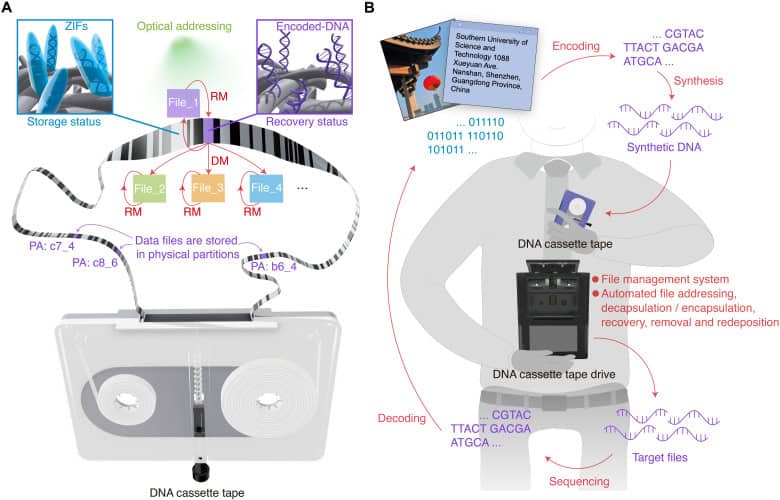 Using barcode patterns for optical file addressing and thereby creating physical partitions on DNA tape. Image from the study.
Read, Write, Rewrite
The team also solved an additional problem. They build a fully automated drive (funny enough, also about the size of a standard casette player) that can manage files. This “file management system” handles the complex chemistry. It can write and rewrite data on the DNA.
One of the biggest hurdles for DNA storage has been the “Write-Once” problem. Usually, once you synthesize the DNA, it’s there forever. If you want to change a file, you have to throw it out and start over. This tape supports a feature the researchers call “DMRM”—Deposit, Many-Recover-Many. You can read a file, remove it, and write a new one in the exact same physical spot. This works by dissolving the Zeolitic Imidazolate framework to delete the file and then re-coating the DNA again after the file is rewritten.
 DNA cassette tape and DNA tape drive held in hands. Scale bar, 5 cm. Image from the study.
As exciting as this storage is, there’s one big problem researchers aren’t close to solving: speed. The speed of DNA storage is still very slow compared to silicon, so DNA won’t replace your laptop’s SSD just yet.
This technology is aiming for “cold storage,” the data you don’t need every day but can’t afford to lose. Family archives, government records, and scientific data need to last longer than a hard drive’s 5-to-10-year lifespan. This is also a big problem because current hardware storage isn’t as durable as you might think.
With the ZIF protective coating, this DNA tape is incredibly resilient. The study suggests that if stored at room temperature, your data remains safe for over 300 years. If you bury it in a cold environment, like inside a mountain, it could last for over 20,000 years.
To solve our digital storage problems, we may just need to look back to biology.
The study was published in the journal Science Advances.