How one programme in Ethiopia is turning refugees’ legal right to work into real livelihoods through evidence-based policy, streamlined systems, and local partnerships.
Key TakeawaysFrom dependence to self-reliance. Ethiopia hosts one of the largest refugee populations in the world, and while the country has taken important steps to give refugees the legal right to work, most still struggle to turn that right into real jobs or businesses. Our project shows that giving work permits is not only about paperwork, but also about helping refugees move from long-term dependence toward self-reliance.Legal rights alone are not enough. Ethiopia’s progressive legal reforms give refugees the right to work, but major administrative and structural barriers persist. Without practical implementation, these rights remain largely symbolic.Refugees want to work, but access remains limited. Baseline data shows overwhelming demand for work permits and business licenses, yet only a small minority of refugees currently hold them. Most employment remains informal, with significant gender gaps.Linking policy to practice. Through a large-scale RCT and close partnership with government, the project is testing what works, building delivery systems, and generating evidence to scale economic inclusion for refugees across Ethiopia and beyond
Why This Matters Now
Over 43 million people were living as refugees at the end of 2024, according to UNHCR. Nearly three quarters reside in low‑ and middle‑income countries, and the majority remain displaced for a decade or longer. In that time, many are legally barred from working. The result is a double loss: refugees are trapped in dependence on shrinking aid budgets, while host economies miss out on productivity, taxes, and entrepreneurship.
Ethiopia hosts over one million refugees, primarily from South Sudan, Somalia, Eritrea, and Sudan: among the largest populations globally and the second largest in Africa. The Government of Ethiopia has committed to a model that turns legal reform into real livelihoods by expanding refugees’ right to work. This project shows how research and policy can work together to make that promise concrete.
From Law on Paper to Livelihoods in Practice
Since 2017, Ethiopia has implemented the UN‑backed Comprehensive Refugee Response Framework (CRRF) and introduced a modern legal regime that recognises refugees’ right to work, culminating most recently in Directive No. 1019/2024. In practice, the legal framework provides for three pathways to economic integration: wage employment, self‑employment, and joint programmes (with development partners).
Operationalising this legal framework requires a complex delivery chain with coordination across various government entities: residence permits from the Refugees and Returnees Service (RRS), work permits via RRS and the Ministry of Labor and Skills (MoLS), and business licenses with local Bureaus of Trade and Regional Integration.
Refugees are also integrated into Ethiopia’s new national ID system “Fayda”, which we also study in our related work with the Oxford Digital Public Infrastructure Research Lab (OxDPI). Moreover, awareness among refugees of their rights is uneven, documentation can be hard to obtain, and procedures remain unfamiliar for local offices. Our project works with the involved government agencies to streamline processes, fix bottlenecks, facilitate procedure to obtain the necessary documents, and close the last-mile delivery gap.
Research-Policy Partnership Built for Action
“We deeply appreciate the partnership we have and would like to take this opportunity to sincerely thank the study team for your unwavering support”.
RRS Deputy Director General Mulualem Desta
In addition to working with our government partners and the World Bank on the processes to operationalise the right to work, our research team from the University of Oxford’s Oxford Martin School and the London School of Economics and Political Science (LSE) is studying the impact that operationalising the right to work has on refugees. More specifically, we ask: How do work permits and business licenses affect employment, earnings, and well‑being of refugees? For whom do they work best, and why?
To do so, we are running a large, multi‑site randomised controlled trial (RCT) in four refugee camps: Bambasi, Sherkole, Tsore (Benishangul‑Gumuz) and Sheder (Somali Region). Eligible refugee households are participating in a lottery that offers a support package that helps them obtain work permits and business licenses.
The package includes:
• Clear information on work rights and obligations
• Hands‑on help to secure the required documents
• Navigation of application procedures for work permits or business licenses
• Coverage of associated administrative fees
The intervention is co‑designed with RRS so that protocols, forms, and training can be adopted nationwide. It complements existing RRS outreach, builds local administrative capacity, and is designed for scalability. The human subject research methods are not just reviewed by standard academic IRBs, but also by a local ad hoc expert committee.

©
Image shows Future of Development director at a workshop with our Ethiopian partners
Insights & Early Outcomes
Even before the first permits are issued, a few early insights and outcomes stand out:
Demand is overwhelming: From our baseline survey, 99% of refugees in Benishangul‑Gumuz and 90% in the Somali Region want both work permits and business licenses. Legal pathways are not just symbolic; they are wanted and will be used.Information gaps are binding: Many refugees confuse residence IDs with work permits, while some are unsure about tax obligations or fear unintended consequences. Well‑targeted information campaigns are essential complements to reform.Formalisation protects livelihoods: As one refugee entrepreneur in Sheder told us:
“Before obtaining my licence, I was fined thirty thousand birr for selling cement without permission. After getting my licence with RRS’s help, I’m now running my business legally without problems.” Legal recognition not only protects livelihoods but also fosters dignity and stability.Legal reforms alone are not enough: They must be paired with robust awareness campaigns, streamlined administrative processes, and continued engagement with host and local communities to address concerns and promote shared benefits.
These findings sit alongside encouraging signs on the host side. A local administrator reflected:
“Allowing refugees to work outside the camp could create substantial advantages for the local economy, more trade and more jobs.”
At the same time, concerns about fairness are real. Ensuring that licensed businesses pay taxes and follow the same rules as everyone else supports social cohesion.

©
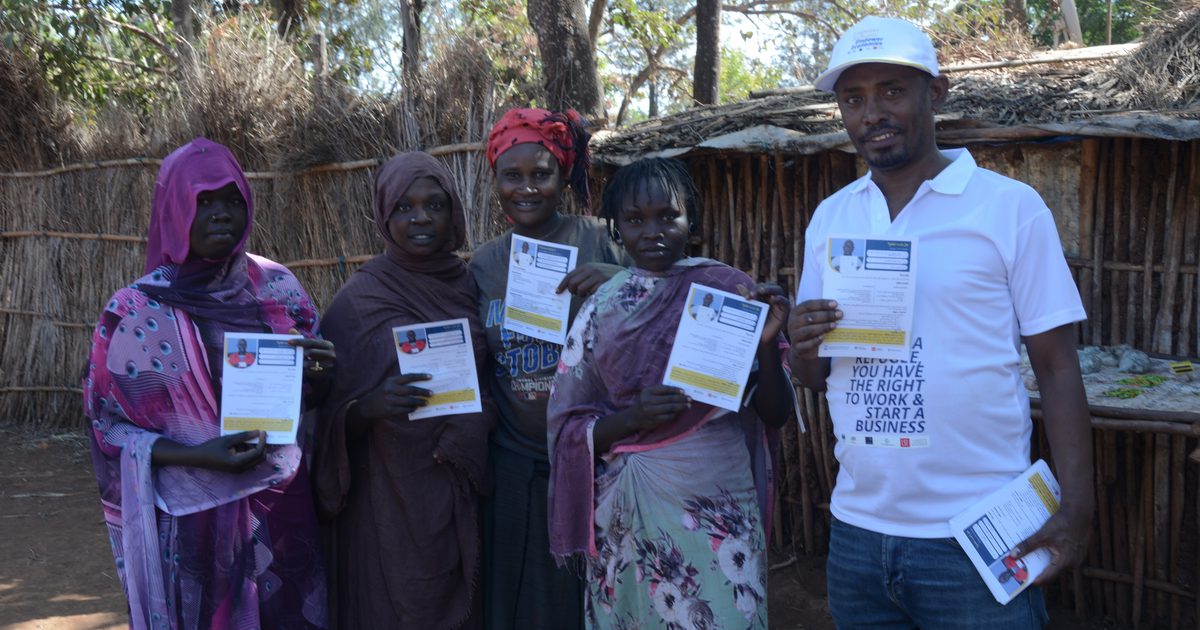
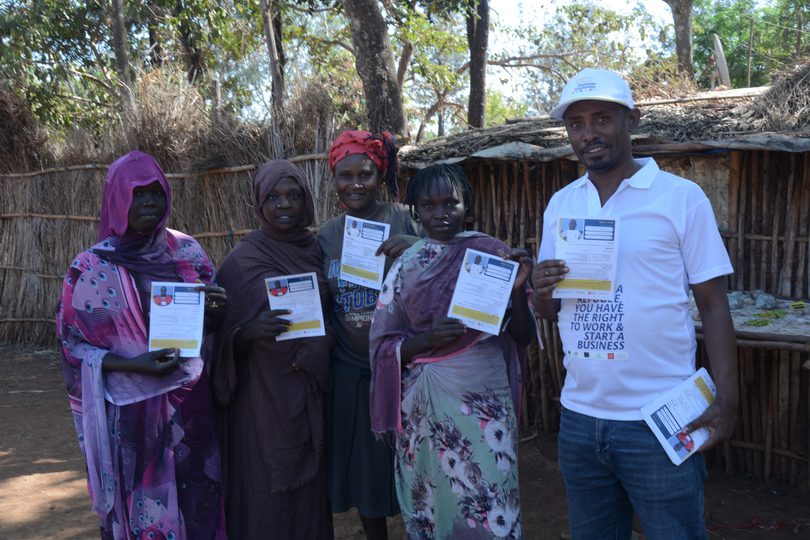
Image shows a man raising awareness through posters in the community
Our Approach in Practice
Our approach pairs research with concrete systems strengthening:
Policy advice: In partnership with RRS, we aligned the study with Ethiopia’s priorities and CRRF commitments. Together we identified capacity and operational gaps and designed solutions to build institutional readiness for scaling refugee economic inclusion.
Awareness Creation: We partnered with RRS and local leaders to explain legal rights to wage work and self-employment, targeting both refugee and host communities.
Technical Assistance: This support combines training, systems development, and continuous advisory engagement with both RRS leadership and technical teams. It includes an intensive RCT methods workshop, online learning on refugee protection, socioeconomic integration, and impact evaluation, plus practical training in data collection, cleaning, analysis, and real-time information management.
Data Collection: We began with a census across four camps to build the sampling frame, followed by in-person baseline surveys of eligible refugee households capturing employment histories, job search, skills, sector interests, and psychosocial wellbeing, plus modules on mobility and aspirations. We complemented this with focus groups and key-informant interviews and an establishment survey of nearby firms to map labour demand, administrative bottlenecks, and perceptions of work permits and business licenses.

©
Image shows equipment being handed over to the Refugees and Returnees Service
Digital and physical infrastructure: The project facilitated the procurement and handover of essential equipment to RRS, such as laptops, ID printers, and registration kits to enable digital processing of applications. The project also supported the establishment of a local tax office in Benishangul‑Gumuz so Tax Identification Numbers (TINs) can be issued near the camps, thereby saving applicants time and money and speeding compliance.
These investments reduce bottlenecks today and create the backbone for scale tomorrow.
Our Data to Date
So far, we have reached over 9,000 households in the initial listing, over 8,000 household baseline interviews

©
Image shows a data collection exercise with a refugee woman
What’s Next
The project has successfully completed its preparatory and baseline phases and is now transitioning toward implementation. We will hold transparent public lotteries in each camp to assign households to treatment and control groups (50/50). With the intervention underway, we will track outcomes through high‑frequency phone surveys and a comprehensive endline survey in 2026. To ensure sustainability, capacity building has been embedded within every stage of the project. This includes developing digital monitoring systems for RRS, training staff on data management, and creating operational protocols that can be scaled nationally. These investments will enable RRS to continue issuing permits efficiently beyond the life of the study.
Learn more and get involved
Contact: christian.meyer@oxfordmartin.ox.ac.uk (Corresponding PI, University of Oxford). The project is registered with the AEA RCT Registry: AEARCTR‑0016299, https://doi.org/10.1257/rct.16299
This opinion piece reflects the views of the author, and does not necessarily reflect the position of the Oxford Martin School or the University of Oxford. Any errors or omissions are those of the author.
Future of Development
Oxford Martin Programme on the Future of Development