The New Zealand military said that during an operation to help enforce sanctions against North Korea, one of its ships was shadowed by China in East Asian waters.
In a Monday news release, the New Zealand Defense Force said the replenishment vessel HMNZS Aotearoa was monitored by seven Chinese naval ships while operating in international waters of the East China Sea and the Yellow Sea in November.
The Chinese Foreign Ministry did not immediately respond to a request for comment.
Why It Matters
New Zealand is one of the United States’ allies and partners that have deployed forces to monitor vessels suspected of transferring prohibited goods at sea, according to a Newsweek map, in support of United Nations Security Council sanctions aimed at imposing economic costs on North Korea for its nuclear and missile programs.
Such operations normally take place in waters near the Korean Peninsula, including the Yellow Sea and the East China Sea off China‘s coastline. China—a steadfast ally of North Korea—has often deployed fighter aircraft and warships to track and intercept foreign militaries operating nearby, leading to close encounters between the two sides.
What To Know
Regarding the Aotearoa’s encounters with the Chinese navy, the New Zealand Defense Force said the Chinese side maintained a safe and professional distance. The 28,660-ton ship, commissioned in 2020, is the South Pacific country’s largest naval vessel.

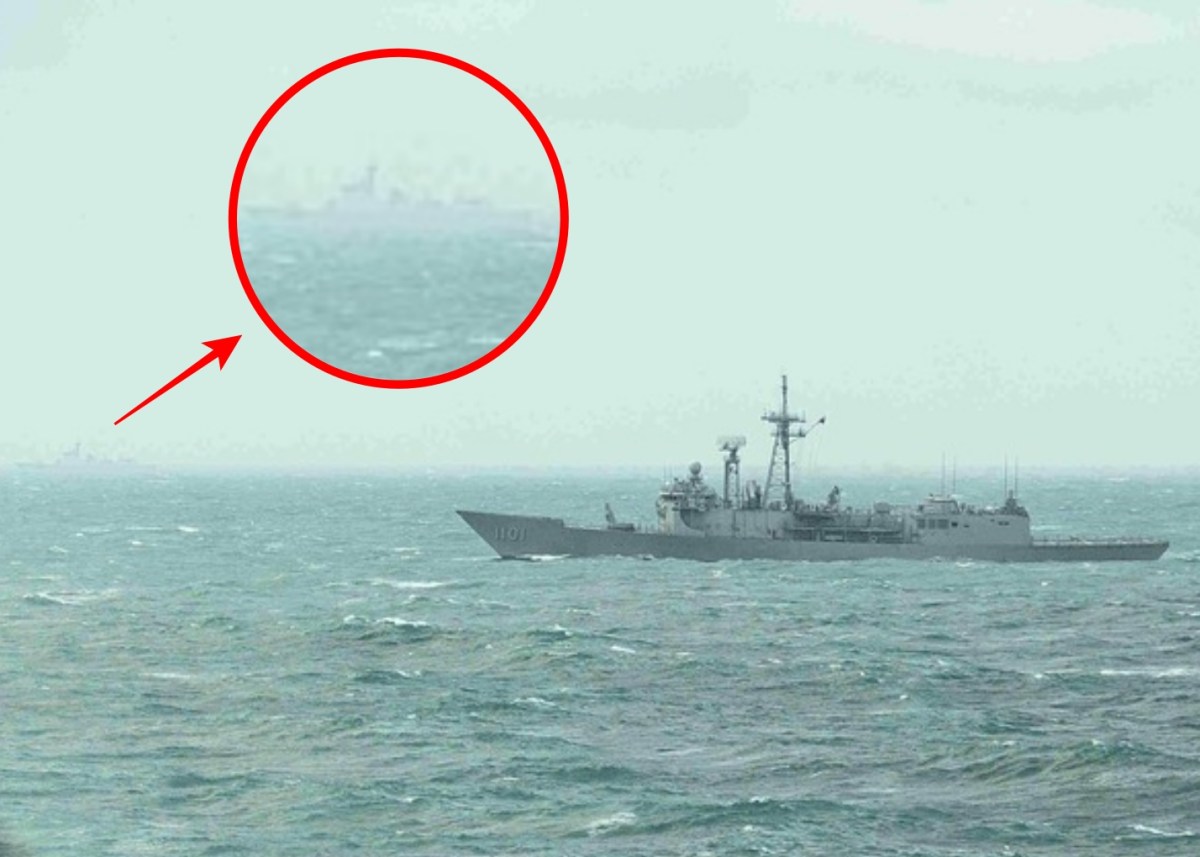
In one of the officially released photos, a naval officer assigned to the Aotearoa can be seen monitoring a naval vessel—identified by the hull number 1101 as the frigate ROCS Cheng Kung of the Taiwanese navy—through binoculars in an undisclosed location.
A New Zealand Defense Force spokesperson confirmed to Reuters on Tuesday that the Aotearoa “briefly encountered” the Cheng Kung while passing through the Taiwan Strait on November 5 as it sailed from the South China Sea to the East China Sea.
However, the silhouette of a third warship—other than the Aotearoa and the Cheng Kung—is barely visible farther in the background when zooming in on the photo, suggesting that all three vessels were sailing in the same direction in the Taiwan Strait.
It was not immediately clear whether the unidentified ship was deployed by the Chinese navy. One naval observer suggested it could be a Chinese Type 052C destroyer.
The Chinese Defense Ministry previously confirmed that the military had deployed naval and air units to monitor and track the Aotearoa’s passage through the strait.
China has claimed the self-ruled Taiwan as its own and has threatened to take it by force. It also asserts sovereignty, sovereign rights and jurisdiction over the 110-mile-wide Taiwan Strait, where the U.S. and its allies regularly conduct military transits.

During its mission to support sanctions against North Korea, the New Zealand vessel patrolled 158,000 square miles of water, interrupted two possibly illicit ship-to-ship transfers, identified seven vessels of interest and broadcast 79 deterrence messages.
According to Japan’s Ministry of Foreign Affairs, the Aotearoa’s deployment in early to mid-November marked the second time the New Zealand navy has monitored and surveilled North Korean illicit activities in waters surrounding Japan since 2024.
What People Are Saying
New Zealand Commander Rob Welford, the commanding officer of HMNZS Aotearoa, said in a news release: “Through maritime patrol, airborne surveillance and international cooperation, we delivered tangible impact—from deterring illicit activity to supporting allied ships at sea. The professionalism of our own crews, and those of our partner nations, was evident throughout.”
Japan’s Ministry of Foreign Affairs said: “As Japan has also been conducting information gathering activities for vessels suspected of violating the [United Nations Security Council resolutions], Japan works closely with relevant countries and international organizations, including New Zealand.”
What Happens Next
The U.S. and its allies and partners are expected to continue deploying forces to help enforce United Nations Security Council sanctions against North Korea, which has refused to abandon its nuclear and missile programs.