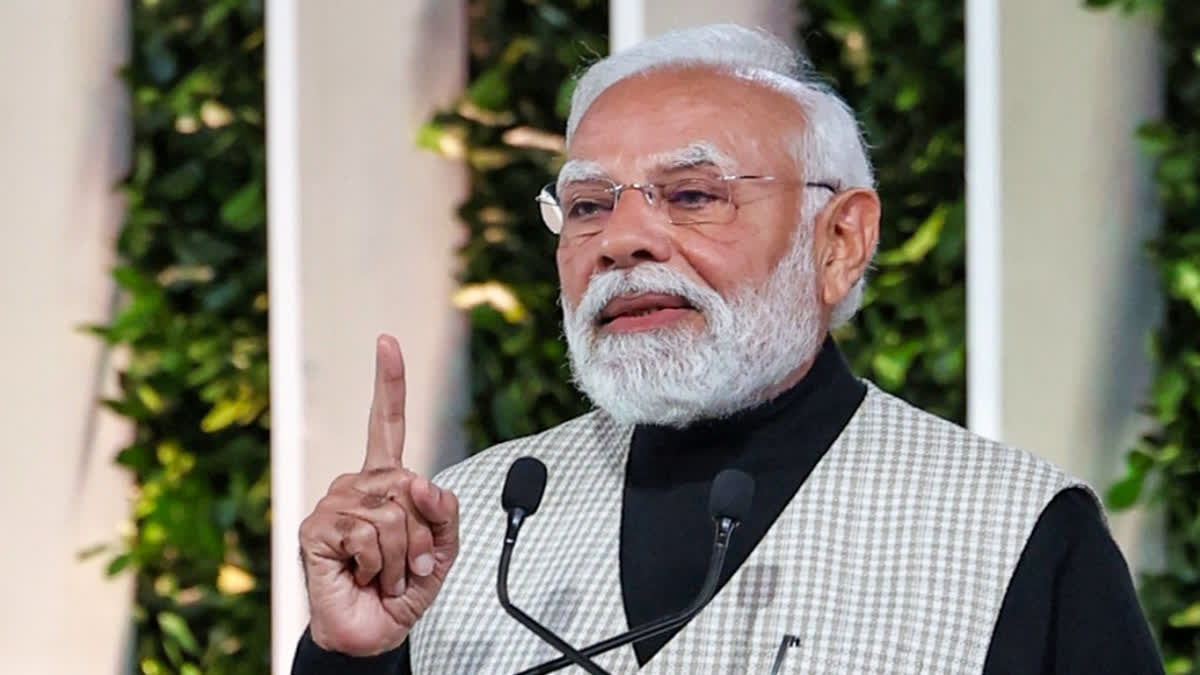
File photo of PM Modi (IANS)
New Delhi: Prime Minister Narendra Modi’s likely visit to Ethiopia next week will mark a significant push in India’s Africa outreach at a time when major powers are stepping up influence across the continent.
Though no official announcement regarding the visit has been made as yet, media reports suggest that Modi will visit the African nation next week amid visits to the West Asian nations of Jordan and Oman.
By choosing Addis Ababa – the seat of the African Union (AU) and a pivotal player in the Horn of Africa – New Delhi is signalling its intent to deepen political engagement and reclaim strategic space in a region central to global governance, connectivity and maritime security.
At a time when major powers – including China, the US, the European Union, the Gulf nations and Türkiye – are expanding their influence in Africa, India’s outreach signals an intention to reclaim diplomatic space and consolidate relationships built over decades. Ethiopia, given its population size, its traditional leadership role in African multilateralism and its geographic location at the crossroads of the Red Sea and Gulf of Aden, has emerged as a natural anchor for India in the region.
In fact, Modi’s visit to Addis Ababa will come close om the heels of his meeting with Ethiopian Prime Minister Abiy Ahmed on the sidelines of the BRICS (Brazil, Russia, India, China, South Africa) Leaders’ Summit in Johannesburg last month. Both leaders discussed ways to expand bilateral cooperation in areas like parliamentary contacts, development partnership and capacity building, trade and investment, defence, ICT, agriculture, skilling of youth and people-to-people linkages.
Historical linkages between India and Ethiopia go back 2,000 years of recorded history. Trade between the two countries flourished during the Axumite Empire (1st century AD). Indian traders trade silk and spices for gold and ivory through the ancient port of Adulis in the 6th century AD. In the 16th century AD, the Portuguese assisted the Christian King in Ethiopia to repel Muslim invaders, and with them came Indians from Goa. In 1868, General Robert Napier led a punitive expedition to obtain the release of European diplomats and missionaries who had been imprisoned by Emperor Tewodros II in his bunker fort at Makdala. The 30,000-strong force had 13,000 soldiers from India, mostly Sikhs. The British Army that ended the Italian occupation of Ethiopia (1936-41) also had a sizeable contingent of Indian soldiers. General William Plat, who led one of the three simultaneous attacks, commanded a force consisting of the 4th and 5th Indian Divisions.
Ethiopia is Africa’s oldest independent country and its second largest in terms of population. Apart from a five-year occupation by Benito Mussolini’s Italy, it has never been colonised. Diplomatic relations between India and Ethiopia at the legation level were established in 1948. Full diplomatic relations were established in 1950 with Sardar Sant Singh as the first Ambassador.
According to the Department of Commerce, India’s total trade with Ethiopia stood at $571.52 million during 2023-2024. During this period, India’s export to Ethiopia stood at $489.59 million, and imports were $81.93 million.
Exports from India mainly include primary and semi-finished iron and steel products, drugs and pharmaceuticals, machinery and instruments, and manufactured products of metal. Major imports by India from Ethiopia were pulses, precious and semi-precious stones, vegetables and seeds, leather and spices.
Samir Bhattacharya, Associate Fellow at the Observer Research Foundation think tank in New Delhi, sees Modi’s likely to visit to Ethiopia as something big in terms of India-Africa relations.
“Ethiopia is not only the host of the AU but is also an important country in the Horn of Africa region,” Bhattacharya told ETV Bharat. “Though the country had faced domestic volatility and had issues with Eritrea and access to the Red Sea, it has stabilised now.”
He said that India is keen to hold the next edition of the India-Africa Forum Summit (IAFS) in Ethiopia as the AU’s headquarters are in Addis Ababa. The first of these summits was held in 2008 in New Delhi, the second one was held in 2011 in Addis Ababa, Ethiopia, and the third one again in New Delhi in 2015. However, after 2015, no such summit has been held to date. Though a fourth edition of the summit was supposed to be held in 2020, it got postponed due to the outbreak of the COVID-19 pandemic.
“Next year, India will be holding the BRICS and IORA (Indian Ocean Rim Association) summits,” Bhattacharya said. “So, our international calendar is very full. In that case, the IAFS can be held in Ethiopia. The AU annual meeting is scheduled to be held in Ethiopia in February next year. Then there is a possibility of holding the IAFS in Ethiopia around that time.”
He also said that Modi’s likely visit to Ethiopia should be seen in the context of the AU’s role in the G20 intergovernmental forum. The AU was brought to the G20 high table under India’s presidency in 2023.
However, when South Africa, a member of the AU, hosted the G20 summit this year, the US boycotted it, accusing Pretoria of discrimination against the white minority community in the country. With the US set to host the next G20 Summit in 2026, President Donald Trump has said that South Africa will not be on the list of invitee nations.
This is where the participation of the AU in the 2026 G20 comes under the lens. “What will be the position of the AU in terms of participation in the G20 Summit if South Africa is excluded?” asked Bhattacharya. “The AU must take a position on this. This is also why Modi’s likely visit to Ethiopia is important.”
He further stated that during Modi’s visit likely visit to Addis Ababa may see some big-ticket investment. Ethiopia is one of the fastest-growing economies in Africa and one of the continent’s most diverse markets. The country’s industrial parks, part of its long-term plan to transition from an agrarian to a manufacturing-driven economy, align well with the strengths of Indian small and medium enterprises (SMEs) and mid-sized investors. India’s experience with low-cost manufacturing and vocational training can help Ethiopia create jobs at scale.
“Ethiopia needs a lot of external investments,” Bhattacharya said. He also pointed out to the fact that, though UN funding for teachers’ training in Ethiopia has stopped, there is a large Indian faculty in Ethiopian institutes. Bhattacharya said that after the Indian Institute of Technology (IIT) Madras set up a campus in Zanzibar, Tanzania, last year, and another IIT campus is set to be opened in Nigeria in western Africa in 2026, a similar announcement can also be expected during Modi’s visit to Ethiopia.
To sum up, if Modi’s visit leads to new economic commitments, stronger political coordination, and expanded development partnerships, it will not only reinvigorate India–Ethiopia relations but also help New Delhi carve a more assertive and sustained role across the African continent.
Read More
Modi’s Upcoming Jordan-Oman Tour Signals A Calibrated West Asia ResetPM Modi Wants To End Culture Of 30–40 Page Forms And Unnecessary Paperwork