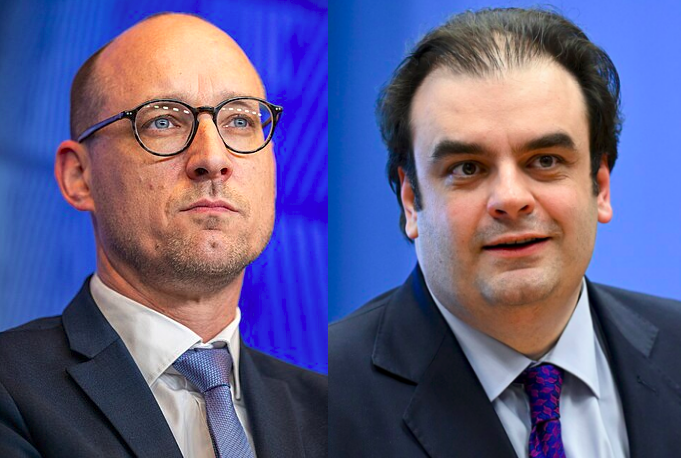
Brussels – Whatever happens, the control of the Eurogroup will remain in the hands of the European People’s Party.
The meeting of EU finance ministers will have to choose Paschal Donohoe’s successor following his resignation, and there are two candidates from the EPP in the running: Kyriakos Pierrakakis from Greece and Vincent van Peteghem from Belgium.
The vote in 48 hours (meeting 11 December, ed.) is less obvious than expected. On the one hand, granting Belgium the presidency of the Eurogroup would mean having extra political leverage to try to break down the country’s resistance to using frozen Russian assets to finance Ukraine’s repair needs. On the other hand, the investiture of the Hellenic minister would mean demonstrating that the tear-and-blood cure imposed on Greece has worked, allowing the country to move from a situation in which there were fears of Athens’ exit from the eurozone to one in which Athens is running it.
A simple majority is enough to elect the new president of the Eurogroup, meaning 11 votes out of the 20 total ministers. The EPP has six votes (Belgium, Greece, Ireland, Latvia, Luxembourg, and Portugal), and it remains to be seen which name the other five ministers will be able to converge on. It cannot be ruled out that, if a clear majority emerges for one name, the other candidate may be asked to step back and proceed to a unanimous investiture.
In any case, the one scheduled for Thursday is a real “musical chairs” game, since in addition to electing the new president of the Eurogroup, the eurozone economic ministers are called upon to start the process of appointing a successor to the vice-president of the European Central Bank, Luis de Guindos, whose mandate ends at the end of May 2026. This interlocking game certainly includes Greece, which has expressed interest in the post. A possible presidency of the Eurogroup would make it more difficult for the Athens government to secure the ECB vice-presidency.
English version by the Translation Service of Withub