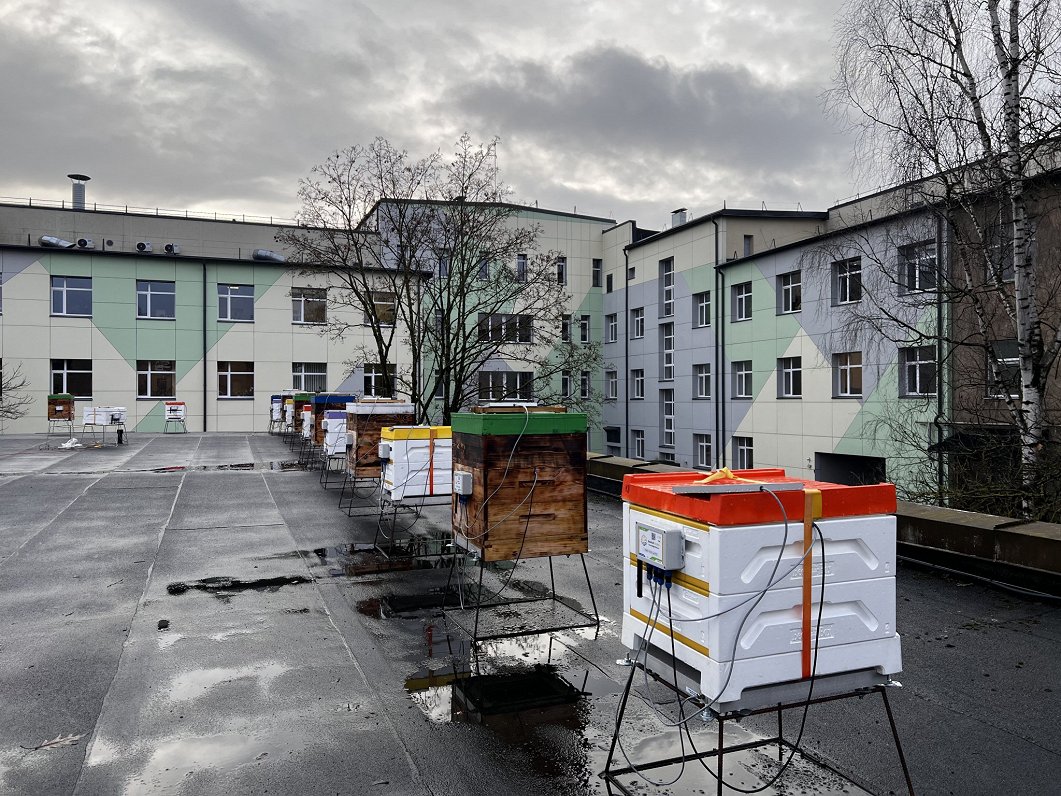
Scientists at the Latvian State Institute of Wood Chemistry are studying how to protect bees during temperature fluctuations – researchers are installing materials in hives that reflect heat, helping bees maintain a cosy temperature during the chilly months.
This three-year project aims to help beekeepers maintain their bee colonies and avoid unnecessary expenses. Interestingly, the experimental hives are located right in Rīga, on the roof of the Institute of Wood Chemistry.
There are 36 beehives on the roof of the Institute – half of them are made of wood, and the rest of them are made of a foam material. This is how researchers compare how bees feel in different environments. Each beehive is attached to sensors that help track changes in the hive, including internal temperature and humidity. The hives are divided into six groups, as indicated by the colour of their lids.
It is the largest urban apiary in Latvia and quite possibly even in Europe or the world, speculated Ulla Milbreta, leading researcher at the Institute of Wood Chemistry.
“We have various hive shielding materials inside, which we are comparing to see which will work better, creating this thermos effect, so that the heat radiated by the bees is better reflected and the bees will have to spend less energy during the winter to warm up this winter core containing the queen. The greater the temperature loss during rapid temperature fluctuations, the more the outer parts of the core die off and the colony becomes smaller – it can either collapse completely or start the spring very weak and be unable to develop afterwards,” the researcher pointed out.
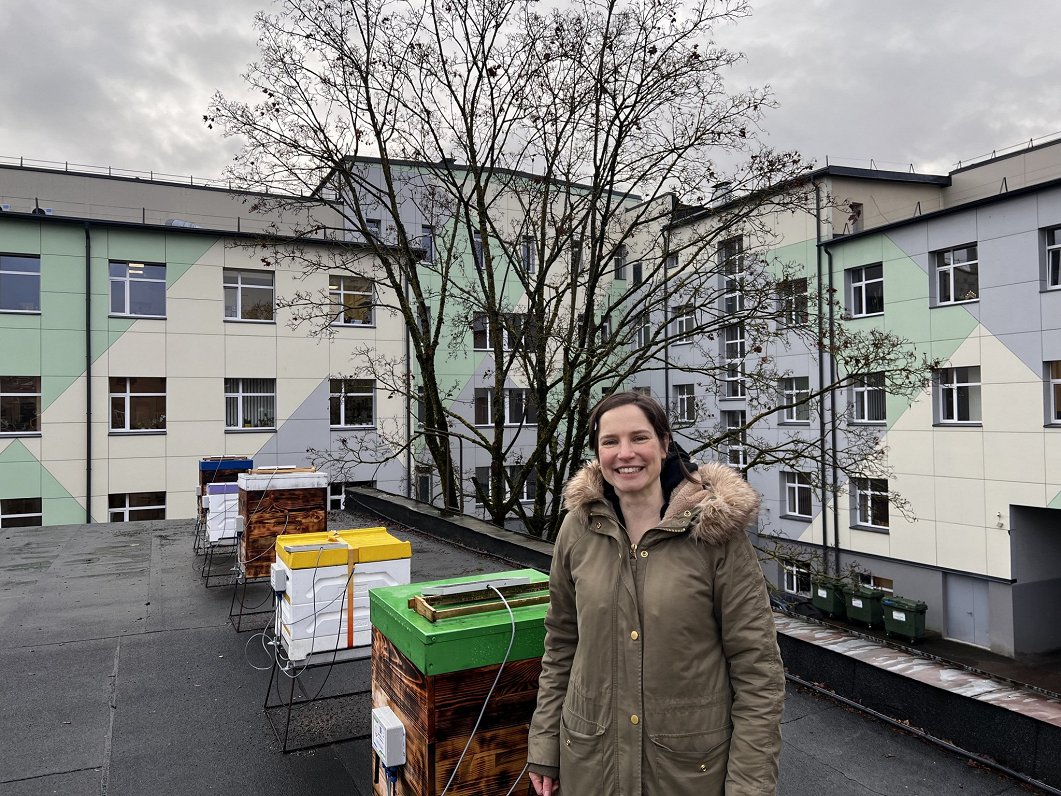
Photo: Viktors Demidovs/Latvijas Radio
The so-called shielding principle is similar to a foil blanket – it prevents freezing in cold weather, but overheating in hot weather. Another dangerous factor for bees today is warm winters and warm autumns, because during this time bees can attacked by wasps, which cannot find other insects that have already gone into hibernation.
“What was previously mentioned as one of the phenomena that could have an impact is now becoming an extremely important factor. We have experienced ourselves that in hives that are unshielded, without this insulation, colonies are unable to resist wasps. This is in the fall. On the other hand, if there is a warm winter, bees can begin their spring flight much earlier. If there is a sharp drop in temperature again after that, then the colony is relatively confused and is no longer able to gather in a ball, is unable to maintain this warmth and also dies,” Milbreta pointed out.
Researchers will observe the bees until May 2028. The total amount of funding for the project is almost 95,000 euros. The three-winter study will allow for more reliable data, and will provide recommendations for beekeepers later. In addition, within three years, the institute plans to develop a special material for hives that will not be as heavy as wood, but more durable than foam plastic.
During the winter, around 14% or more of all bee colonies die in Latvia every year, according to the Latvian Beekeeping Society, though temperature fluctuations are not the main reason for the deaths of insects. The head of the association, Valters Brusbārdis, said: “The most important factors why bee colonies die are a small pest called varroa. The second, which is very important, is the quality of food, and the third is genetics. These are the three basic things that are most important to us at the moment for the quality of bee colonies to overwinter. The hive is currently, in my opinion, quite well designed and of sufficient quality for the bee colonies to overwinter well.”
Select text and press Ctrl+Enter to send a suggested correction to the editor
Select text and press Report a mistake to send a suggested correction to the editor
Tell us about a mistake