The Norwegian Nobel Committee managed to carry out its annual Peace Prize ceremony in Oslo’s ornate City Hall on Wednesday despite drama, security challenges and the absence of the Peace Prize winner herself, Venezuelan political activist Maria Corina Machado. Her hazardous journey from Venezuela, where she’s been living in hiding, took much longer than expected.
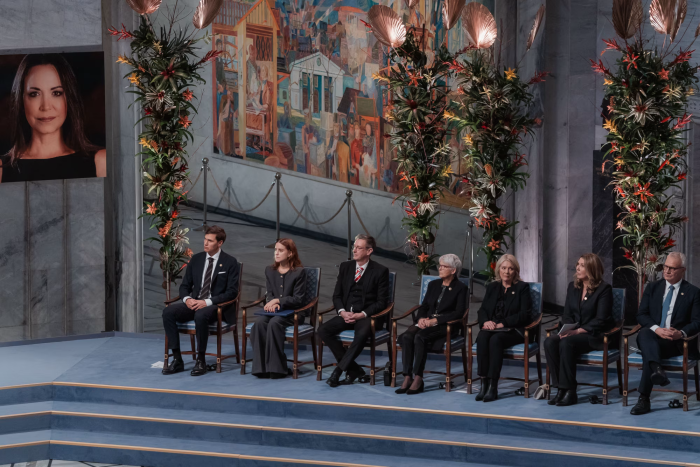 Hanging on the wall at the Nobel Peace Prize ceremony in Oslo on Wednesday was a large photo of its absent winner, Maria Corina Machado. Seated below are the members of the Norwegian Nobel Committee who selected her, and her daughter Ana Corina Sosa Machado, who delivered the Nobel Lecture on her mother’s behalf. PHOTO:©Nobel Prize Outreach-Helene Mariussen
Machado won this year’s Nobel Peace Prize for what Nobel Committee leader Jørgen Watne Frydnes called “her tireless struggle” to move “from dictatorship to democracy in Venezuela.” All Nobel events scheduled for the day before the ceremony (always held in Oslo on December 10, the anniversary of benefactor Alfred Nobel’s death) had to be cancelled, however because of Machado’s absence and uncertainty over when she might arrive.
Frydnes confirmed from the podium in Oslo’s City Hall that Machado’s journey from Venezuela to Norway “has been difficult.” He assured the large audience at the Peace Prize ceremony, however, that “she is safe and she will be with us here in Oslo” later in the day. Norwegian media were citing The Wall Street Journal Wednesday afternoon after it reported that Machado was finally able to leave Venezuela by boat on Tuesday and sailed to Curacao, where she continued the long trip to Norway.
Frydnes went on to deliver a lengthy and powerful speech that both condemned the authoritarian rule of Venezuela’s embattled leader Nicolas Maduro, and exposed its horrors. He led off by citing case after case of kidnappings and brutality against anyone even questioning Maduro’s authority or mentioning last year’s election in Venezuela that Maduro refused to recognize. Frydnes spoke of torture chambers, electric shock treatment and suffocation even of children and youth, along with rape, other sexual violence and how young girls and women are forced into prostitution as punishment for refusing to support Maduro’s regime.
“This is the Venezuela of today,” Frydnes said, stressing throughout his remarks how it’s the result of a regime that became increasingly authoritarian under “a small elite at the top, shielded by political power, weapons and legal impunity” that enriched itself. The country, once wealthy from its oil industry and other vast resources, has sunk into a “deep humanitarian crisis” and a quarter of the population has fled, leading to “one of the world’s largest refugee crises.”
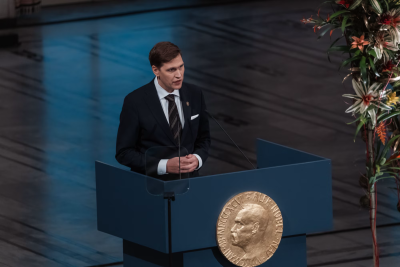 Nobel Committee leader Jørgen Watne Frydnes, delivering his Nobel address on Wednesday. PHOTO:©Nobel Prize Outreach-Helene Mariussen
He stressed how Venezuela is not alone in its descent under an authoritiarian leader intent on personal enrichment. “The world is on the wrong track,” he said. “The authoritarians are gaining,” noting how their track is often the same, as they characteristically refuse to accept election results, undermine the courts and their counties’ legal systems, resort to nepotism and installing family members into powerful positions, and sending out police or military troops under the guise of restoring order. Instead, ordinary citizens who have not committed crimes are rounded up and held in custody. Democracy is undermined along the way, he said, and democracy is necessary for maintaining peace.
Frydnes even went so far as to publicly call for Maduro’s immediate resignation as the entire Nobel ceremony was broadcast worldwide. “Maduro,” he said from the podium, “accept the election results and step down!” That was followed by lengthy applause that became a standing ovation.
(Read the Norwegian Nobel Committee leader’s entire speech here, external link.)
Frydnes’ speech also strongly defended the Norwegian Nobel Committee’s decision to award the Nobel Peace Prize to Machado, who was a right-wing politician who evolved into a “champion of peace and democracy.” The decision drew criticism (and some protest demonstrations in Oslo this week) after it was announced in October, because it appeared political and favoured a conservative candidate. Machado herself even “dedicated” her prize to the also-controversial US President Donald Trump, because of his earlier support for her political positions and work.
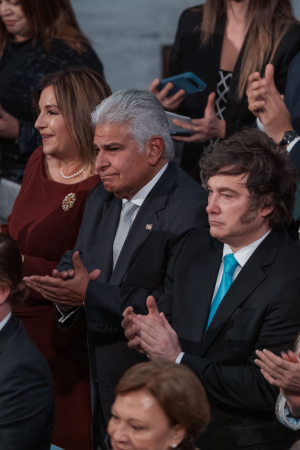 The president of Argentina, Javier Milei (right), was among guests invited to Wednesday’s Peace Prize ceremony by winner Maria Carino Marchado. PHOTO:©Nobel Prize Outreach-Helene Mariussen
Trump himself, though, is also known for exhibiting many of the authoritarian signals Frydnes and Machado’s own daughter, in delivering her mother’s acceptance speech, warned against. Trump also questioned and refused to accept election results in 2020, when he lost his bid for re-election at the time. Since his comeback as president earlier this year, he has also questioned or dismissed court decisions, replaced high-ranking federal workers who have questioned or criticized, filed lawsuits against his political opponents and regularly resorted to the nepotism Frydnes warned against, even sending his son-in-law to a meeting with Russian President Vladimir Putin regarding Putin’s war on Ukraine and another son to Greenland after announcing he wanted the US to take it over.
That’s why questions remain as to why Machado at least, chose to flatter Trump in her initial reaction to winning the prize, and invite several guests who also want to cater to Trump. Trump has made no secret of his desire to win a Nobel Peace Prize, too, and Machado’s ties to Trump sparked criticism. On Wednesday, the authoritarian warning signals that can also be tied to Trump seemed to be overlooked, when Frydnes claimed that “authorian regimes learn from each other.” He added that “behind Madura stand Cuba, Russia, Iran, China and Hezbollah, providing weapons, surveillance and economic lifelines. They make (Maduro’s) regime more robust, and more brutal.”
Trump, on the other hand, has made it clear how much he opposes Maduro, even bombing vessels believed to sail from Venezuela with narcotics on board but without proof of that. Trump has also ordered a military build-up off Venezuela that’s threatening Maduro. Despite Maduro’s brutality, it’s ironic how the Peace Prize to Machado quickly contributed to war-like measures, not peace.
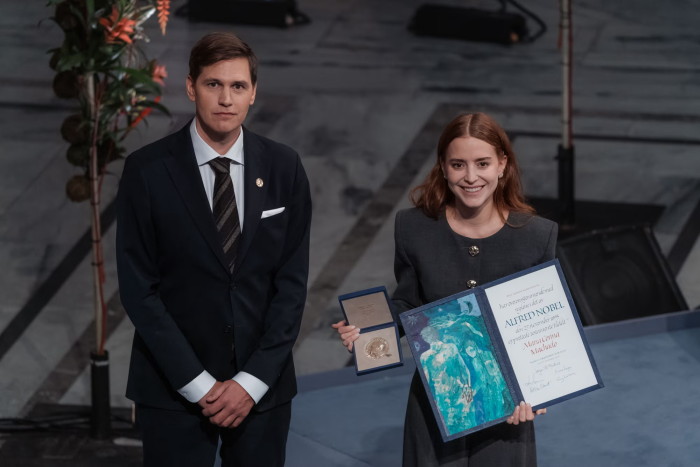 Nobel Committee leader Jørgen Watne Frydnes with the Peace Prize winner’s daughter Ana Corina Sosa Machado, who delivered her mother’s speech and accepted the Peace Prize on her mother’s behalf. PHOTO: © Nobel Prize Outreach – Helene Mariussen
Then it was Machado’s daughter’s turn to take the podium, from which she also delivered a strong and passionate appeal. It included both a short introduction of her own before she read the speech her mother had prepared but wasn’t able to deliver.
Maria Corina Sosa Machado began by thanking the Nobel Committee and everyone involved in the past two days of carefully planned meetings and events that later had to be changed. She told the roughly 1,100 people in the room that her mother had said she would come to Oslo “and she never breaks a promise.” Her daughter, who’s living in exile in the US and hasn’t seen her mother for nearly two years, was confident that “we will finally be able to embrace her here,” adding that her mother would “be back in Venezuela very soon.”
She also expressed “the gratitude of an entire nation,” before beginning to read the speech her mother had prepared. It related the history of Venezuela, of centuries of development they could be proud of, only to descend into “nepotism, corruption” of the country wealth, “all stolen” since 1999. Her mother stressed that everyone is “born to be free,” recounted the long struggle to mount last year’s elections and restore democracy, and how the huge election turnout had reunited the Venezuelan people until the Maduro regime reacted “with terror.”
Read the Nobel Laureate Maria Corina Machado’s speech here (external link).
The younger Machado’s speeches, both her own and her mothers, moved many to tears in the audience, not least family members gathered for the first time in a long time. Norway’s Royal Family was also listening intently, along with the prime minister, the president of Norway’s Parliament (which Machado is still expected to visit on Thursday), Supreme Court justices, the leaders of Norwegian political parties and many others. Many of them would gather again Wednesday for the annual Nobel Peace Prize banquet at Oslo’s Grand Hotel.
They all hoped that Machado would finally arrive in time for both the banquet and a torchlit parade outside that traditionally honours Peace Prize winners. They were disappointed. Nobel staff had to later confirm that she’d miss both, but they still hoped she’d be safely in Oslo on Thursday.
NewsinEnglish.no/Nina Berglund