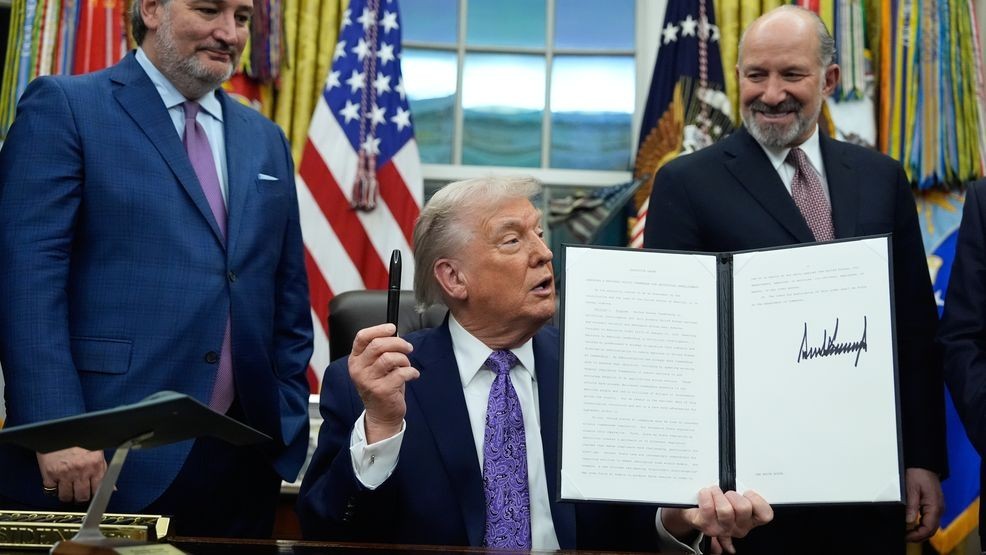
WASHINGTON (TNND) — President Trump has banned states from regulating artificial intelligence. Trump signed an executive order this week that aims to create a single national framework for AI. The move comes as the U.S. pushes for global dominance in the AI sector.
Every time you make a change, and it could be a very reasonable change. You still won’t get it approved if you have to go to 50 states, so this centralizes it,” Trump said from the oval office Thursday.
Right now, many states have AI-related laws and regulations in place. But Trump argues that without a single approach, it could stifle innovation, U.S economic competitiveness, and allow countries like China to move ahead in the AI race.
“There’s only going to be one winner here, and that’s probably going to be the U.S. or China, and right now, we’re winning by a lot,” said Trump.
U.S. Secretary of the Interior Doug Burgum backed the President’s approach to AI. Saying that, aside from winning the AI race, the U.S. needs artificial intelligence for national security.
Just go back to last spring, I mean, Iran launched 500 missiles at Iran…I mean from Iran to Israel in one day. 498 were shot down because of AI,” Burgum told Fox & Friends on Thursday.
Former Arizona Senator Kyrsten Sinema echoed Burgum. Adding that the U.S. needs to expand domestic data centers while also investing in AI infrastructure.
“We’ve got to double down and make sure that American values are the values of the world and that we control this global AI agenda, and that’s why these AI data centers are so important all across the country,” Sinema also told Fox & Friends Thursday.
But some Democratic lawmakers disagree. Calling the executive order dangerous and unconstitutional. Arguing that blocking state-level safety regulations could put people at risk of discrimination and surveillance abuse.
“We’re talking here about laws that are protecting kids. Things that red states have done, not just blue state governors,” Sen. Amy Klobuchar (D-MN) told CNN this week.
According to the National Conference of State Legislatures, during the 2024 legislative session, at least 31 states enacted some form of AI legislation or resolution. Many focused on deepfakes, criminal child sexual abuse material, data privacy, and government policies. Trump’s executive order doesn’t instantly get rid of the laws, but does direct federal agencies to take action to counter some of them.
“AI can unleash great things. Cures for rare diseases and alike. But not if all the bad is what everyone sees,” said Klobuchar.
The executive order marks a win for tech companies, like OpenAI and Google, that have lobbied to limit regulations they view as a bit excessive. States that don’t follow the new order could face funding restrictions, but it is expected to be challenged in court.