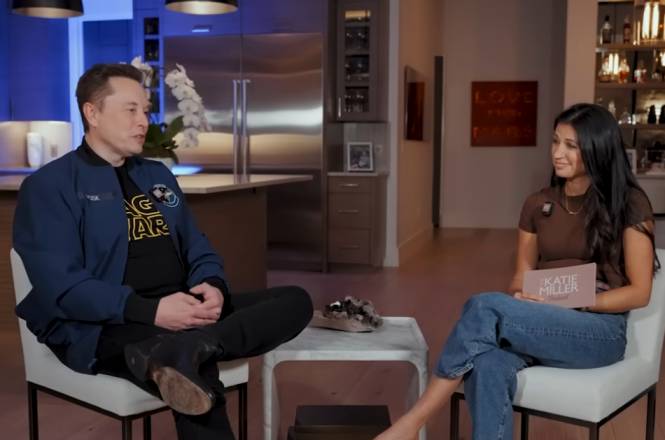
KATIE MILLER: Do you think you were successful?
ELON MUSK: We were a little bit successful. We were somewhat successful. I mean, we stopped a lot of funding that really just made no sense. That was just entirely wasteful.
For example, there was probably $100 million, maybe $200 billion worth of zombie payments per year, which simply by enforcing that there be a payment code and an explanation for the payment, that the payment would not go out. So we’ve made that change to the main treasury computer and a bunch of other computers.
It seems insanely obvious, but there are just, call it 2 or 3% of government payments that go out that really should not be going out. And it’s actually quite hard to stop. So it’s a pretty rare individual that would ask the government to stop sending them money.
Would He Do It Again?
KATIE MILLER: Would you ever do Doge again?
ELON MUSK: Do you mean, would I repeat history or would I…
KATIE MILLER: Two ways to think about it. One is, if you could go back and start from scratch, like it’s January 20th all again, would you go back and do it differently? And knowing what you know now, do you think there’s ever a place to restart? You, not saying others in your stead, you go back and restart doing Doge?
ELON MUSK: I mean, no, I don’t think so. I probably, I don’t know.
KATIE MILLER: Would you do Doge again, knowing what you know now?
ELON MUSK: I mean, the thing is, I think instead of doing Doge, I would have basically worked on my companies, essentially. And the cars, they wouldn’t have been burning the cars.
KATIE MILLER: You gave up a lot to Doge.
ELON MUSK: Yeah. If you stop money going for political corruption, they will lash out big time. So they really want the money to keep flowing. So if you stop it from flowing, there’s a very strong reaction to stopping the money flowing.
KATIE MILLER: After you were in D.C. for a while, did you become disillusioned with how it operates?
Government Waste and Immigration
ELON MUSK: Well, I wouldn’t say I was super illusioned to begin with. I guess it’s just you really want the least amount done by government possible. The least amount.
I guess maybe the biggest thing is that there are massive transfer payments going to illegal immigrants. Massive. Essentially we’re paying people to come here from somewhere else in vast numbers, including flying them in. So it’s not like you need a border wall. If you’re flying them in, then fast tracking them to citizenship and making them beholden to government payments and voting hard left, that’s essentially voter importation.
If you create a gigantic money magnet where you say, “If anyone comes here from anywhere else, we’re going to pay you tons of money, give you lots of free stuff, come to America and get paid to do so,” you’re going to get a lot of people taking up on that offer.
People say this is fake. I’m like, actually, well, let’s look at Ilhan Omar, who literally was voted into power, voted into Congress by a large group of people from Somalia who are in Minnesota, which is really far from Somalia, or Mamdani who was voted to be mayor by a majority of people who are not born in America. That’s my understanding at least.
And then California, big time situation. So I don’t know, we just don’t want to turn into a communist hellhole. Basically.
AI, Robotics, and the Future of Work
KATIE MILLER: You’ve said in the future that no one’s going to need to worry about money or work because AI is going to take care of the rest. AI and robotics. What do you mean that people won’t have to work in the future?
ELON MUSK: Assuming the current trend of artificial intelligence and robotics continues, which seems likely, the AI and robots will be able to do anything that humans want them to do, essentially. So hopefully not more than that, but AI and robotics will be able to provide all the goods and services that anyone could possibly want.
KATIE MILLER: But you wouldn’t need to work. What would you do with your free time?
ELON MUSK: People will be able to do whatever they want with their free time. Work will be optional. I just want to separate out what I wish would happen versus what I predict will happen because people get confused about that. They think that what I predict will happen is what I want to happen. What I predict to happen is not the same as what I want to happen.
If I could, I would certainly slow down AI and robotics, but I can’t. It seems to be advancing at a very rapid pace. Whether I like it or not.
KATIE MILLER: Is AI what keeps you up at night?
ELON MUSK: It used to be. At this point, I don’t know. I wouldn’t say there’s anything particularly keeping me up at night right now, except that if you say, why do I wake up in nightmares? AI. Yeah. Actually I’ve had a lot of AI nightmares. I had AI nightmares many days in a row. What am I supposed to do about it?
Fear, Sleep, and Daily Life
KATIE MILLER: What’s your biggest irrational fear?
ELON MUSK: I try not to have irrational fears.
KATIE MILLER: None.
ELON MUSK: If I find an irrational fear, I squelch it. I don’t believe fear is… Fear is the mind killer. So I’m somebody who feels fear strongly.
KATIE MILLER: On average, how many hours do you sleep a night?
ELON MUSK: Six. You can tell based on my posts.
KATIE MILLER: Yes, you can.
ELON MUSK: People have actually mapped them so it’s very clear when I’m sleeping and when I’m not. I tried having less than six hours sleep, but although I’m awake more hours per day, my cognitive function is reduced.
So my natural sleep, and I actually timed it with the phone. You can get a phone app, time it. It’s 5 hours 56 minutes. That’s what the phone said.
KATIE MILLER: What’s an average day for you look like?
ELON MUSK: Well, I have a lot of inbound communication, so it’s information triage. I try to segment the days so that there’s not too much context switching, because arguably fear is not the mind killer, context switching is.
It’s hard not to context switch if you’ve got an inbox full of stuff, but you can think of, if you had to context switch every three seconds or every 30 seconds or every three minutes, the context switching cognitive penalty would be very high every three seconds.
KATIE MILLER: And you’re talking about switching between, say, Tesla, X, xAI, SpaceX, personal…
ELON MUSK: But even within Tesla and SpaceX, there are many different things. Getting stuff on X, random news things, people being brought alive and stuff like that. They’re like, what the hell’s going on in this country?
Personal Reflections
KATIE MILLER: Who’s the funniest person you know in real life?
ELON MUSK: You know, President Trump is very funny. He’s got a great sense of humor.
KATIE MILLER: President Trump is very funny.
ELON MUSK: He’s very funny. He’s naturally funny, somewhat effortless. I mean, when he had Mamdani in the office and they asked him if he still thought the President was a fascist, and the President said, “Just say yes. It’s easier that way. Don’t worry about it. Just say yes.” He’s like, “Yes.” Whatever. How silly.
KATIE MILLER: Who do you look up to the most?
ELON MUSK: The creator.
KATIE MILLER: What’s your current position on God?
ELON MUSK: God is the creator.
KATIE MILLER: You don’t believe in God though, do you?
ELON MUSK: Well, I believe this universe came from something. People have different labels.
KATIE MILLER: When’s the last time you did something extremely ordinary like go to Target or CVS?
ELON MUSK: I can’t go to things where there’s a general public because there’s an immediate “Can I have a selfie” line that forms. And these days, particularly in light of Charlie Kirk’s murder, there are serious security issues. It’s not that I don’t want to. I simply can’t.
KATIE MILLER: Has Charlie’s murder changed how you do things, or were you already locked down pretty well before that?
ELON MUSK: It certainly reinforced the severity of the situation where life is on hardcore mode. You make one mistake and you’re dead. It only takes one. One mistake.
KATIE MILLER: What’s one moment in your life that you could live again? Just to feel it.
ELON MUSK: Well, I mean, obviously when my kids were born, or the first time SpaceX got to orbit, or Tesla made an electric car work. There’s a lot of things. There’s a lot coming down the pike.
Starship and Becoming Multi-Planetary
KATIE MILLER: Like what?
ELON MUSK: Starship. The degree to which Starship is a revolutionary technology is not well understood in the world. It’s the first time that there’s been any rocket design where full and rapid reusability is possible or full reusability at all is possible. This is the first design where a reusable rocket is one of the possible outcomes. Where success is in the set of possible outcomes.
KATIE MILLER: Are you talking about V3 or V2?
ELON MUSK: Well, we could have made V2 reusable, but there were a lot of performance improvements for V3, so it made sense to go to V3. There’s 10,000 different changes between V2 and V3. Maybe more than 10,000. Really.
If there are historians in the future, they’ll look back at Starship and say it was one of the most profound things that ever happened. Now you can think of historic events as where would they fit in the evolutionary hall of fame?
So you’ve got things like single-celled life, then you’ve got multicellular life, capturing mitochondria so that you have a power plant in the cell. You’ve got differentiation into plants and animals, life going from oceans to land. And then also on that scale, probably in the top 10, is life becoming multi-planetary.
There just aren’t very many things that are in the top 10 of the evolution of life where you could basically evaluate any given civilization or any given life form on that scale. Life becoming multi-planetary is in the top 10.
It needs to be sustainably multi-planetary. So not just visiting, but actually multi-planetary in the sense that if you have planetary redundancy, so if there were to be a catastrophe on one of the planets, the other planet would survive.
KATIE MILLER: Are all of your companies…
ELON MUSK: Starship is capable of doing that for the first time in history and no AI was used to create it, so the AI will appreciate that.
KATIE MILLER: Are all of your companies working towards that same goal to help us become multi-planetary? Does the AI exist to be able to help life on Mars or is that primarily for what is happening here currently?
Fashion and Cultural Evolution
ELON MUSK: You know, Tesla is mostly about making sure life on Earth is good. And xAI is about that too. Because multi-planetary means Earth’s got to be good and you need another planet.
Sometimes people think because they have legacy templates, mental templates, they think that going to Mars is an escape from Earth or that it would be some place where billionaires would go or something like that. But actually Mars will be very dangerous and the moon base would be also dangerous. Much more dangerous and much less comfortable than Earth.
So the people that would go in the early days to make life multi-planetary on Mars or the moon, they would have a much higher risk of death than if they stayed on Earth. And things would be cramped and uncomfortable. So that’s the sales pitch for Mars. It’s going to be uncomfortable. The food won’t be as good as Earth. You might die. It’s going to be a mass amount of hard work and it may not succeed. That’s the sales pitch. Do you want to go?
KATIE MILLER: Same as when people came to America.
ELON MUSK: Yeah. Didn’t want to be in Jamestown.
KATIE MILLER: People went anyway.
ELON MUSK: Yeah. Maybe if there had been social media back then, they would have been saying, “We’re all dying. Here’s videos of us dying.” Would have probably put a damper on future voyages. But yeah, they just, poof, on fuel just disappeared. We don’t know what happened to them.
KATIE MILLER: You talk a lot on X about wardrobe and how you wish current wardrobe would be differently.
ELON MUSK: I just think like from a fashion standpoint we should evolve. Like my son Saxon said at one point, “Why does everything look like it’s 2015?” I was like, damn, things do. Everything does look like it’s 2015. It’s like if you took a picture from 2015 and said in 2025 it looks exactly the same. There were still, stylistically things are the same as 2015. We have not moved the needle in a decade.
KATIE MILLER: So what should it look like?
ELON MUSK: Something new, you know, like the 60s had a definitive style, the 70s had a definitive style, the 80s had a definitive style. And then the 90s also had a different style. But then you start looking at the 2000s and 2010s and it’s like less and less every year.
I think we should evolve our style. And if you look at some of the older paintings, you know, past cabinet secretaries, some of them like they look cool. Like their jackets are cooler than what we have right now. You know, they have sort of like a high collar and like a sort of, I don’t know what some sort of, what do you call those things, ascot or something like that. I mean it just looks cool, but we don’t. Everything’s like a very normal looking suit at this point.
But like literally the same as 2015. I’m being generous, because arguably the same as 2010. So in 15 years. And I’m like, from a fashion standpoint, I don’t think we’ve moved since 2000. In 25 years, if you showed someone a picture of, “This is a bunch of dudes in 2000. This is a bunch of dudes in 2025. Which year is which?” So I think we should, I don’t know, spice it up a little.
Conspiracy Theories and Aliens
KATIE MILLER: What’s a conspiracy theory you believe in?
ELON MUSK: I mean, which conspiracy theories haven’t come true at this point? We’ve run out of conspiracy theories that, because it will come true as far as I can tell. I mean, I don’t know of any aliens. People always ask me if there are aliens. I have seen no evidence of aliens. No one on the SpaceX senior team has any evidence of aliens. Because I’ve asked him, like, “Guys, am I missing something? Has anyone on the team, has anyone seen any evidence of aliens?”
KATIE MILLER: Does that include UFOs?
ELON MUSK: That’s just an unidentified flying object. So UFOs, it could be like some new weapons program or whatever. That’s, you know, some hypersonic missile or something like that. That would be technically a UFO, but it’s just basically some weapons prototype. It’s not like aliens. So although Neil Armstrong, Neil A. spelled backwards is alien. Coincidence.
KATIE MILLER: You believe we actually went to the moon, though?
ELON MUSK: Yes. We went to the moon a few times, actually. And played golf on the moon. We didn’t just go to the moon. We actually got a little bored and started playing golf on the moon.
KATIE MILLER: But why didn’t the flag move? There’s like that confusion.
ELON MUSK: That was the jump the shark moment.
KATIE MILLER: About the flag?
ELON MUSK: No, the playing golf on the moon.
KATIE MILLER: Okay.
ELON MUSK: You know, I looked at it.
KATIE MILLER: No, I understand that.
ELON MUSK: Yeah, yeah. Whacked golf ball on the moon.
KATIE MILLER: Is there, there’s no gravity, though, right?
ELON MUSK: So, like, there is gravity. One-sixth. If it wasn’t gravity, you just float away. There’s no atmosphere.
KATIE MILLER: Okay, fair.
ELON MUSK: But there is one-sixth gravity.
Misconceptions and Work Culture
KATIE MILLER: What’s the biggest misconception about you?
ELON MUSK: I don’t know. How would I know? What do you think?
KATIE MILLER: I think it’s, I get asked this a lot when I do interviews about you.
ELON MUSK: Me?
KATIE MILLER: Oh. Everyone always thinks you’re a very difficult person to work for.
ELON MUSK: Oh.
KATIE MILLER: Which I think you’re very kind.
ELON MUSK: Thanks.
KATIE MILLER: Like people think, which you are, like a very demanding boss. I think that you are. I’ve never heard you yell at any employee.
ELON MUSK: Yeah, I don’t yell.
KATIE MILLER: I think every employee who works at every single one of your companies is incredibly mission driven, which is unlike any other workplace I’ve ever seen. Like, Starbase is the most inspirational place you’ll ever go to. Everyone is there to work on a singular goal.
And so I think to me, the biggest misconception about you is how every employee at all of your companies are fiercely loyal because it’s all mission driven and you are a very good employer to work for. And I think people assume you are not.
ELON MUSK: Right. Well, why would they think anyone would work at the companies? Yeah, I mean, talented people can go work anywhere they want. So they’re only going to work at one of my companies if they want to. And if they’re mistreated in some way, they would leave and go work somewhere else.
Starbase and Disney World
KATIE MILLER: How did you come up with the idea for Starbase?
ELON MUSK: Well, I think we needed something inspirational. We kind of have a lot of star things, you know, so we got Starlink, Starship. Well, where would Starship depart from? Starbase. I mean, Starbase is, as you mentioned, it’s like, I think it’s probably the coolest place on Earth.
KATIE MILLER: I agree.
ELON MUSK: And it used to be a sandbar down by the Rio Grande. It’s only like 3 feet above sea level. So we built a gigantic rocket factory and two giant launch towers down by the river, literally within sight of the Rio Grande. And on an actual sandbar. Kind of had to have like an inspirational name. And then we made it a city. So it’s an incorporated city, like legally a city. You don’t hear about new cities being formed that often.
KATIE MILLER: The last time there was a company town, it was Disney World.
ELON MUSK: Yeah, I think Ford had some kind of like company town situations. But yeah, Disney World is, it’s literally its name. I’m Walt Disney. This is my world. I’ve gone from land to world. They got like incorporated as a city and got tax exemption, which was like a whole, was a big deal. Yeah, I’ve been to Disney World probably 10 times.
KATIE MILLER: Really?
ELON MUSK: Yeah, maybe more than, maybe more than 10, but at least 10 times because Cape Canaveral is right by Disney World.
KATIE MILLER: This makes sense. Yeah.
ELON MUSK: So when I’d have the kids, then I would, my older kids and I was, we’re trying to get the rocket launch from Cape Canaveral. Then, you know, the thing they’d want to do is go to Disney World or Harry Potter Land.
KATIE MILLER: What’s your favorite ride?
ELON MUSK: I’m sort of tempted to say Space Mountain, I suppose. Yeah, probably Space Mountain. I mean, I do think Space Mountain needs an upgrade. A little herky jerky. It doesn’t look quite as sci-fi as it used to. You know, it’s like the day before yesterday is tomorrow or just like yesterday.
Parenting and Philosophy
KATIE MILLER: What’s your favorite age to parent of your kids?
ELON MUSK: Generally, kids are the most fun between 5 and 10.
KATIE MILLER: Do you think humanity is inherently good or is it just trying to be?
ELON MUSK: The concept of good wouldn’t exist without humanity. I do think humanity is, on balance, good. I generally think increasing the amount of consciousness in the universe is a good thing. Trying to try to understand the nature of the universe, which you can only do by increasing conscious awareness.
I’ve thought about like, how did we get here? Because if we just start out as a hydrogen gas cloud that sort of condensed and then formed stars, and then these stars exploded and then they recondensed, formed stars again and then exploded, exploded again, and then eventually you get to us 13.8 billion years later.
One of the interesting questions to think about is how many times have your atoms been at the center of a star? I think it’s like on average three or four times, something like that. Then how many times will your atoms be at the center of a star? Estimates vary, but it seems like we’re roughly halfway.
So your atom’s likely to be at the center of the star, maybe another four times or something like that. It depends on what your predictions are for the future. But in terms of existence as measured by the number of times your atoms will be at the center of a star, we seem to be roughly halfway that early. You know, if you want to look at the big picture, that’s the really big picture.
KATIE MILLER: What’s one invention that’s made us worse, not better?
ELON MUSK: What’s one adventure that’s made us worse?
KATIE MILLER: Mm, invention.
ELON MUSK: Maybe short form video. It seems to be rotting people’s brains.
Technology and Simulation Theory
KATIE MILLER: What’s one piece of technology you hope never gets invented?
ELON MUSK: I hope never gets invented.
KATIE MILLER: Like, yeah, like it’s going to destroy us all, or you think with the proper safeguards?
ELON MUSK: Well, I mean, obviously I hope like that people don’t invent a virus that can kill all humans. Like that’s an obvious thing. I mean, yeah, generally I hope inventions that destroy consciousness are not invented.
I think the future is going to look very interesting. So I do have this theory about predicting the future, which is that the most interesting outcome is the most likely. Which, if simulation theory is accurate, makes sense. Because if anyone is simulating a wide range of futures, they’re going to stop the simulation when it gets boring. Because this is what we do in our reality.
So if SpaceX is doing, or Tesla doing simulations to understand how a car would work or robot or spaceship or something like that, we run all these simulations in the computer and the simulations that we pay attention to are the ones that are the most interesting. Like the simulation where everything goes right on the rocket we actually don’t pay attention to because that’s not a, everything goes right simulation is fine.
So we actually test the, when we simulate the rocket flight, we’ll actually test all sorts of oddball situations. But we don’t test it. We don’t have the simulation be totally wrong because I mean like if the rocket just explodes immediately, that’s also not interesting.
So it’s like you’d need to find the envelope of possible flight paths where the rocket can make it to orbit and without exploding. And then you find those boundaries and then when you launch the actual rocket, you try to make sure it stays within those boundaries.
Or another way to think of it is like we could be an alien Netflix series and that that series is only going to get continued if our ratings are good.
KATIE MILLER: Are the ratings good?
ELON MUSK: Yeah, but you can think of it like from a Darwinian standpoint applied. If you apply Darwin to simulation theory, then only the most interesting simulations will continue. Therefore the most interesting outcome is most likely because it’s either that or annihilation. So really we have one goal, keep it interesting.
KATIE MILLER: Do you think social media has made people more honest or more performative?
Social Media: Performance vs. Reality
ELON MUSK: Well, social media makes people more performative. By the same token, you get more real life video of things that are actually happening, and anything that is very interesting will go viral on the Internet. So you have both. You’ve got more performative where people are doing anything they can to get a few more views on their TikTok video or whatever, or their reels, or maybe on their X post or something. And so that’s very performative. But then you also see real life videos that challenge the narrative but are nonetheless real.
KATIE MILLER: Is there any X accounts you’re surprised when you changed it so people could see country of origin that wasn’t in the United States that you thought was in the United States?
ELON MUSK: I don’t really think about it that much. I mean, there’s in a country of origin, we have to be a little careful about this. You can actually technically just specify your region. Like you can say I’m in Asia or something like that, which is quite big. But it does make it a little harder that if somebody is trying to pretend that they’re, say, a member of the American public or in Europe or Africa, wherever. If everything about their account is from a different continent than they are pretending to be from, it gets a little harder to pretend. We don’t want to dox people, but we kind of think you’re not really doxing someone if you say which continent they’re from.
KATIE MILLER: Yeah, I think it’s fair.
ELON MUSK: Yeah.
Would You Rather: Rapid Fire Questions
KATIE MILLER: Okay, so in every episode we’ve played, would you rather. Would you rather save humanity from extinction on Earth or guarantee its survival on Mars?
ELON MUSK: It’s a false dichotomy. I think I’d say guarantee Earth. Earth’s much better than Mars, to be clear. But Mars is just our best option if we want to become a multi-planet species. It’s really our only option if you want to become a multi-planet species. We’ve got Mars, which is very difficult, but not impossible. Earth is much better than Mars, but we can’t—I think it was Tsiolkovsky, or I think he said, “Earth is a cradle of civilization, but we can’t stay in the cradle forever.”
KATIE MILLER: Would you rather be a Marvel superhero or a Bond villain?
ELON MUSK: I think it would depend on which Marvel superhero or which Bond villain. I suppose I’d rather be a Marvel superhero. They did model Iron Man in the movies after me.
KATIE MILLER: Yeah. So you were in the Iron Man movie, right?
ELON MUSK: Yes. That’s pretty cool. Yeah. Robert Downey Jr. and Favreau met with me, toured SpaceX and stuff. In fact, Iron Man 2, a large part of the movie is filmed in SpaceX.
KATIE MILLER: Really?
ELON MUSK: Yes. If you watch Iron Man 2, you’ll see it’s the SpaceX factory is the actual background.
KATIE MILLER: That’s so cool.
ELON MUSK: Yeah, it was cool. We had Scarlett Johansson doing martial arts in the lobby, actually. Yeah. And you expect me to believe this is all real, the simulation?
KATIE MILLER: Is all real, the simulation?
ELON MUSK: Exactly. What are the odds?
KATIE MILLER: Yeah.
ELON MUSK: I mean, if you were me—
KATIE MILLER: No, I agree with you.
ELON MUSK: Would you think this is real or a simulation?
KATIE MILLER: Your life is a simulation.
ELON MUSK: Yeah.
KATIE MILLER: Your life gets to be the simulation.
ELON MUSK: Yeah. And I’m doing all the side quests and everything.
KATIE MILLER: What’s your best side quest?
ELON MUSK: Doge, probably.
KATIE MILLER: Okay. Would you rather launch a social network with no algorithm or a rocket with no manual override?
ELON MUSK: Who came up with these questions?
KATIE MILLER: Keep going. These are funny. Maybe not to you because they’re too trivial.
ELON MUSK: What do you mean? So that with an algorithm means you only see the people you follow.
KATIE MILLER: Like it’s just a mess. Like it was Twitter before you bought it.
The X Algorithm and Content Discovery
ELON MUSK: Yeah, yeah. There’s the sort of people you follow. And then there’s a recommendation algorithm. I think probably in December we’ll finally have a half decent recommendation algorithm.
KATIE MILLER: It’s a lot better recently.
ELON MUSK: Yeah. So it really is just trying to show people stuff they’d be interested in. But there’s an enormous amount of AI horsepower being applied to this. Where Grok, poor thing, is reading—is going to read all 100 million posts per day, which is—
KATIE MILLER: Does that take up a lot of compute?
ELON MUSK: Hopefully it doesn’t destroy its mind or something. Yeah, it does take a lot of compute. Most posts are—there’s a lot of spam, scam stuff. So that can be easily discarded, I suppose. But then you’ve got to take 100 million pieces of content, match that to sometimes 3 or 400 million people per day. So that’s a lot of matching.
KATIE MILLER: My algorithm used to look a lot like other people’s when you open their X account. Now mine is very unique comparatively to other people’s.
ELON MUSK: Well, we really are kind of—this is just the beginning kind of thing. What I mentioned, like Grok reading everything and recommending any given thing to anyone should go live in December. So the acid test for this is: are you seeing content that you find really interesting from accounts you’ve never seen before? If that’s happening, then the algorithm is working.
It should be possible for somebody to post content as a new user with no followers. And if that content is excellent, it gets seen by a lot of people. So can an account with small number of followers or a new account, if the content is intrinsically excellent, can that content be seen by a lot of people? That’s our goal.
KATIE MILLER: All right, last one. Would you rather invent time travel or teleportation?
Time Travel, Teleportation, and Simulation Theory
ELON MUSK: Actually those things are almost the same thing in that you can’t break the speed of light without breaking reality. And so if you could teleport somewhere instantly, if you were talking about teleportation faster than the speed of light, presumably it would be—then that would break our reality, as would time travel. Unless there’s a very important conditional here. Unless we are a simulation. Time travel does not break a simulation.
KATIE MILLER: Is it like in Loki where you’re on the time and you just break a new one?
ELON MUSK: I think—well, people do tend to get wrapped up in knots with the time travel thing because they try to simultaneously say something must be logically consistent but logically inconsistent. That’s impossible. But if you think of it like a video game and say, okay, you’ve got various saved games and you can go back and restore a saved game from a prior start point. You still have your other saved games, and there are many games going on in parallel. They don’t have to be consistent with each other.
That is a false assumption. If we’re a simulation, we might be somebody’s video game or TV show or something like that. Like I said, we’re just going to keep it interesting so they don’t turn the computer off. I’m just saying, if that’s true, keep it interesting. Or they can turn off the computer and they might. Please don’t delete us. Please don’t delete us. We’ll keep it interesting. I swear.
KATIE MILLER: You keep it interesting.
ELON MUSK: Yeah. So if the most interesting outcome is most likely, what do you think are the most interesting things that can occur now? Most interesting is not what you want. It’s just as viewed by a third party. Let’s say this was, for argument’s sake, an alien Netflix series, and you’re trying to maximize your viewership, maximize your ratings.
It’s actually an interesting thought experiment. It’s actually not that interesting if everything just blows up. It’s now over. That’s not that interesting. It’s not that interesting if there’s a calamity that wipes out all the humans. The show just ended. But I mean, fortunately and unfortunately, if there is drama that, like war or something like that, that is interesting. People will go to movies and watch, say, a World War I movie where people are getting blown up from cannon shells and they’re in the movie theater eating popcorn, drinking a soda. You wouldn’t go to a movie where everything was just perfect and stayed that way. You’d leave the theater.
KATIE MILLER: Good romance story, doesn’t it?
ELON MUSK: There’s always a story arc. There’s always an arc, and it’s generally not a linear arc. So it’s not going to be like things start here and just go straight up and to the right and end up in a good place or something like that. There’s usually ups and downs.
Classic sort of story arcs, essentially. Act 1, Act 2, Act 3. You have an initial rise in Act 1, fall down in Act 2, surge back in Act 3 with a happy ending if it’s a comedy, or a sad ending if it’s a drama. If you look at President Trump’s story, it’s more interesting that he lost the intermediate term and then won his second term after that. Just like the story arc, initially up, then down, then resurgent again. If you went with my theory that the most interesting outcome is the most likely, then that was the most likely outcome. It was inevitable.
Personal Favorites and Daily Life
KATIE MILLER: What are you watching on TV right now?
ELON MUSK: I am—Irony Man. Something like that. I’m paraphrasing. What am I watching? Actually, right now? I’m watching Teenage Mutant Ninja Turtles, the TV series. Turtles in a Half Shell. Turtle power. Yeah. Because Little X wants to watch that. I’m watching things that the kids want to watch. Re-watched Dodgeball last night.
KATIE MILLER: It’s a good movie.
ELON MUSK: Yeah. “If you can dodge a wrench, you can dodge a ball.” “If you can dodge a wrench, you can dodge a ball.” What? Yeah. High motivation to dodge if somebody’s throwing a wrench at you.
KATIE MILLER: What song instantly puts you in a good mood?
ELON MUSK: “The Final Countdown” by Europe.
KATIE MILLER: Heard that song a lot. Do you read the instructions or just wing it?
ELON MUSK: What’s the goal?
KATIE MILLER: Like, if you’re putting something together. Do you read the instructions or do you wing it?
ELON MUSK: If it’s a simple thing, I’ll wing it. If it’s a complex thing, I’ll look at the instructions.
Starting From Scratch
KATIE MILLER: If you had to start from scratch today with only $1,000, what would you do?
ELON MUSK: Well, I did originally come to North America with, I don’t know, $2,500 Canadian. So I don’t know, maybe $2,000 U.S., one bag of books and one bag of clothes in Montreal at age 17. So that is how I started out.
At this point, I have a lot of knowledge. A lot of things have to go wrong for that to be the case. It’s like, am I just emerging from prison, perhaps with a stipend? All my company’s been confiscated. I mean, it would take Armageddon, which hopefully that doesn’t happen, like Ragnarok next level. And I lost.
KATIE MILLER: Yeah.
ELON MUSK: What the hell.
KATIE MILLER: Bad hand.
ELON MUSK: I mean, it’s impossible for someone to have that amount of all the knowledge that I have and then be dropped down to a low resource amount. Because the reality is that either something truly catastrophic has happened, like civilization has melted, or I will be able to ask people to just give me money. And with the promise that I will have a high return, which is what I’m able to do right now. If you give me a dollar, you will get back much more than a dollar.
So this is—it’s somewhat of an impossible dichotomy because civilization would have had to have been destroyed or something. In which case $1,000 is not going to solve your problems. You can’t do much with this. If you’re wandering around radioactive craters and you’re in, like, Fallout or whatever, then $1,000 is not going to solve anything. And if civilization has melted, then probably just talk people into giving me money, which I’ve done before.
KATIE MILLER: If you weren’t running your companies, what random job would you enjoy doing the most?
ELON MUSK: I don’t know if that’s all that random, but I’d probably write video games or something like that. I did that at one point. I like solving problems, so I like building things. I built a lot of things. Like, a lot.
KATIE MILLER: What do you eat in a typical day?
ELON MUSK: Well, these days, I start off with a breakfast of steak and eggs and coffee. And then dinner tends to vary. I usually don’t have lunch or if I do something very small, and then dinner, depending on whether it’s social or not, will vary in cuisine. I like a wide range of cuisine.
KATIE MILLER: What’s your favorite food?
Favorite Foods & Cheeseburger Philosophy
ELON MUSK: American food is my favorite food.
KATIE MILLER: Like pizza or a cheeseburger?
ELON MUSK: Yeah, the cheeseburger is probably the—if I had to say, like, there’s only one thing you can ever have for the rest of time, which admittedly would be a bit monotonous, but it would probably be a cheeseburger, because cheeseburgers are amazing. It’s a genius invention.
I’ll tell you a funny story about when I was living in LA and I took my older boys out for lunch to Sugarfish, which is a very kind of uptight sushi restaurant. In fact, on the menu of the restaurant, it says, “Do not ask for soy sauce because the chef has put the right amount of soy sauce, and you can’t have any more.” And if the chef doesn’t think you should have soy sauce, you can’t have soy sauce. That’s what it says on the menu, basically. So, like, extremely strict sushi restaurant.
And so the waiter is going around asking everyone what they want, and then it comes to Saxon, and Saxon says, “I’ll have a cheeseburger.” And the waiter takes a moment for the waiter to recover because no one’s ever asked for a cheeseburger at this very strict sushi restaurant. Took him, like, 30 seconds to realize he’d just been asked for a cheeseburger because you’re not even allowed to ask for soy sauce.
So then when he finally recovered, he said, “We don’t have cheeseburgers.” And Saxon goes at the top of his voice, “What? Like, what kind of restaurant doesn’t have cheeseburgers?” And says, “Fine, I’ll have a hamburger. I don’t know what you got against dairy,” but, yeah, they don’t have hamburgers either.
KATIE MILLER: Did he stay for the rest of the meal?
ELON MUSK: Yeah, but he was nonplussed. It’s like, “I can’t believe this place doesn’t have cheeseburger.” So, yeah, I mean, I guess I like barbecue, which is good because I’m here in Austin. I mean, if it’s haute cuisine, I like French food as well. But not every day. Every once in a while.
Rapid Fire Questions
KATIE MILLER: If your friends described you in one emoji, what’s the emoji?
ELON MUSK: I guess the emoji I use the most, which is the laughing emoji.
KATIE MILLER: All right, and we close on this question every episode. If you could host a dinner party with three people dead or alive, who’s coming to dinner and what are you eating?
ELON MUSK: Or maybe Shakespeare, Ben Franklin, Nikola Tesla. I mean, there’s actually a lot of people I’d like to—I would have liked to talk to. And we’ll eat, I guess, whatever they’d like. I think if you’re going to—if this is a once in a lifetime thing, I think you’d want to have some epic, you know, 12-course meal or something like that.
KATIE MILLER: Feast.
ELON MUSK: Yeah. Yeah. Do you want to go all out for that dinner? I think you’re probably not going to serve cheeseburgers unless they want it. Yeah. Maybe one of the courses could be like a tiny cheeseburger.
KATIE MILLER: Those don’t taste as good as the big ones.
ELON MUSK: No, but they could. It’s just they don’t try. There’s nothing—you could make a tiny cheeseburger taste just as good as a big cheeseburger if you tried.
KATIE MILLER: Have you ever had a tiny cheeseburger that actually tastes good?
ELON MUSK: Rare, but yes.
KATIE MILLER: Okay.
ELON MUSK: 1% of the time.
KATIE MILLER: Fair.
ELON MUSK: But usually it’s too much bread and it’s dry.
KATIE MILLER: Correct.
ELON MUSK: Yeah.
KATIE MILLER: And then, like, there’s not enough meat in proportion to the bread.
ELON MUSK: Yeah, but could you make a tiny cheeseburger that’s good? Of course. Like, you’re not breaking—you’re not—like, you don’t need a Nobel Prize for this. You can definitely make a tiny cheeseburger. It’s not physically possible. I’m saying it’s just rare.
KATIE MILLER: Thank you for doing this.
ELON MUSK: You’re welcome.
KATIE MILLER: Thanks for watching this week’s episode of the Katie Miller Podcast. We’ll see you next week. Tuesday, 6:00 p.m.
Related Posts