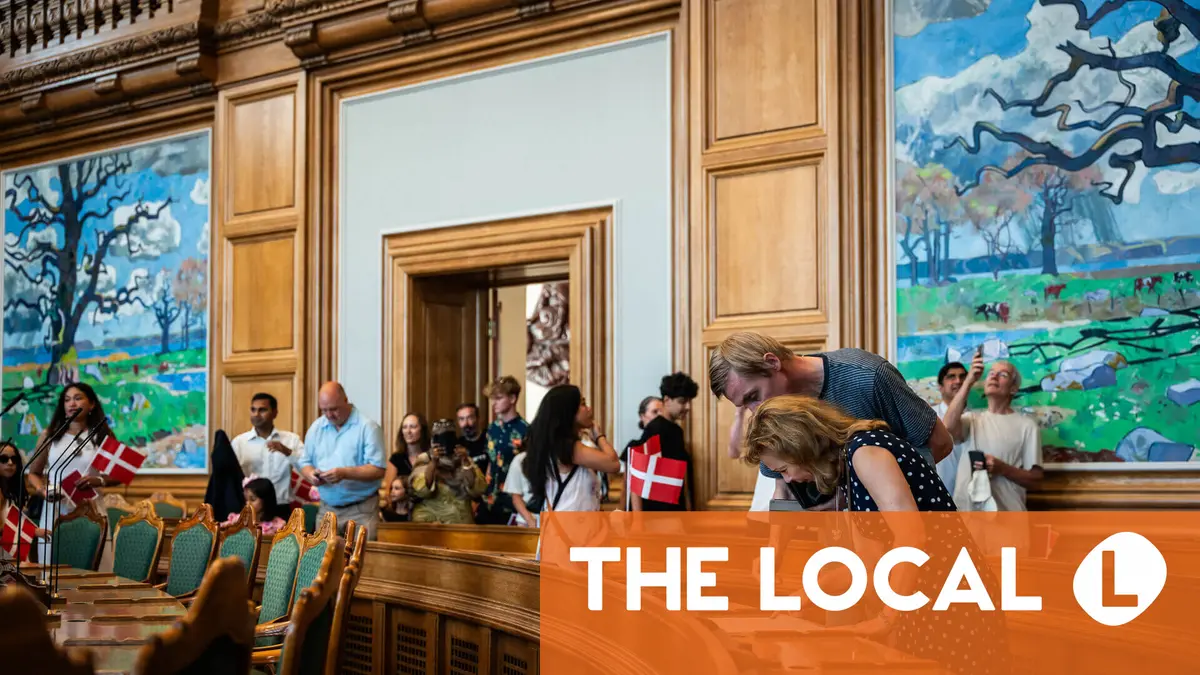
Our column Inside Denmark looks at our most talked-about stories of the last seven days. This week, increasingly bleak prospects for the average applicant for Danish naturalisation.
Another week, another round of being talked down to – or rather, just talked down – by Danish politicians who want to score points on citizenship.
A year ago, the Liberal Alliance party became the first to call for individual screening of applicants for citizenship, something I personally don’t think is a bad idea in and of itself, even if it would almost certainly extend the already interminable processing time of two years for citizenship applications.
Screening would likely mean each individual who applies for citizenship would be assessed on the basis of their personal views, whether expressed on social media or ascertained through some kind of interview – the exact model is likely to take some time to work out.
The party is now going a step further, with leader Alex Vanopslagh saying in an interview that Liberal Alliance will vote to block every single applicant for citizenship from being naturalised until screening is implemented – something which could take years.
“In my view, one of the most important requirements, and one of the most important issues to address, is making a greater effort to assess whether someone genuinely has a democratic mindset,” Vanopslagh said.
We’ve described the naturalisation system in Denmark in other articles, but in short, you get assessed on a range of criteria including past criminal record, length of residence, financial situation, Danish language proficiency and ability to pass a citizenship test. This is probably a stringent set of demands by most people’s standards.
Advertisement
If you meet these requirements, parliament must vote for you and all other similar applicants on a special naturalisation bill, thereby approving you for citizenship. It is by refusing to vote for these bills that Liberal Alliance is exerting pressure on the government to expedite, or just make certain, the decision to introduce screening. This would add a likely subjective element to the existing objective criteria on which applicants for citizenship are assessed.
The passage of the bill through parliament, thereby granting the citizenships to the applicants, depends on a majority of lawmakers voting for the bill.
This was a formality in past years, but no longer. As well as the Liberal Alliance, every single right wing or right-of-centre party apart from the Liberals (Venstre) has now either abstained from or voted against the bills in recent years.
Given the general direction of travel in Danish politics, it’s easy to envisage an overall right-wing majority in parliament and a “blue bloc” government after next year’s election. In this situation the Liberals, currently a partner in the centrist coalition, would be back working closely with the rest of the conservative grouping.
Advertisement
From here, it’s not a huge leap for the Liberals to take the same line as their allies on citizenship, and hey presto, no-one gets citizenship anymore.
Surely the Liberals, a government party and the most centrist of all parties on the right, wouldn’t break with convention in this way, you might think.
Cue the party’s brand new spokesperson for immigration, Marlene Ambo-Rasmussen, who entered parliament this week following a reshuffling of job roles after the local elections.
“I will fight to ensure that we take a stand against immigrants who do not learn Danish, who place the Quran above the constitution, or who insist on being supported by the state or the municipality,” she said in a statement.
Ambo-Rasmussen also promised to work for a more restrictive approach to whom is granted Danish citizenship.
“The Danish passport is one of the most precious things we can hand out,” and it should not be given to just anyone, she proclaimed.
Compare her two quotes here: if you don’t learn Danish, only live by the word of the Quran (or any other religious scripture), and subsist permanently on state benefits, you are getting nowhere near Danish citizenship. The existing criteria comfortably see to that.

Liberal immigration spokesperson Marlene Ambo-Rasmussen, seen here attending a royal gala, has promised to be tough on prospective Danish citizens. File photo: Philip Davali/Ritzau Scanpix
These new pronouncements of hostility towards naturalisation make me nervous.
I’m not writing this article from an impartial perspective. I have a pending citizenship application myself, and am not due to receive a response until 2027.
That gives plenty of time for the momentum against citizenship bills to keep growing, the Liberals to join it, and an indefinite delay preventing me from partaking in elections and generally receiving the same rights and acceptance in Denmark as the rest of my Danish family.
Advertisement
It’s not certain things will work out this way. It could end up being far from the most likely scenario.
But once again, we have senior politicians putting citizenship applicants in a box with people they don’t want in Denmark, using descriptions that fit almost none of the thousands of people who apply for naturalisation (and wait patiently for it) every single year.
That’s before we even get to the issue of what screening will actually entail. What will be considered “antidemocratic” and “incompatible with Danish society?” Those sound like very subjective concepts to me.
Most people would probably support denying citizenship to those who espouse homophobia or religious bigotry, but what about more general criticism of Denmark? Or of the sitting government? A specific government policy or decision? Am I putting my own future status at risk by writing and publishing this article?
I hope not, but there’s little to ease the concerns I have, or those of anyone else who wants to commit their future to Denmark.