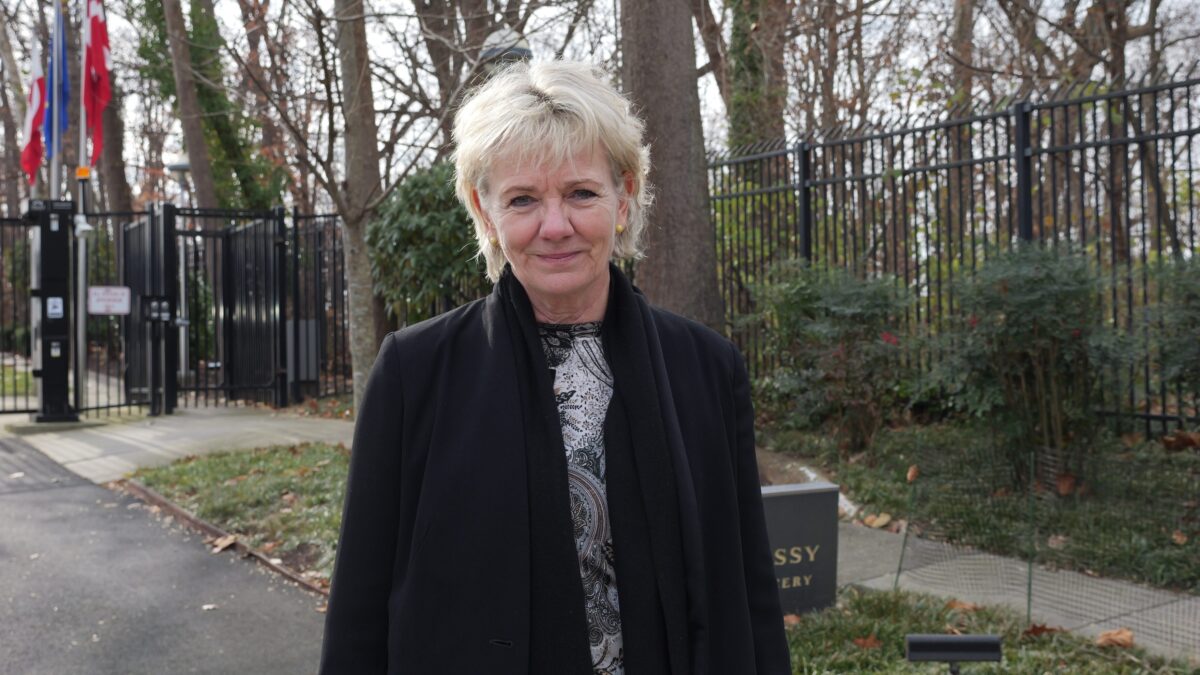
Denmark’s Special Envoy for Afghanistan, Mette Knudsen.
Denmark remains deeply committed to supporting the Afghan people despite a worsening humanitarian and human rights crisis, Denmark’s Special Envoy for Afghanistan, Mette Knudsen, said, warning that global attention must not wane.
In an interview with Amu TV in Washington, D.C., Knudsen, who is also a former Danish ambassador to Kabul, addressed the erosion of women’s rights under Taliban rule, rising deportations from neighbouring countries and Denmark’s diplomatic engagement through the United Nations and the European Union.
“Denmark is still very engaged in Afghanistan,” Knudsen said. “We are trying to provide humanitarian systems assistance responding to the displacement crisis in the country, to the other events, earthquakes and so on. But we also try to provide the longer-term assistance, what we call basic human needs assistance, where we support, through the UN, the World Bank, to try and achieve more sustainable results for the people of Afghanistan.”
Denmark currently holds a seat on the UN Security Council and chairs the Council of the European Union. Knudsen said Copenhagen is using that platform to press for international attention to the situation of Afghan women and girls, who have been most affected by Taliban policies.
“I’m very concerned about the situation for women and girls in Afghanistan,” she said. “I was in Afghanistan when the current regime came into power, so I witnessed the gradual destruction, you could say, of the rights of women and girls during the first six to eight months of this government. And it has only gone from bad to worse.”
Referring to the recent UN Security Council meeting on Afghanistan, she said: “Both the report and also the debate in the Security Council had a strong focus on the situation of women and girls.”
Knudsen said Denmark does not recognise the Taliban as Afghanistan’s legitimate government and therefore does not hold bilateral talks with them.
“Well, I don’t meet directly with the Taliban authorities. My government does not recognize the de facto authorities in Afghanistan, so I can only meet them in a multilateral context,” she said. “But of course, in those situations and through the UN we continuously raise the issue of the fact that the right to education, the right to work are basic human rights that should be extended to all women and girls of Afghanistan.”
She warned against international disengagement from Afghanistan.
“We cannot forget Afghanistan,” Knudsen said. “We have been there to support Afghanistan for many decades. And I think that we have both a moral obligation to continue to support the Afghan people, but we also have our own interests in making sure that Afghanistan does not continue to be a haven for extremist terrorists, that Afghans can find a future in their own country, that they don’t have to migrate to get a decent living.”
Knudsen called for sustained international support, particularly for Afghan women.
“I think we should continue to support Afghan women. I think we should support women’s organizations both inside Afghanistan and outside, so that Afghan women can voice themselves what they would like to see for the future,” she said. “But we should also continue to support, with our humanitarian assistance, the access to health, access to education to the extent that we can, and also providing jobs and possibilities of entrepreneurship for women.”
More than two million Afghans have been deported or returned from Iran and Pakistan so far in 2025, according to international estimates. The United Nations says more than 1.4 million Afghan children are currently out of school, most of them girls, while economic losses linked to restrictions on women’s participation in the workforce exceed $1 billion annually.
Knudsen concluded with a message urging unity among Afghans.
“Afghans have to define how they would like to see their future,” she said. “But in order to influence the present situation, I think it’s very important that Afghans try to be united across the different ethnic groups, religious groups, men and women, and that they are clear in their message to the current regime that long-term stability, sustainable development in Afghanistan cannot come about if there’s not an inclusive system where all Afghans have a voice in how they want to govern and what goals and ambitions they have for their country.”
Addressing Afghan women directly, she added: “Stay strong. We are there with you. We will continue to support you. Good luck with your fight.”
Afghanistan has faced a deepening humanitarian and human rights crisis since the Taliban returned to power in August 2021, prompting most Western governments, including Denmark, to withhold formal recognition of the Taliban. While diplomatic engagement continues through the United Nations and other multilateral forums, bilateral ties remain limited and heavily focused on humanitarian assistance.
International aid has declined sharply amid donor fatigue and competing global crises, even as needs remain acute. The United Nations estimates that more than half of Afghanistan’s population requires humanitarian assistance, with widespread poverty, unemployment and food insecurity compounded by natural disasters such as earthquakes and drought. Funding shortfalls and some Taliban restrictions on women have forced aid agencies to scale back food, health and protection programs.