Ever since the General Assembly of the European Broadcasting Union (EBU) met on 4 December, it has been clear: Israel will also compete in next year’s Eurovision Song Contest.
The member broadcasters did not vote directly on Israel’s participation, but on changes to the voting and advertising rules. However, according to the EBU, approval of these rule changes automatically means that all countries are eligible to participate.
A further vote on Israel’s ESC future was therefore no longer necessary. And this despite the fact that several countries had expressly called for a secret ballot on the country’s continued participation.
While Israel’s President Izchak Herzog and national broadcaster KAN are jubilant, it is a decision which has divided the competing nations more deeply than ever.
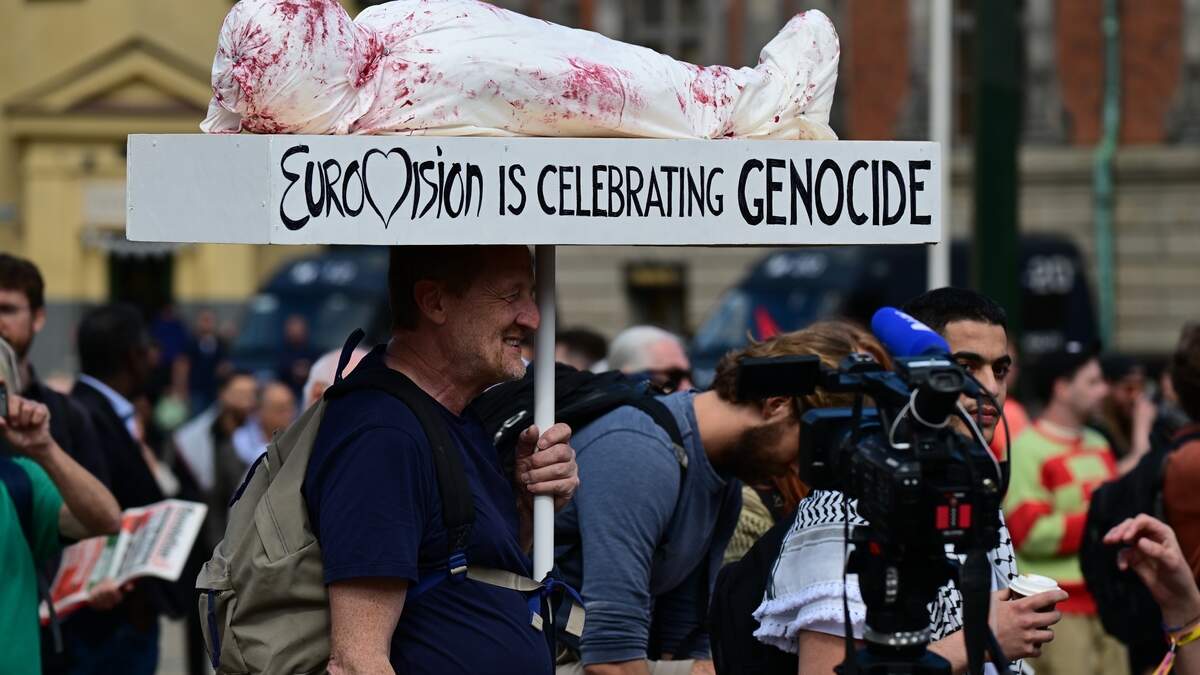
Protesters gathered outside the RTL headquarters in Kirchberg on Saturday, calling on Luxembourg to withdraw from Eurovision © Photo credit: Gilles KAYSER
Protesters gathered outside the RTL headquarters in Kirchberg on Saturday, calling on Luxembourg to withdraw from Eurovision © Photo credit: Gilles KAYSER
Protesters gathered outside the RTL headquarters in Kirchberg on Saturday, calling on Luxembourg to withdraw from Eurovision © Photo credit: Gilles KAYSER
Protesters gathered outside the RTL headquarters in Kirchberg on Saturday, calling on Luxembourg to withdraw from Eurovision © Photo credit: Gilles KAYSER
Four countries, the Netherlands, Slovenia, Ireland and Spain, have made good on their threat and withdrawn their participation. On Wednesday evening, a fifth nation, Iceland, joined the boycott. And the number of withdrawals could rise even further.
Also read:Luxembourg to compete in 2026 Eurovision Song Contest
The loss of Spain is particularly serious for the Eurovision. The country is a major donor and guarantees high spectator numbers. Ireland’s withdrawal will also hit hard, as a traditional competitor which has won the competition the joint most times.
Their withdrawals jeopardise the diversity of the competition. For this reason, the EBU may try to win back former participants such as Moldova, Romania and Bulgaria.
Luxembourg’s stance
Nevertheless, the outcome was predictable. Over the last few weeks, the core message from the EBU and the Austrian broadcaster ORF, as host, has come through loud and clear: the world’s biggest music spectacle was an event organised by public broadcasters and had nothing to do with politics.
ORF Director Roland Weißmann expressed his wish for Israeli participation in Vienna at the beginning of September and even travelled there to convey this message.
ORF Director Roland Weißmann, seen here after the EBU General Assembly at the beginning of December. He was in favour of Israel’s participation from the outset © Photo credit: AFP
Even after the vote, Austria showed little understanding for the boycott announcements. Vienna’s mayor, Michael Ludwig, declared that he was generally “sceptical about boycotting artists – especially when it concerns their origin”.
Such voices are also coming from Germany. Minister of State for Culture Wolfram Weimer takes a positive view of the EBU’s decision in Bild, stating: “Israel belongs to the ESC like Germany belongs to Europe.” A few weeks ago, he emphasised that excluding Israel would turn the basic idea of the Eurovision Song Contest on its head and turn a festival of understanding into a tribunal.
And what is the mood in Luxembourg? Back in October, three ministers – Xavier Bettel, Elisabeth Margue and Eric Thill – clearly ruled out a possible boycott in a joint response to a parliamentary question.
“The Eurovision Song Contest is an international music competition that aims to promote artistic expression, diversity and mutual respect. The Luxembourg government also has this understanding of the contest,” they said at the time.
Accordingly, they do not plan to give an opinion on the fact that four countries have withdrawn from the contest to date. “The decision to withdraw from the contest lies solely with the individual countries,â€� the Luxembourg ministers said.
Also read:Luxembourg will not push for Israel to be banned from Eurovision
However, not everyone in Luxembourg shares the same position. For example, the Déi Lénk sent an open letter to both RTL and public broadcaster 100.7 on Tuesday in which it questioned their participation and demanded an explanation from the media.
On Saturday, a group of 30 to 50 people protested outside the RTL headquarters in Kirchberg, calling on the broadcaster to become the sixth to withdraw from the competition in 2026.
Despite the official Gaza ceasefire, Israeli Prime Minister Netanyahu’s government is still driving a humanitarian catastrophe in the Gaza Strip, Déi Lénk claimed.
The letter raises the question of whether Luxembourg could take part in a competition that would provide a perfect stage to cover up the crimes in Gaza and the West Bank while people in Gaza are starving and civilians are being killed, Déi Lenk further claimed.
The argument that the Eurovision Song Contest is a purely cultural event that is exclusively about music can no longer be taken seriously, the party said. It is not about a permanent boycott, but rather about turning the event into what it once was: an event in which states that commit genocide are not allowed to participate, the left-wing outfit said. Déi Lénk has also launched a petition in favour of a Luxembourgish boycott, which has now collected over 1,000 signatures.
Numerous people took to the streets again in protest before this year’s contest in Basel © Photo credit: AFP
Shadow cast over the Eurovision
Since the beginning of the Gaza war, a shadow has been cast over the Eurovision Song Contest. This was triggered by the terrorist attack by Hamas on 7 October 2023, in which around 1,200 people were killed and more than 250 hostages were abducted from Israel.
According to the Hamas-controlled health authority, more than 65,000 Palestinians have been killed in the Gaza Strip in two years of fighting. A ceasefire between Israel and Hamas has been nominally in place for almost two months. But the atmosphere remains tense.
As in Malmö in 2024 and Basel in 2025, protests are also expected in Vienna in 2026. Israel’s last two appearances were accompanied by boos and whistles, which were drowned out by applause on television. In Malmö, tensions arose behind the scenes between the Israeli delegation and journalists and artists from other countries.
At a press conference in 2024, journalist Szymon Stellmaszyk asked Israeli participant Eden Golan whether she was aware that her participation posed a security risk for everyone. There was no answer.
The journalist was no longer accredited for the 2025 competition, even though he had 20 years of experience covering the Eurovision Song Contest. The EBU justified this by prioritising media with greater reach and more original content, as well as the limited capacity of the venue.
In this year’s edition, Yuval Raphael competed for Israel with the song “New Day Will Rise” © Photo credit: Jens Büttner/dpa
Eden Golan competed for Israel in 2024 with her song “Hurricane” © Photo credit: Alma Bengtsson/EBU

 The televoting puzzle
The EBU had already announced rule changes to the voting procedure in the run-up to the event. Was this intended to appease the doubting countries? One thing is certain: the rule change described at the beginning was overdue.
Among other things, it means that the audience vote will have less weight in future. This is why the juries are also returning in the semi-finals.
In addition, the number of jury members will be increased and the number of televoting votes reduced. Finally, the security mechanisms that control televoting are to be improved in order to prevent fraudulent activities.
The EBU is also responding to pressure from several broadcasters, including from Spain and Belgium, which argued for a need for clarification in the voting process. The striking discrepancy between jury and viewer voting raises questions: does the current system fairly reflect the viewers’ opinions?
Rumours are circulating in fan circles about a security loophole in the voting process. This is said to allow multiple votes – more than the permitted 20 – by changing SIM cards and thus explain Israel’s disproportionately good performance with the audience. Adding fuel to the fire is that Israel has been heavily promoting its entries for the past two years. However, other countries have also been actively promoting their participants.
In 2024, Eden Golan landed in second place in the audience ratings with Hurricane (fifth place overall). In 2025, Yuval Raphael won the audience rating with New Day Will Rise and took second place overall; for a short time, Israel was even in first place until Austria overtook it.
A contest at a crossroads
After several years of strong results, an Israeli victory in the foreseeable future is certainly realistic. However, the consequences would be serious: for security reasons, the contest could hardly take place in Israel.
Even if Berlin or Paris were to step in as an alternative venue, numerous countries would boycott the competition. There is also the question of whether an ESC organised by Israel would not itself become a propaganda tool.
One frequent criticism levelled by critics is the EBU’s lack of consistency in exclusion procedures. Belarus, for example, was suspended by the EBU board in 2021 after their entry song was judged to have broken the rules around political messaging. The following year, the EBU banned Russia in response to the invasion of Ukraine, and neither Belarus nor Russia has competed in the contest since.
EBU spokespeople have repeatedly emphasised a difference between Israel and Russia: Israel’s KAN is a broadcaster independent of the government in a democratic state.
Broadcasters take part in the ESC, not governments. However, the independence of the medium is ambiguous. Netanyahu ordered the closure of the old broadcasting authority back in 2014 and replaced it with KAN in 2017 – with the declared aim of influencing critical reporting.
In light of the ESC story, the argument that “music should remain apolitical” appears naive. Israel’s entry Hurricane had to be revised three times in 2024 because it alluded too explicitly to the Hamas attacks of 7 October. In 2025, Israel sent Yuval Raphael, a survivor of those same attacks.
The design of the Eurovision Song Contest was only recently revised, but old problems still remain © Photo credit: Harald Schneider/APA/dpa
Back in September, Spain’s Prime Minister Pedro Sánchez chose clear words: “In such a complex world, we stand out because we stand up for what is right, namely common sense, by being on the side of the victims and the attacked and not on the side of the attackers.”
On the evening of the grand finale in May this year, Spanish broadcaster RTVE inserted the following message before the actual broadcast: “When human rights are at stake, silence is not an option. Peace and justice for Palestine.”
Afterwards, the broadcaster said that the contest had always been political. However, it was not a question of politics, but of humanity. And when it comes to humanity, there must always be a consensus.
Now the decision has been made. Not only Spain, but also other countries have made a decision. This decision will change the shape of the Eurovision Song Contest forever.
It is possible that the number of participants will be reduced in the coming years, which will also limit the competition’s geographical and cultural diversity. At the same time, however, security concerns, organisational challenges and reputational risks for the EBU are growing.
Luxembourg’s pick
Luxembourg’s entry for next year’s Eurovision Song Contest will be determined in January. The Grand Duchy’s entry will be chosen on 24 January at the Luxembourg Song Contest at the Rockhal. Andrew the Martian, Daryss, Eva Marija, Hugo One, Irem, Luzac, ShiroKuro, and Steve Castile will face off, with the winner going on to represent the country at the 70th edition of the Eurovision Song Contest in Austria in May 2026.Â
The eight songs have been available to listen to on the RTL website since Thursday, and on music platforms such as Spotify, Deezer, Amazon Music and Apple Music since midnight on Friday.
(This article was originally published by the Luxemburger Wort. Machine translated using AI, with editing and adaptation by John Monaghan.)