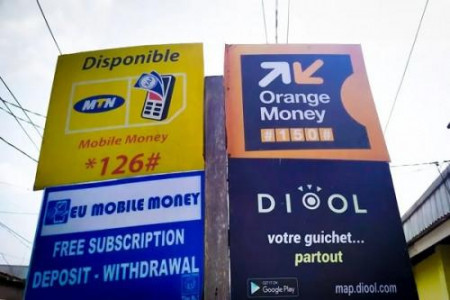
(Business in Cameroon) – Cameroon now has sufficient data to assess the impact of the mobile money tax introduced on January 1, 2022. According to a report by the International Monetary Fund (IMF), Taxing Mobile Money: Theory and Evidence, consulted by Business in Cameroon, the 0.2% levy applied to each transfer and cash withdrawal has significantly reshaped the economics of electronic transactions in a country where mobile money already accounted for nearly 50% of GDP by transaction volume in 2020.
The 2022 finance law introduced a proportional 0.2% tax on both transfers and withdrawals, meaning that a full transfer-and-withdrawal cycle is subject to a cumulative tax burden of 0.4%. Bank transfers, deposits into mobile wallets, payments to registered merchants, and transactions used to pay taxes and duties are exempt. In 2025, the framework was tightened further with the introduction of a flat CFA4 fee per transaction, added to the initial tax.
Transaction costs surge, reaching up to 400%
According to the IMF, the introduction of the 0.2% tax did not change operators’ pricing structure for transfers, which remained set at 1% for amounts between CFA50 and CFA6,500, then applied on a progressive scale ranging from CFA50 to CFA500 for transactions up to CFA1 million. However, the tax sharply increased the total cost borne by users once operator fees and taxes were combined.
In practice, the smallest transactions saw cost increases of around 20%, while the highest brackets recorded increases of up to 400%, the IMF report says. The institution notes, for example, that in the CFA50,001–CFA80,000 bracket, the tax amounts to CFA100–CFA160, equal to or double the original fee of CFA100. In the upper CFA500,001–CFA1,000,000 bracket, the tax represents CFA1,000–CFA2,000, or two to four times the previous cost of CFA500.
Withdrawals more expensive despite limited fee adjustments
For cash withdrawals, which already carry higher operator fees than transfers, pricing adjustments after the tax was introduced were minimal. Only two brackets were revised: fees fell from CFA180 to CFA175 for withdrawals between CFA6,500 and CFA10,000, and from CFA1,350 to CFA1,300 for the CFA50,001–CFA80,000 range.
These marginal cuts were not enough to offset the effect of the 0.2% proportional tax. Overall, the total cost of a withdrawal, combining operator fees and tax, increased by between 4% and 28%, depending on the transaction amount.
Financial inclusion at risk, IMF warns
In a report published in March 2022, shortly after the mobile money tax was introduced in Cameroon, the IMF warned about the redistributive effects of such sector-specific taxation. The institution said that taxing mobile money can be fiscally inequitable and hinder the already low level of financial inclusion.
It added that poor and unbanked segments of the population, often living in rural areas and facing high transaction costs from formal banks, are negatively affected by the measure. In effect, the combination of a proportional tax, a fixed per-transaction fee, and already high withdrawal charges raises the cost of a payment tool that has become central for households and economic actors most reliant on mobile financial services.
Amina Malloum