By Claire Taylor, Staff Writer
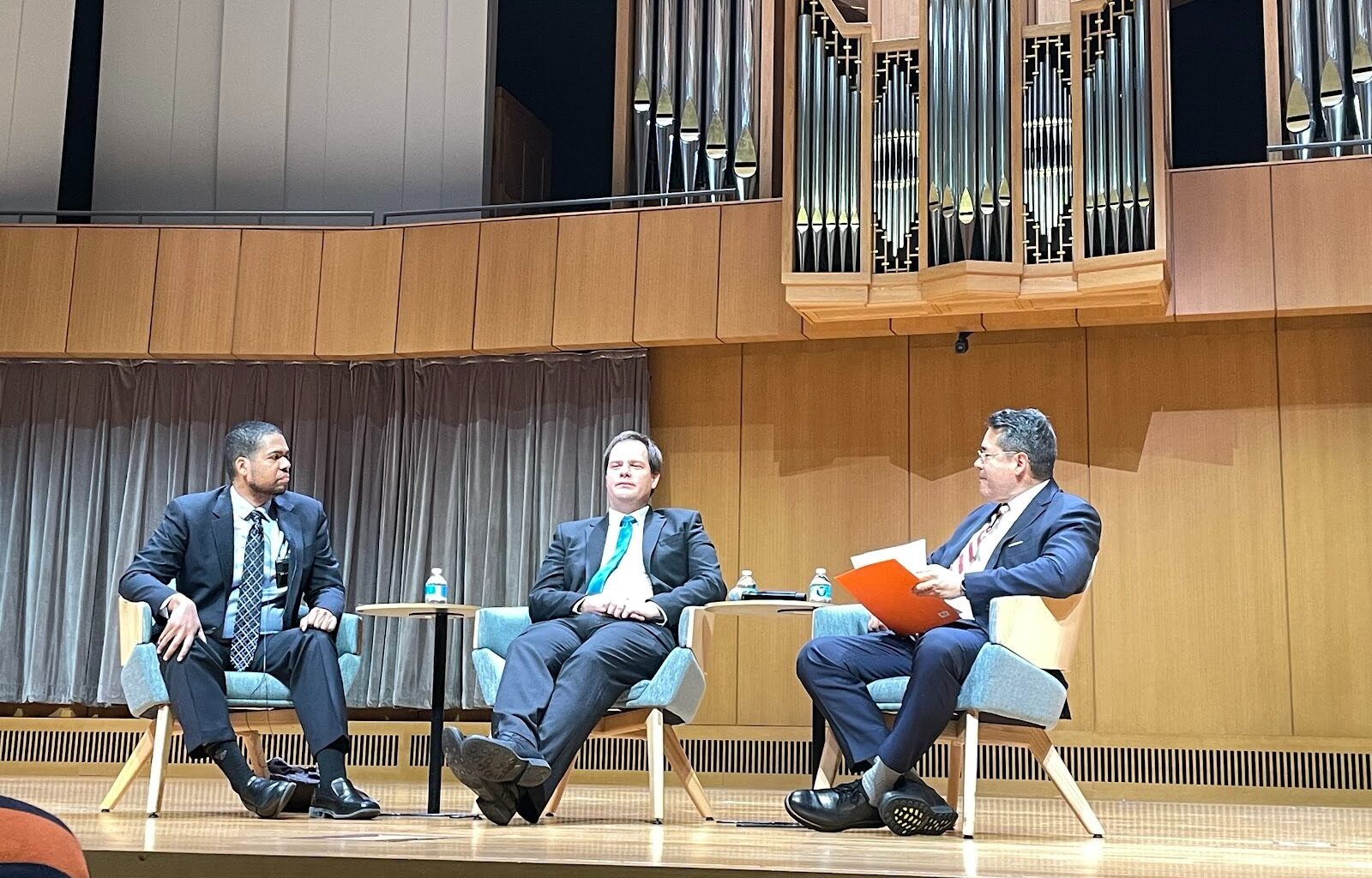
The Department of Politics and International Relations sponsored a conversation about ICE tactics and the Trump administration’s immigration policies on Dec. 3. The discussion was moderated by department chair Michael McKoy. About 300 people attended.
Director of Wheaton’s Center for Faith, Politics and Economics David Iglesias ‘80, and Vice President of Advocacy and Policy at World Relief Matthew Soerens ‘06 participated in the conversation. Both speakers are Wheaton graduates.
“We hold this event with a certain amount of trembling,” McKoy said before the conversation began. The event follows a discussion panel in late November about the immigration crackdown.
McKoy acknowledged that the topic of ICE is controversial, even on Wheaton’s campus, and said that the goal of the discussion was shalom, “a wholesome, righteous and just peace.”
On Oct. 12, Wheaton students organized a prayer and worship service in front of Broadview ICE Processing Facility as a form of protesting ICE in Chicagoland. Many students have been involved with off-campus anti-ICE efforts.
Soerens and Iglesias began by sharing their experiences with immigration.
Iglesias served in the Navy from 1985 to 1988 and from 2008 to 2014. He also served as team leader, prosecutor and spokesman for the U.S. Military Commissions, dealing with war crimes and terrorism cases. He was appointed by President George W. Bush to serve as U.S. attorney for the District of New Mexico from 2001 to 2007.
Soerens interned for World Relief during college, and has worked for them the past 20 years. He received his masters in international public service from DePaul University in 2010. He has previously taught for the Humanitarian Disaster Institute at Wheaton and has co-authored three books about refugees and the immigration system.
After making introductions, the pair moved on to the topic of immigration policy changes under Trump’s administration.
Soerens said that last year ICE’s budget was between $3 billion and $4 billion. This year, as a result of the “Big Beautiful Bill”, the budget is now $170 billion. He added that the funding was drawn from various government programs, including the Transportation Security Administration.
Iglesias focused on how every administration has to implement immigration reform.
“I think there has been a crisis for a long time,” he said. “The crisis is that we don’t have a system that works.” Iglesias framed this crisis as a bipartisan problem that both the Obama and Bush administrations failed to solve. He asked the audience to suspend judgement on the policies of the current administration.
“Just give it a chance,” Iglesias said. “Just wait — if Trump’s right, you could see some real world changes.”
He was particularly weary of media coverage comparing the Trump administration to the Nazis.
“We’re not living in a new Nazi age, we are trying to fix problems that have been unresolved for decades,” Iglesias said.
Soerens discussed some possible solutions to the decades-long immigration crisis that Iglesias referred to. He said there should be an easier pathway for undocumented immigrants currently living in the U.S. to become legal citizens, barring any criminal convictions. This solution has been proposed in Congress as the Dignity Act, which has been gaining bipartisan support in Congress recently.
This proposal intrigued sophomore international relations major Katherine McCulloch, who said that Soerens offered “a solution I hadn’t heard before.”
Throughout the conversation, Iglesias expressed concern about whether the U.S. has the capacity to accommodate the number of people hoping to immigrate. He cited a poll taken in Mexico showing that most Mexican citizens would choose to live in the U.S. According to Iglesias, the U.S. does not have enough infrastructure, vehicles or food to support 100 million immigrants.
Soerens said he is more concerned about population decline than overpopulation, particularly given that the U.S. fertility rate hit an all-time low in 2024. While Iglesias emphasized the need for immigration limits, Soerens emphasized that immigrants are crucial for the U.S. economy’s well-being.
Junior urban studies student Anya Miller, who admitted that she had walked into the event with a bias toward a particular side, remarked that the discussion was more “civil” than she expected — reflecting the goals McKoy outlined at the beginning of the event.
“Shalom requires the courage to have difficult conversations, and that is why we are here tonight,” McKoy said.