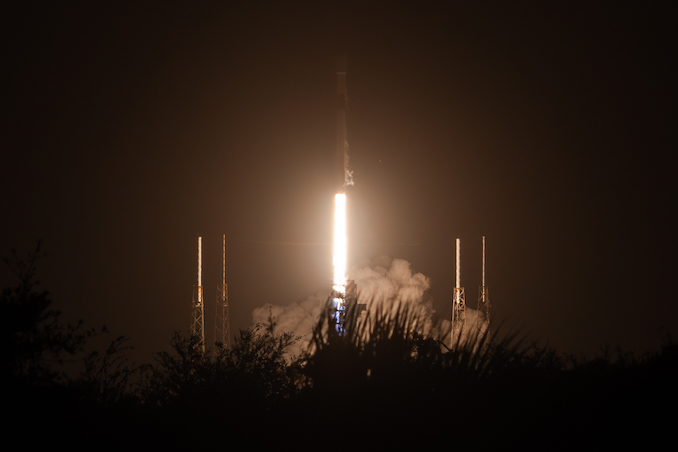
 A SpaceX Falcon 9 rocket blasts off from Space Launch Complex 40 at Cape Canaveral Space Force Station to begin the Starlink 6-82 mission on Dec. 15, 2025. Image: Adam Bernstein / Spaceflight Now
Update Dec. 14, 1:40 a.m. EST (0640 UTC): SpaceX confirms deployment of the Starlink satellites.
SpaceX launched its 580th Falcon 9 rocket to date with an overnight flight from Cape Canaveral Space Force Station that flew in the midnight hour.
The Starlink 6-82 mission added another 29 Starlink V2 Mini satellites into the growing megaconstellation in low Earth orbit. This was SpaceX’s 120 Starlink launch so far this year.
Liftoff from Space Launch Complex 40 happened at 12:25 a.m. EST (0525 UTC). The rocket flew on a south-easterly trajectory upon leaving the launch pad.
On Saturday, the 45th Weather Squadron forecast a 30 percent chance for favorable weather during the launch window. Meteorologists point to a cold front expected to move through the state on Sunday that will combine with an area of “strong, high pressure centered over the Ohio Valley” resulting in “a very tight pressure gradient behind the front.”
“This will bring a surge of northerly winds on Sunday evening near the opening of the window, with winds likely to increase as the night progresses,” launch weather officers wrote. “The main concern is the low-level winds violating liftoff constraints, along with the low risk of a coastal shower violating the flight through Cumulus Cloud Rule.”
SpaceX flew the mission using the Falcon 9 booster with the tail number, 1092. This was its ninth flight following missions like CRS-32, GPS III-7 and USSF 36.
A little more than eight minutes after liftoff, B1092 performed a landing on the drone ship, ‘A Shortfall of Gravitas.’ This was the 137th landing on this vessel and the 551st booster landing to date for SpaceX.