Facebook
Twitter
LinkedIn
Pinterest
Reddit
Email
Print
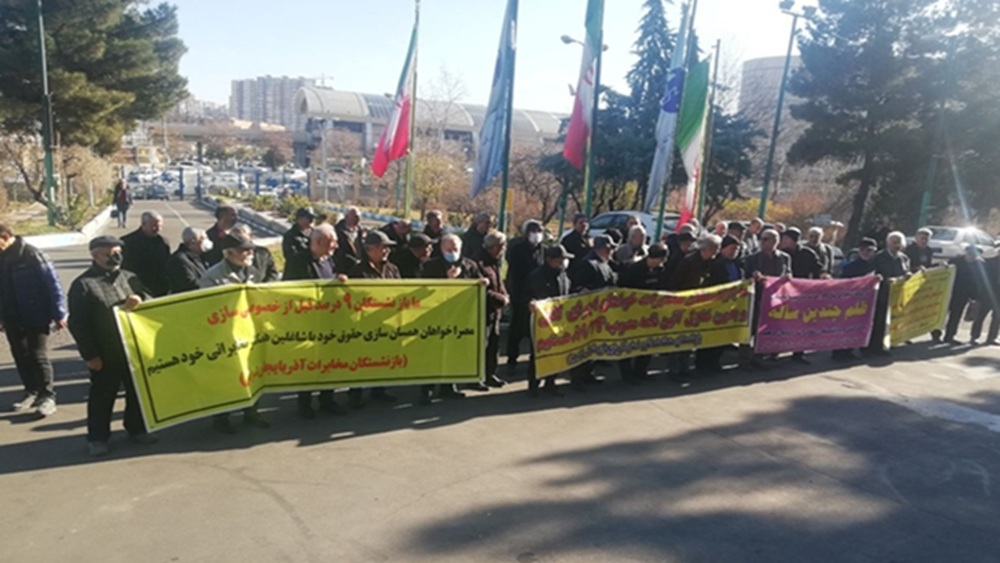 Protest by retirees of the Telecommunications Company of Iran (TCI) in Tabriz – December 15, 2025
On Monday, December 15, 2025, a sweeping wave of protests emerged across Iran, spanning from the bustling streets of Tehran to the southwestern province of Khuzestan. As the national currency continues its freefall—with the US dollar hitting a historic high of 131,000 tomans—dissatisfaction has permeated nearly every stratum of society. Retirees, healthcare workers, and university students organized simultaneous demonstrations, united by a common realization: their poverty is the direct result of systemic looting by state-affiliated institutions.
Since the inauguration of Masoud Pezeshkian’s government in August 2024, the price of the dollar has surged by 121 percent. This economic shock has obliterated the purchasing power of ordinary Iranians. Yet, as Monday’s slogans revealed, the public no longer views this merely as administrative incompetence, but as deliberate predation by the regime’s leadership and the Islamic Revolutionary Guard Corps (IRGC).
Telecommunication Retirees Target the Regime’s Economic Empire
The most politically charged demonstrations on Monday were led by the retirees of the Telecommunication Company of Iran (TCI). Protests were reported in dozens of cities, including Tehran, Tabriz, Isfahan, Kermanshah, Shiraz, Sanandaj, Ahvaz, Mashhad, Urmia, and cities across Hormozgan province.
December 15—Ahvaz, southwest Iran
Retirees of the Telecommunications Company of Iran (TCI) held a protest march against looting and repression by regime-linked bodies, blaming EIKO, the IRGC, and rent-seeking owners for destroying their livelihoods. #IranProtests pic.twitter.com/EPyx0GftDc
— People’s Mojahedin Organization of Iran (PMOI/MEK) (@Mojahedineng) December 15, 2025
These protesters took aim at the ownership structure of the telecommunications sector, which was “privatized” years ago into the hands of entities controlled by the Supreme Leader. Retirees gathered outside central TCI buildings, chanting slogans that directly implicated the Execution of Imam Khomeini’s Order (EIK or Setad Ejraei) and the IRGC cooperative foundations.
In Isfahan and Kermanshah, the chants were explicit: “Setad, Sepah [IRGC], and rent-seeking owners have ruined our lives.” In other gatherings, protesters declared, “Institutions affiliated with the Leadership have turned looting and oppression into a routine.”
December 15—Kermanshah, western Iran
Retirees of the Telecommunications Company of Iran (TCI) rallied against looting and repression by regime-linked institutions. They said regime-affiliated bodies have turned plunder and injustice into standard practice.#IranProtests pic.twitter.com/GcheoXWter
— People’s Mojahedin Organization of Iran (PMOI/MEK) (@Mojahedineng) December 15, 2025
The retirees are demanding the full implementation of welfare regulations (Article 89) passed in 2010, which the company’s state-linked owners have refused to honor. They argue that the takeover by these powerful institutions has stripped them of their insurance coverage and frozen their welfare benefits, effectively looting the pension funds to finance the regime’s other priorities.
Healthcare Sector: “Humiliation” Instead of Payment
While retirees rallied against institutional corruption, Iran’s healthcare sector faced its own crisis. In Ahvaz, personnel from the Jundishapur University of Medical Sciences gathered outside the central organization to protest the non-payment of overdue wages. Staff members demanded the implementation of “extra special” pay tiers, noting that the economic pressure has become unbearable.
December 15—Ahvaz, southwest Iran
Support and sanitation staff at Jundishapur University of Medical Sciences rallied outside the central administration, demanding immediate payment of overdue wages/benefits, better livelihoods, and the “special allowance.”#IranProtests pic.twitter.com/Voh53HdWTT
— People’s Mojahedin Organization of Iran (PMOI/MEK) (@Mojahedineng) December 15, 2025
Simultaneously, in Minudasht, Golestan province, nurses at the Fatemeh Zahra Hospital went on strike. Their grievance highlighted the depth of the state’s bankruptcy and disregard for essential workers. After months of delays, authorities finally announced the payment of tariffs owed from May—seven months prior. However, to the shock of the staff, only half of the owed amount was deposited.
Nurses described this partial payment as “humiliating.” Facing forced overtime due to labor shortages and crushed by inflation, the medical staff stated that the government’s approach is a “war of attrition” against their livelihoods. Their message to the Ministry of Health was stark: “Patience is over; one cannot live on empty promises and half-money.”
December 15—Minudasht, northern Iran
Nurses at Fatemeh al-Zahra Hospital went on strike over empty promises and humiliating partial payments. After months, officials offered only half of the May tariff arrears. Staff demand full, immediate pay and fair conditions amid inflation,… pic.twitter.com/25lNfc09GC
— People’s Mojahedin Organization of Iran (PMOI/MEK) (@Mojahedineng) December 15, 2025
Student Protests and Economic Paralysis
The unrest also reached university campuses. At Eqlid University in Fars province, students launched a protest against the dismal quality of food in the university cafeteria. In a symbolic act of defiance, students placed their food trays on the ground in lines, signaling their refusal to accept substandard nutrition despite rising costs. They cited repeated ignored warnings regarding hygiene and food quality as the catalyst for their demonstration.
These scattered protests are occurring against a backdrop of total economic mismanagement. Domestic critics note that regime officials lack basic economic literacy; they fail to understand that prices in Iran are “sticky”—meaning that once prices rise due to currency devaluation, they rarely recede, permanently impoverishing the population.
The regime’s response has been characterized by apathy. As the protests on December 15 demonstrate, the Iranian people are aware that the state is not merely incompetent, but actively predatory. With the “Setad” and IRGC dominating the economy, the wealth of the nation is being siphoned off, leaving the public with a binary choice: surrender to destitution or rise in protest.