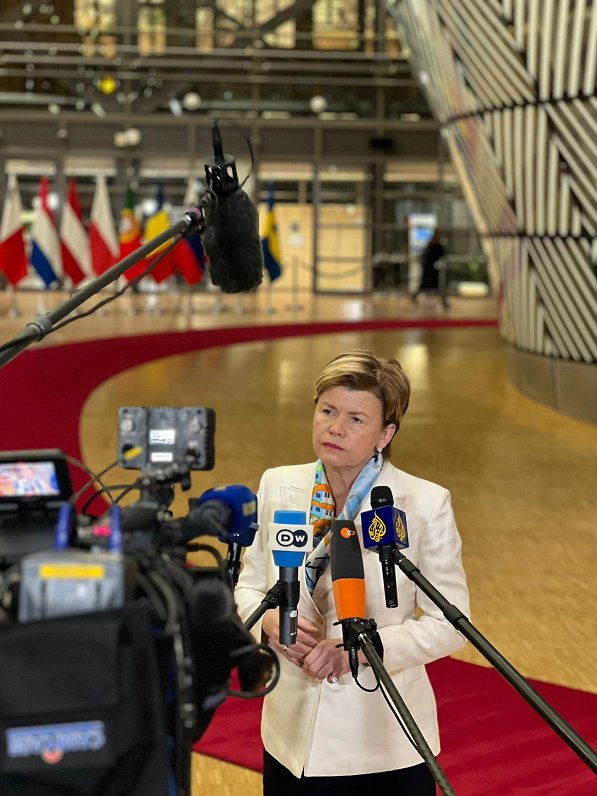
Latvia’s Minister of Foreign Affairs, Baiba Braže, made an unequivocal statement on December 15th saying that Latvia would never recognize the areas of Ukraine currently under Russian occupation as Russian territory.
Speaking at the closing of the EU Foreign Affairs Council in Brussels, Braže “stressed that all EU levers of influence should be used to achieve a just and lasting peace in Ukraine,” according to a Foreign Ministry press release.
“Latvia will never recognize the incorporation of the currently occupied Ukrainian territories into Russia”, she said.
Braže was in the United States just a week ago, where she said she “welcomed the US efforts to achieve peace in Ukraine”, though recent days have seen rumours reported widely suggesting that American negotiators are pushing for Ukraine to cede territory to the aggressor state.
On Monday Braže said: “Russia continues its aggression, targeting civilian infrastructure and innocent Ukrainian citizens, and there is no indication of its readiness for peace. Russia alone is an obstacle to achieving a sustainable and just peace in Ukraine. It is trying to reduce support for Ukraine, divide the EU, NATO, and also reduce the global influence of the US. Therefore, Europe must use all the levers of influence available to it to achieve “peace through force” and put maximum pressure on Russia.”
Braže also pointed out that Ukraine needs not only air defence and other defensive capabilities, but also ammunition and long-range precision-guided weapons to destroy Russian military targets and stop Russian attacks on Ukrainian civilians and civilian infrastructure.
The meeting was attended remotely by Ukrainian Foreign Minister Andriy Sibikha. He briefed the EU ministers on the peace talks to end the war, Ukraine’s internal reforms, readiness for EU talks, and thanked EU partners for their support so far. Sibikha also stressed that a solution for the unconditional return of children kidnapped by Russia must be part of the peace talks.
The EU Foreign Affairs Council also imposed sanctions on 4 legal entities and 5 individuals associated with Russia’s sanctions-busting “shadow fleet” of cargo ships. Clamping down on the shadow fleet has been a particular drive of Braže, who has had some success hauling it up the EU’s agenda.
“I am pleased with the new sanctions against the Russian ‘shadow fleet’ – we agreed to impose sanctions on 41 ships without waiting for the next round of EU sanctions. I called for this at the November EU Foreign Affairs Council so that the sanctions would be applied as promptly as possible. We also approved the EU declaration on international law in relation to the threat of the ‘shadow fleet’ and the protection of critical maritime infrastructure,” said Braže.
New sanctions have also been applied to 12 individuals and 2 legal entities that spread propaganda, disinformation and carry out destabilizing activities in Europe.
Select text and press Ctrl+Enter to send a suggested correction to the editor
Select text and press Report a mistake to send a suggested correction to the editor
Tell us about a mistake