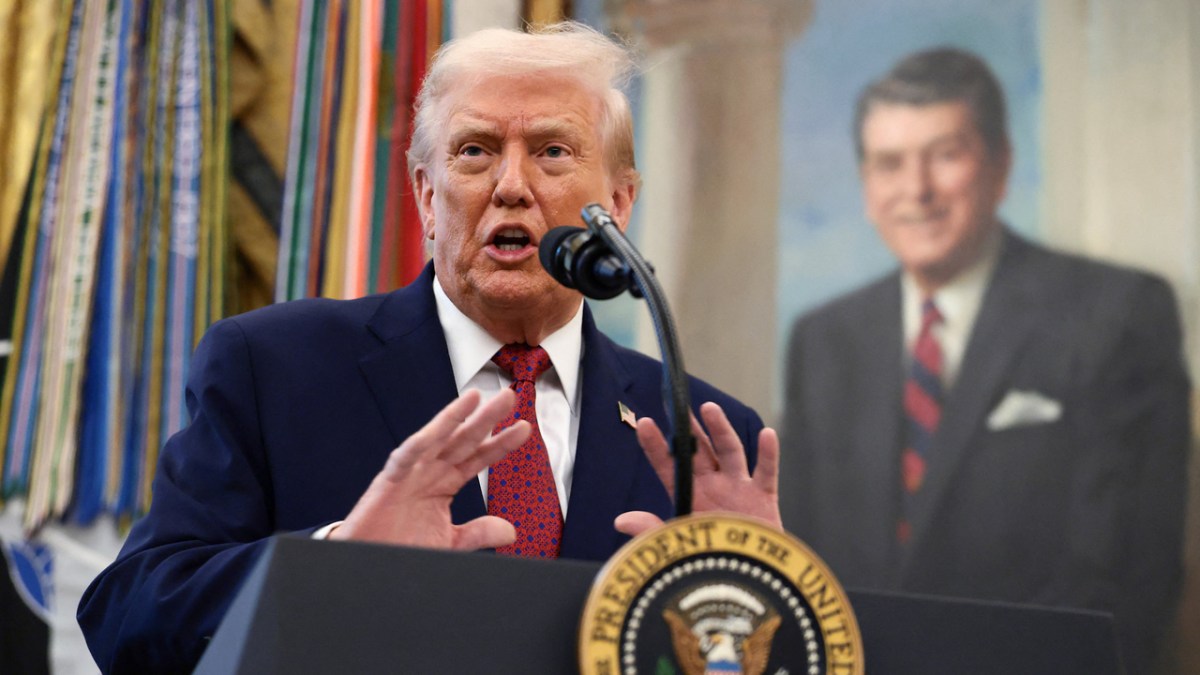
President Trump said that a deal to end Russia’s war in Ukraine was closer than ever on Monday night after European leaders set out proposals for peace that were jointly agreed with Kyiv.
The US leader hailed potential progress in ending nearly four years of war after what he said were “very long and very good talks” with President Zelensky and others including the leaders of Britain, France, Germany and Nato.
“I think we’re closer now than we have been ever,” Trump told reporters in the Oval Office after joining discussions in Berlin by phone.
Zelensky said that the US and Europe were prepared to offer Ukraine security guarantees “corresponding to” Nato’s Article 5 mutual defence clause to preserve a ceasefire with Russia.
Trump’s own negotiators presented “very substantial” and legally binding American commitments to defend Ukraine in what would be a big step towards a peace deal, the Ukrainian leader said.
Trump confirmed he spoke earlier on Monday with Zelensky and the leaders of other European nations including Sir Keir Starmer.
“The security protocols yesterday were amazing, and they have been amazing, having to do with Russia and Ukraine, and I had a long talk with President Zelensky. Also, I spoke with the heads of Germany, Italy, Nato, Finland, France, the United Kingdom, Poland, Norway, Denmark and the Netherlands,” Trump said at a White House event.
He said US envoys were “working with Europe” to agree on the details of security guarantees, adding: “We’re working on the security guarantee so the war doesn’t start up again. We don’t want to have a war set up again.”
Trump repeated his claim that “the war should have never, ever started”, before claiming that Russia, which invaded Ukraine in February 2022, also wanted to end the conflict.
“We’re having tremendous support from European leaders. They want to get it ended also and at this moment, Russia wants to get it ended. The problem is they’ll want to get it ended, and then all of a sudden they won’t. Ukraine will want to get it ended, and all of a sudden they won’t. So we have to get them on the same page. But I think that’s working along. Very good talk.”
After two days of talks in Berlin between European leaders and Trump’s envoys Steve Witkoff and Jared Kushner, both Zelensky and Friedrich Merz, the German chancellor, said there had been tangible progress on many points, with only a few outstanding areas of disagreement.
The most notable of these are Russia’s demands that Ukraine withdraw troops from the territory it still holds in eastern Donbas, and the technical details of how a ceasefire would be monitored and policed.
Pushed on whether Ukraine was being forced to give up territory, Trump said the Ukrainians had “already lost the territory, to be honest”.
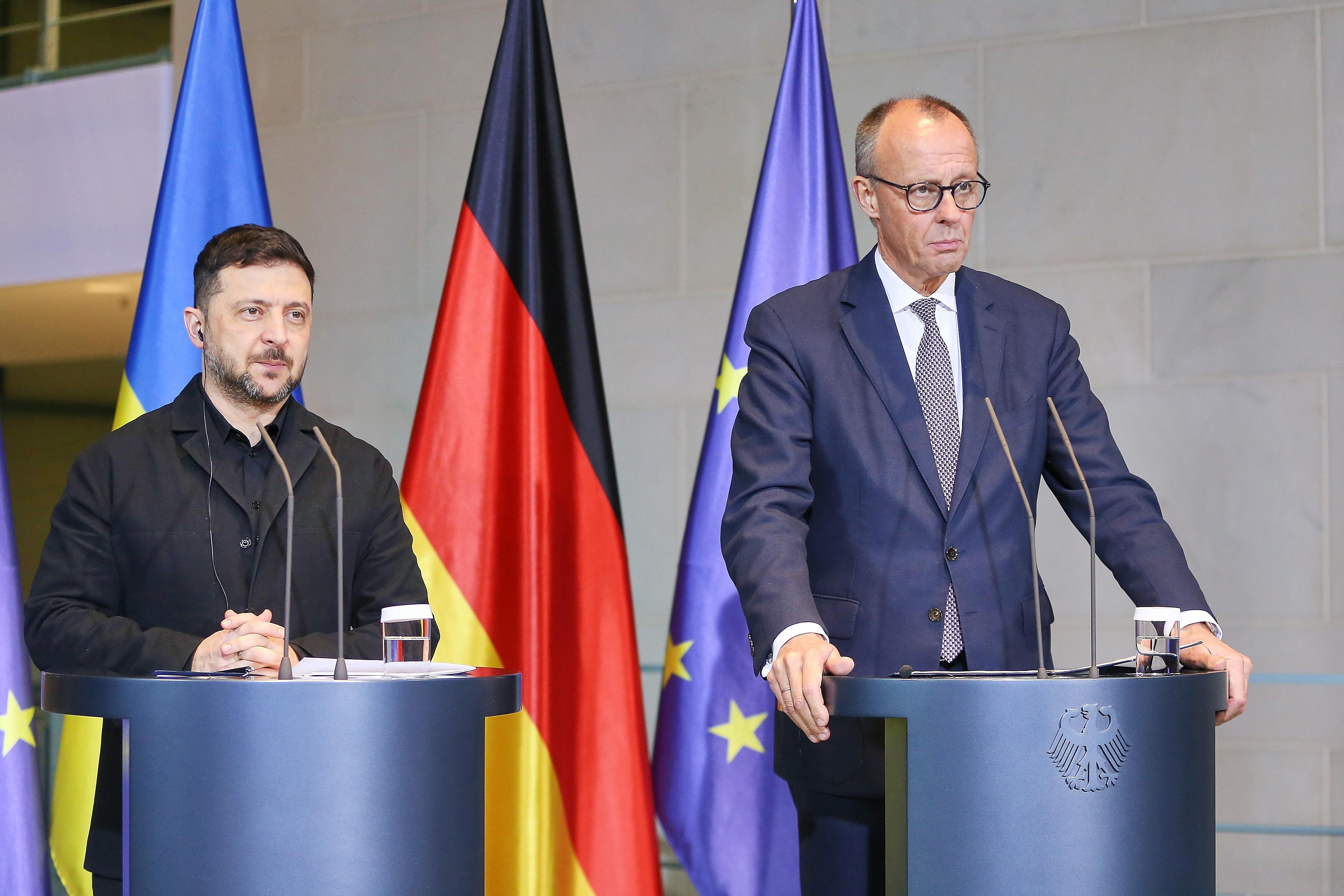
President Zelensky and Friedrich Merz, the German chancellor, at a press conference after the talks at the Chancellery in Berlin on Monday
SHUTTERSTOCK EDITORIAL
On Monday night Starmer, President Macron of France and the other European leaders also announced a plan for a US-backed “multinational force Ukraine”, drawing on “contributions from willing nations”.
The deployment, which would at least partially operate “inside Ukraine”, would involve air defence, “supporting safer seas” and helping to train Ukrainian soldiers.
The 12 leaders also offered a “legally binding commitment … to take measures to restore peace and security in the case of a future armed attack”, ranging from “economic and diplomatic actions” to “armed force”. This echoes the Article 5 pledge for each ally to take “such action as it deems necessary, including the use of armed force” if another is attacked.
• The Times View: Warnings about Russia’s threat cut no ice without defence spending
Zelensky said he was willing to hammer out the details of the “sensitive” and “painful” territorial question once he could be confident of security guarantees. “We do not assume that these will be a matter of Nato membership,” he said. “But now we have heard from the American side that they are ready to give us security guarantees that correspond to Article 5 of the Nato treaty, and that really doesn’t look too bad.”
Merz, the German chancellor, confirmed that the Americans had proposed “Article 5-like” guarantees, which would be a stronger promise than anything the Trump administration had previously entertained.
“This is a really far-reaching and substantial agreement that we didn’t have before: that both the Europeans and the Americans are prepared to offer Ukraine … security guarantees that are similar [to Article 5],” Merz said. “That is from my perspective a really great step forward. The Americans have raised the prospect of making it legally binding.” He added: “If it comes to the point where the ceasefire lasts, they will allow Ukraine to be capable of defending itself both with its own strength and through the support of its allies, and that is a piece of good news.”
Merz said the joint positions agreed in the talks would now be presented to the Russian regime: “It is now entirely down to Russia whether we will succeed in achieving a ceasefire before Christmas.”
The American side did not immediately confirm Merz and Zelensky’s account of the results, although US officials said in anonymous briefings that a great deal of progress had been made in Berlin and only a few issues of substance still needed to be resolved.
The US delegation was led by Steve Witkoff, Trump’s special envoy, and Jared Kushner, both of whom were praised by the Europeans for their constructive approach and serious engagement.

The US delegation was led by Steve Witkoff, right, President Trump’s special envoy
KAY NIETFELD/AFP VIA GETTY IMAGES
The second day of the talks appeared to have been partially disrupted by a cyberattack on the government district in Berlin, with problems detected on the Bundestag’s email systems.
Kaja Kallas, the head of the EU’s foreign service, said Witkoff and Kushner had been obliged to abandon a briefing on the negotiations with the bloc’s foreign ministers because the video link to the chancellery had broken down.

Kaja Kallas, the EU’s top diplomat
DURSUN AYDEMIR/ANADOLU VIA GETTY IMAGES
Afterwards, Merz delineated five points that he said had been agreed upon, including that any ceasefire would leave open the possibility of Ukraine joining the EU and would not impair the unity of Nato or the EU.
Merz wrote on X: “For the first time since the war began, a ceasefire now seems possible. We want to move along the path to peace together with the Ukrainians, our European partners, and the United States. I believe that today, in Berlin, we are taking an important step towards that path.”
European officials had previously been rattled by a proposal in the original “28-point” peace plan that had been negotiated between Witkoff and Putin’s representatives for the US to serve as an intermediary between Nato and Moscow. Zelensky also said he was relieved that certain “destructive” elements from the 28-point plan appeared to have been disposed of.

Zelensky with President Stubb of Finland
EPA
On Monday evening Witkoff, Kushner, Merz and Zelensky conducted further rounds of talks with other European leaders including Starmer, Macron and Ursula von der Leyen.
Earlier Starmer told MPs that a “text that may take us forward” was in play: “I hope we can make some further progress but the route to peace is not a straight road … but we will keep on trying to get to the right outcome.”
The Donbas question may yet remain a big obstacle. The Ukrainian armed forces have clung on to about a quarter of the Donetsk oblast despite intense Russian assaults.
Kyiv is loath to abandon its laboriously prepared defensive lines in the area and also to cede the moral principle that the victim in a war of aggression be obliged to hand over territory it still controls. Kallas, the EU’s top diplomat, said: “We have to understand that Donbas is not Putin’s endgame. If he gets Donbas, then the fortress is down, and then they definitely move on with taking the whole of Ukraine.”
• William Hague: Putin will never stop trying to export chaos
However, Zelensky hinted that the issue could be unlocked if Ukraine were to receive sufficiently persuasive security guarantees to provide a serious deterrent to another Russian invasion.
“My message with regard to the security guarantees is this: before we undertake any steps [towards a withdrawal] on the battlefield, we need to be able to see very clearly what security guarantees there are,” he said.
There is cautious optimism on the European side that at the very least the West and Ukraine can find a common position that would “leave the ball in Russia’s court”, as Johann Wadephul, the German foreign minister, put it.
Merz said the past few days had brought “perhaps the greatest diplomatic dynamism” to the peace process.
The next few days will be decisive for mobilising up to €210 billion in frozen Russian central bank assets to provide Kyiv with much-needed money.