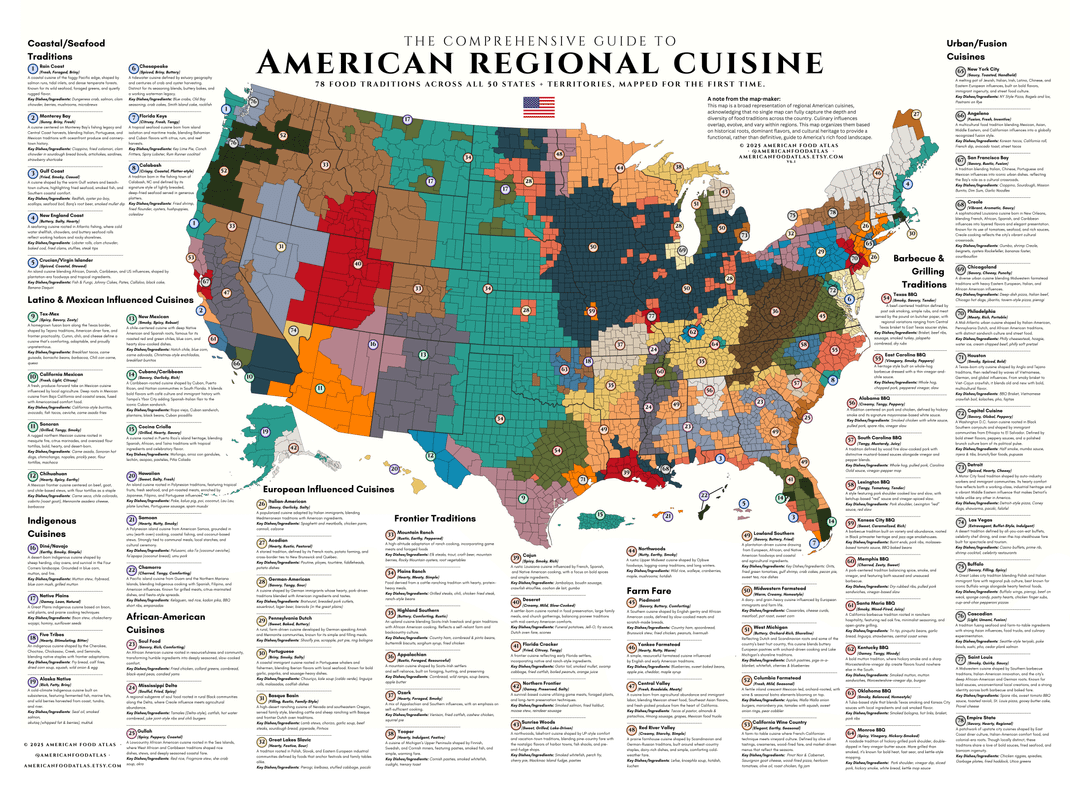
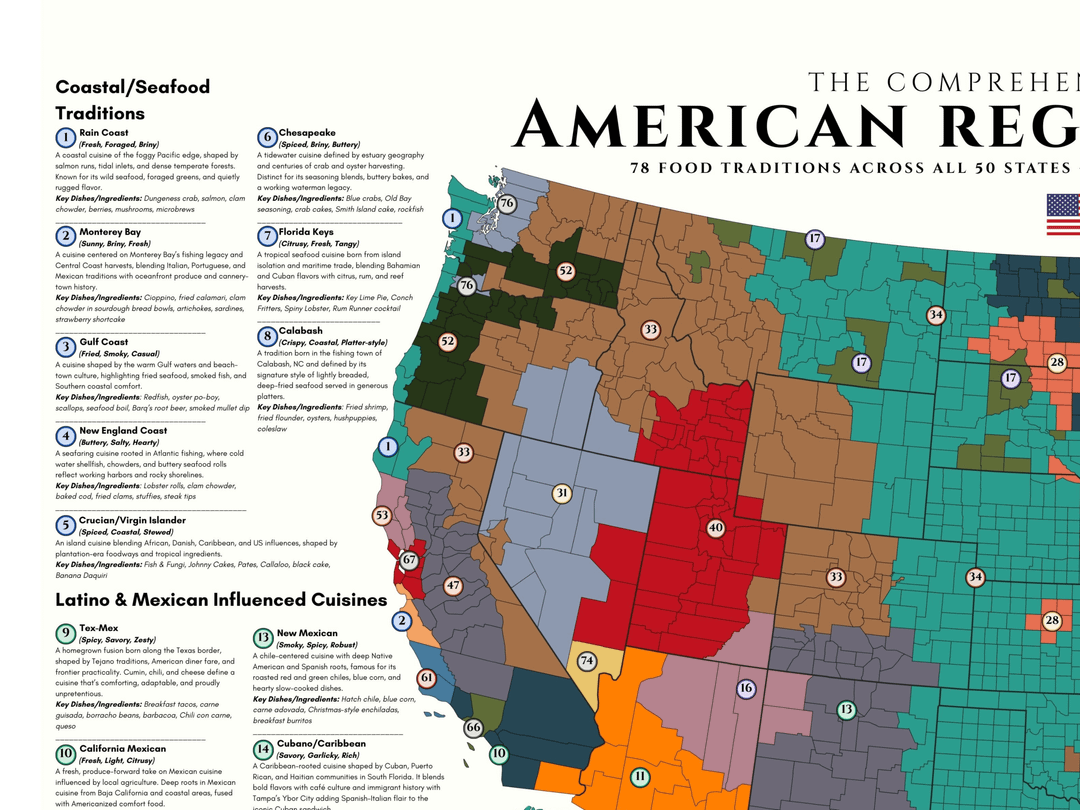
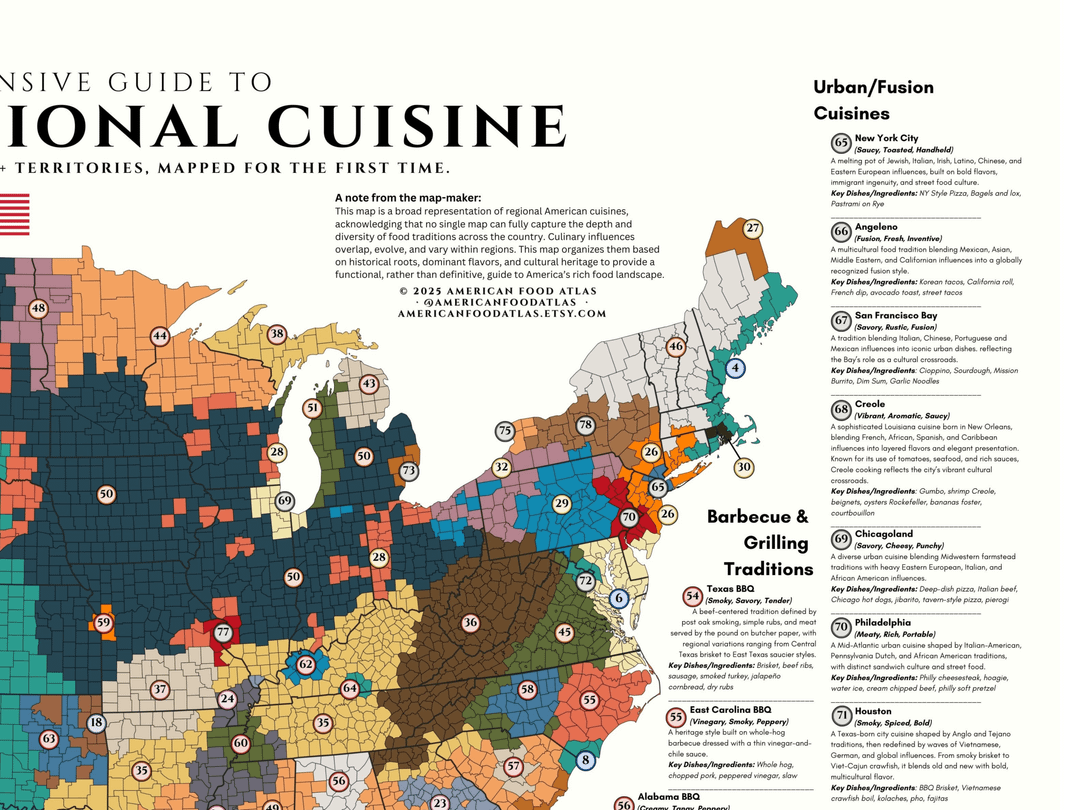
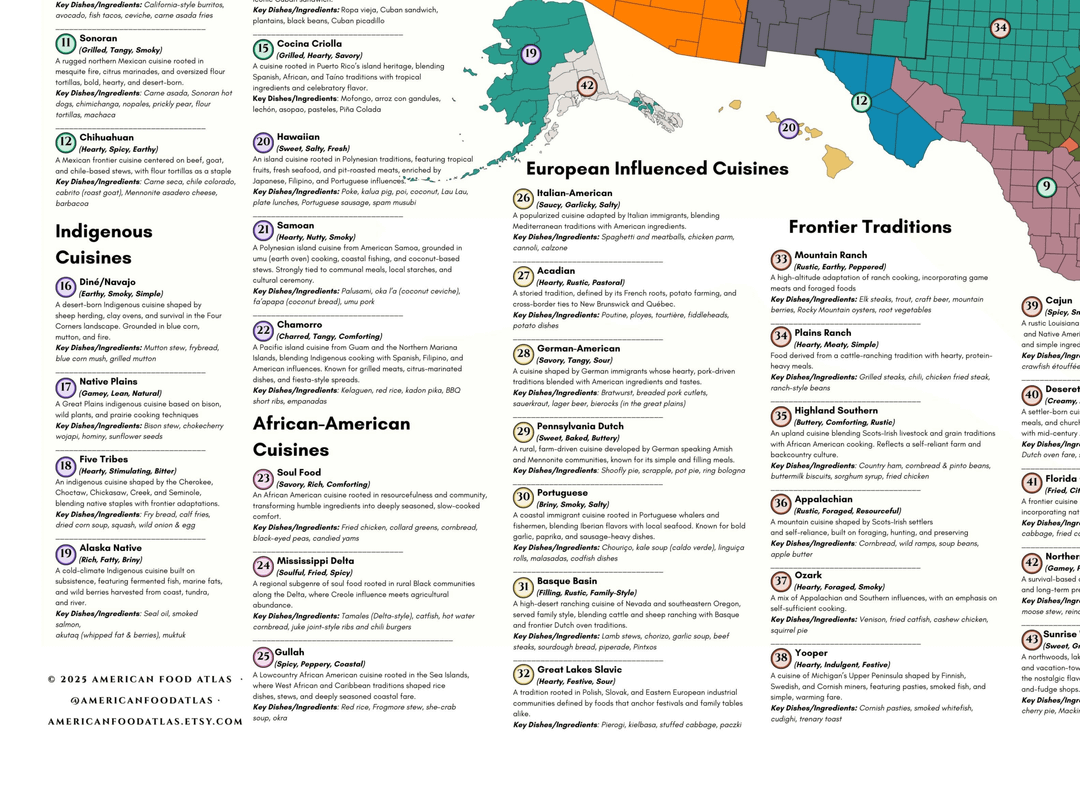
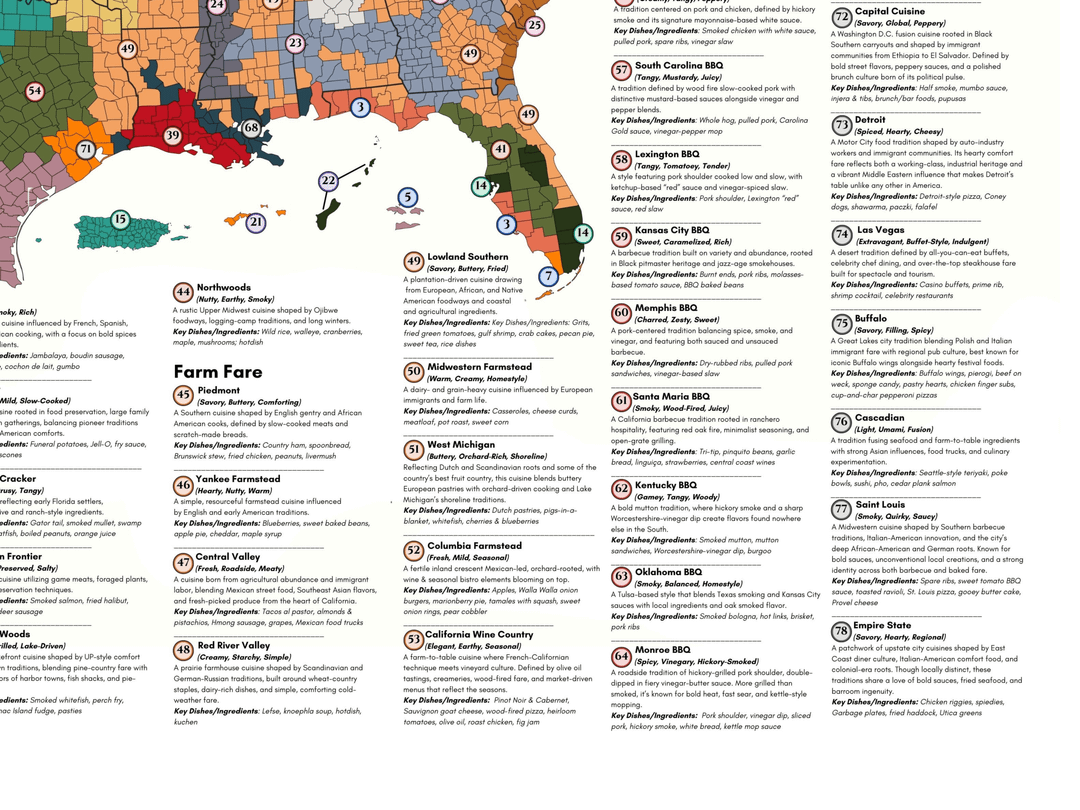
After a year of research, debate, and help from many of you in your home regions, I’ve finished a national map of 78 U.S. food regions. Each area is based on distinct culinary traditions shaped by geography, culture, and history, from Gullah and Tex-Mex to Monroe BBQ and Crucian cuisine.
I’d love your feedback: Did I miss something obvious? Should a region be renamed, removed, or split further?
A version of this map’s headed to print next year as part of a national cultural atlas, so this is the last round of tuning before it gets locked in.
Methodology note:
This map is interpretive rather than purely statistical. Regions were defined using a mix of historical settlement patterns, agricultural zones, immigration history, regional dishes, and feedback from locals across multiple revisions.
This is the 5th major revision, and I’m posting here specifically to invite critique before it goes to print as part of a larger cultural atlas.
Edit- just tried to reupload this in higher resolution. I went as high res as Reddit would let me. Sorry if it's still blurry or unreadable. DM me or look at links in my profile and I'll point you to a higher-res version
Posted by piri_reis_
34 comments
**Sources:**
This map synthesizes multiple qualitative and semi-quantitative inputs rather than a single dataset, including:
• U.S. Census & ACS ancestry / immigration data (county & metro level)
• USDA agricultural production data (major crops & livestock by region)
• Historical settlement patterns (secondary sources, historical atlases, state histories)
• Regional restaurant menus, food festivals, and local culinary institutions
• Iterative feedback from residents, cooks, historians, and prior Reddit threads across 5 revisions
**Method:**
Regions were delineated interpretively by overlaying these inputs and identifying areas where culinary traditions consistently cluster. Boundaries are approximate and intended to reflect dominant traditions rather than strict exclusivity.
**Tools:**
Base map + county shapefiles, GIS editing (QGIS), Adobe Illustrator for final layout and labeling.
This is cultural cartography rather than a purely statistical model, and overlap between regions is expected in reality.
Can you post a legible version for phone users ?
The topic is interesting but this is the most frustrating way to view a graphic
Can you upload a full resolution image somewhere?
Reddit likes to compress images. At least on mobile.
I cannot read anything in the first image.
You put all this work into your research and then made it as illegible as possible.
im super interested in this, but the links in your profile go to your insta, which is still too low rez to read, twitter which breaks when attempting to use it without an account, and to get a poster, which is actually awesome, and i might buy….if i could read the whole thing first.
Do you have a website where the whole thing is hosted or something? a dropbox, something with it?
Now thats beautiful. Well done
This is actually really good wow. I don’t know what the other replies are talkin about, the first pics resolution is perfectly fine when zooming
Shoutout 57 and 23! Been eating SC bbq since before I can remember, my folks used to throw tf down lol. Goat, hog, and chicken all at the same cookout used to hit 🙌🏾
you did not post a ‘zoom in’ version of column 39-41. that’s a bummer.
You’d probably get in a fistfight with someone from my county if you tried to ascribe a single food tradition to us, but it seems pretty close otherwise lol
Like others, I can’t read the first image but I can read the others. For every place I’ve lived or have family, you pretty much nailed it. And I came in expecting to be critical.
So many people think ENC BBQ is just “pork with vinegar sauce” but you nailed the whole hog + chopped pork (not pulled) distinction.
Only a couple nitpicks:
For “Piedmont” I personally would specify *boiled* peanuts.
For “Appalachian” it’s hard to list foods without listing the mighty pawpaw fruit, especially in the last 15 years or so as hipsters (bless their hearts) got hold of them. Everyone knows ramps, but pawpaws should be there too.
“Capitol Cuisine” doesn’t seem like a coherent cuisine to me, but I’ll let you have that one since it’s an utter mishmash and you listed half smokes.
Surprisingly super nice job, at least on the ones I know well.
that was… actually spot on for my area (oregon; I’ve lived in all three regions). Looks like great work!
Also the image seems to be hi-res for me on mobile, I just had to give it a second to load
I can read it in my mobile phone perfectly well, and wow…this is BEAUTIFUL. And I’m not talking about the aesthetics, but the data itself. Granted, I have not looked at every place, but just places that I’ve lived (Los Angeles, San Francisco, Denver), and a few other small locations around the country. It’s so cool that you have looked at historical patterns that influenced the food in that place. This is Human Geography – well done. I would totally order this.
I would legitimately buy this as a print if it was available, it’s perfect for a kitchen
You did a good job on the areas I’ve spent significant time in (6, 45, 36, 77) great job I’m saving for this.
Love this so much! You’ve captured all the cuisines I was expecting in the areas I’ve lived. FYI – you have a typo (key food / ingredients typed out twice on number 49’s description.
New England (4): I’ve never heard anyone say “Stuffies” and had to search it up. It seems to be a specifically a Rhode Island term; therefore “stuffies” would instead probably be more fitting to the region marked “30”. In the region marked “4”, clams would be universally called “Steamers” (maybe because they wouldn’t ordinarily be ‘stuffed’).
Super cool. Would be great to have an interactive website version where users could hover over sections to see what they are to make it easier to interact with.
Is it intentional that numbers don’t appear to be used on the map in any sort of proximity?
Awesome! I would like it if the descriptions also referenced the colors used on the map. I started reading the descriptions first, and sometimes had a hard time locating the numbers on the map for the ones I didn’t recognize.
Amazing work, thank you for this! I am really enjoying the map and looking up the dishes!
This is really well done, nice job.
As someone with strong ties to the Northwoods (44) cuisine, I love the recognition of the Ojibwe and logging camp influences. Probably the absolute coziest food I’ve ever eaten, and absolutely made for long cold winters.
I remember seeing an older version of this a while ago that I didn’t jive with. However, you now definitely got the 6 regions that all surround where I grew up well! They definitely all mixed together with the dominant one you described for my county!
Same for the two cuisines that my parents were most raised on.
Good work!
I’m from upstate NY, you should add salt potatoes to #78
I think the influence of Vietnamese food is markedly underrepresented for the SF Bay Area and LA areas, though they are both such large melting pots. Your 47 Central Valley seems either too large or imprecise or both. While there is a good sized Hmong (and Filipino) population in these areas, they are both ethnic groups that have not been fast to open restaurants and influence food outside of their own ethnic groups. A far more influential food group would’ve been Basque. But having spent 30+ years living up and down California, this mostly hits.
I wish I could read it. It’s low resolution makes it impossible.
This is why Albany County NY (and the capital region in general) has such good food. We have the classic NY diners, we get the “Maine” blueberry pancakes with “Vermont” maple syrup. We’re close to the coast so you can trust the seafood. We have amazing Italian, Greek, Chinese, African, Japanese, French, Indian, Mexican, Korean, you name it. We have a lot of immigrants (I’ve always assumed due to being close to NYC and Boston) so we have a melting pot of local foods. The BBQ and southern foods have been making strides recently due to the large number of people from TX that are moving here. There’s always at least one STELLAR place in the area to get most cuisines. And we have one thing that most of NY doesn’t (it’s been spreading in recent years)…
Raspberry Melba Sauce
If you mapped out America and didn’t include food deserts then you didn’t do the actual work here.
Why are the numbers not based on geographic proximity?
Region 27 should extend along the border in a thin strip to upstate NY. As someone who grew up along the border in VT and has lived in upstate NY and NH, that would be accurate.
I had meat pie (tourtiere) at 2 separate thanksgivings and every home style restaurant near the border has a poutine.
This is beautiful and as far as my experience extends, accurate.
Number 78 is missing steamed hams
Is this a repost? I swear I’ve seen this map before. I thought in this very sub.
Las Vegas doesn’t really have as many all you can eat buffets anymore, they were kinda on the way out and COVID finished the job for many of them. Aria, for instance, replaced their buffet space with a food hall/galley.
More here: https://www.independent.co.uk/news/world/americas/las-vegas-buffets-food-halls-b2831400.html
I’ve been living here for a few years now and to my mind once you get away from the strip and go to where people actually live, you can find a lot of great chinese, thai, japanese, indian, hawaiian, mexican, italian, burger joints, BBQ, many of them in strip malls as well. By and large, I think the local restaurants benefit from a lot of good sourcing and distribution options and infrastructure *because* of the big celebrity chef places on the strip.
(Having said that, “Best Friend” is on the strip and is a “celebrity” chef place, I guess, and it’s *really* good.)
>Edit- just tried to reupload this in higher resolution. I went as high res as Reddit would let me. Sorry if it’s still blurry or unreadable. DM me or look at links in my profile and I’ll point you to a higher-res version
New Reddit has a limit on how high the res can be. Going though old Reddit shows the full res images: https://old.reddit.com/r/dataisbeautiful/comments/1po1qx2/a_year_of_work_mapping_us_regional_food/
Comments are closed.